Q.Compare the working principle of a simple microscope and a compound microscope, and explain why a compound microscope can reach a much higher magnifying power than a simple microscope.
You're viewing a preview — the full solution, concept, methods & PYQ mapping are locked.
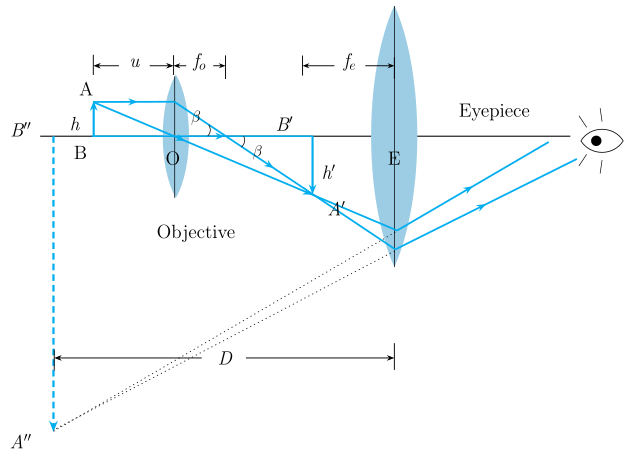
Start your 14-day free trial to unlock the full solution →A simple microscope is just one convex lens, used to view an object placed within its focal length so that a single stage of magnification produces an enlarged virtual image; because the magnifying power grows only by using an ever shorter focal length , and a very short focal length lens suffers increasingly severe optical aberrations, a simple microscope's magnifying power is, in practice, capped at around . A compound microscope instead uses two convex lenses in series: a short-focal-length objective forms a real, inverted, and already substantially magnified intermediate image of the tiny object; this intermediate image is then used as the "object" for a second lens, the eyepiece, which — acting exactly like a simple microscope on this already-magnified intermediate image — magnifies it a second time into the final image the eye sees. Because the overall magnifying power is the PRODUCT of the objective's own magnification and the eyepiece's own magnifying power, , and each of the two factors can independently be made reasonably large without e …
Unlock everything free for 14 days
- Full step-by-step solutions
- Concept-first explanations
- Methods, shortcuts & mistakes
- PYQ mapping + timed mock tests
Full access for 14 days. No credit card required.