Physics · Ch 1 — Electric Charges and Fields
Conductors and Insulators
Conductors and Insulators
Conductors and Insulators
Materials are classified based on how easily they allow electric charges to move through them.
- Conductors allow electricity to pass through easily. They have free electrons that can move within the material. Examples: metals, human and animal bodies, earth.
- Insulators offer high resistance to the flow of electricity. Their charges are tightly bound and cannot move freely. Examples: glass, porcelain, plastic, nylon, wood.
Key Behaviour: Charge Distribution
When charge is transferred to a conductor, it readily distributes over the entire surface of the conductor. This happens because the free electrons repel each other and spread out as far as possible.
In contrast, if charge is placed on an insulator, it stays at the same place where it was put. The charges cannot move because there are no free electrons.
Why a Comb Gets Electrified but a Metal Spoon Does Not
- When you rub a nylon or plastic comb (an insulator) on dry hair, the charge stays on the comb because it cannot move. This is why the comb becomes electrified.
- When you rub a metal spoon (a conductor), the charge quickly leaks through your body to the ground because both your body and the ground are conductors. Hence, the spoon does not show signs of charging. …
Drawn by us to help you understand the concept clearly, and verified to make sure it's accurate. For exams, practice from your NCERT textbook's own diagram.
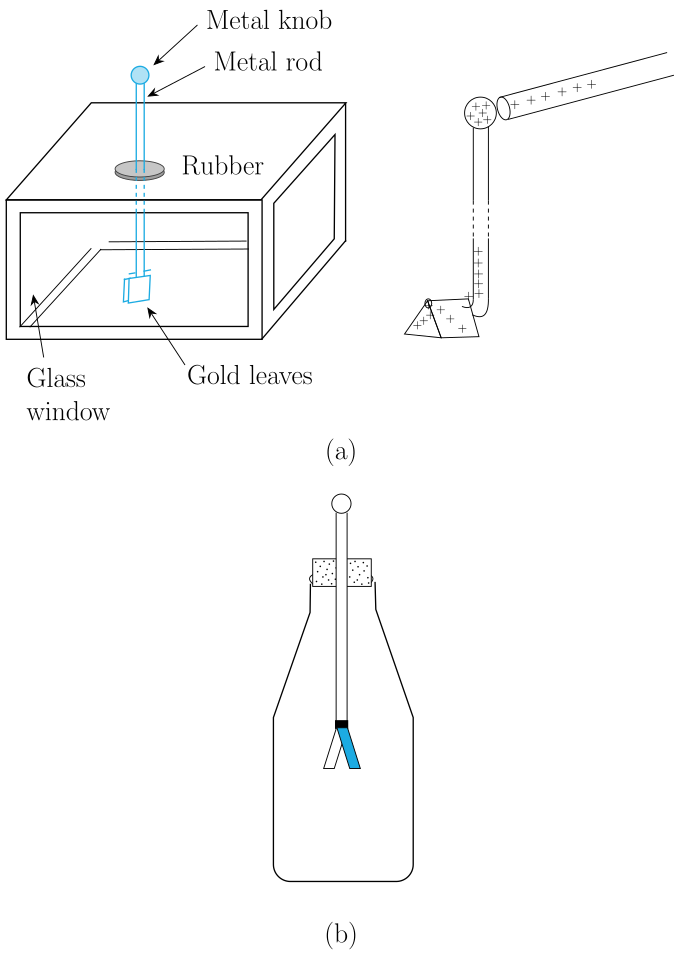
Figure 1.2: Two Types of Electroscopes
The figure has two panels, (a) and (b), showing different designs of the same device — an electroscope used to detect electric charge.
Panel (a): The gold leaf electroscope
This is a realistic drawing of a laboratory instrument. A metal rod passes through a rubber disc (an insulator) set into the top of a glass case. At the top of the rod is a metal knob; at the bottom, two thin gold leaves hang side by side. Beside the case, a charged bent rod (with + signs along its top segment) ends at a charged paper crumple (unlabelled). The key idea: when the knob is touched by a charged object, charge flows through the metal rod to the gold leaves. Because both leaves receive the same type of charge, they repel each other and diverge. The glass case protects the leaves from air currents.
Panel (b): Schematic of a simple electroscope
This is a simplified diagram. A bottle has a cork (an insulator) through which a knobbed metal rod passes. At the lower end of the rod, two diverging leaves are shown. This version omits the glass case and gold-leaf detail, focusing on the essential parts: a conductor (rod + leaves) insulated from the surroundings by the cork.
Physical idea taught
The figure illustrates charging by conduction and the distribution of charge on conductors. When a charged object touches the metal knob, charge flows onto the electroscope. Because the rod and leaves are conductors, the charge spreads over their entire surface. The leaves, now carrying like charges, repel each other — their divergence indicates the presence of charge. The rubber disc (or cork) insulates the metal parts from the case, preventing the charge from leaking away.
Key formula developed with this figure
The electroscope is used to demonstrate Coulomb's law for the force between two point charges:
where:
- is the magnitude of the electrostatic force between the charges,
- and are the magnitudes of the two charges, …