Physics · Ch 1 — Electric Charges and Fields
Dipole in a Uniform External Field
Dipole in a Uniform External Field
Dipole in a Uniform External Field
A permanent dipole (dipole moment exists even without an external field) placed in a uniform external electric field experiences zero net force but a non-zero torque.
Why is the net force zero?
- The force on the positive charge is .
- The force on the negative charge is .
- Since is uniform, these forces are equal in magnitude and opposite in direction. Their vector sum is zero.
Why is there a torque?
- The two forces act at different points (separated by the dipole length ).
- They form a couple (two equal, antiparallel forces not acting along the same line).
- The torque is independent of the origin when net force is zero.
Magnitude and direction of torque
- The perpendicular distance between the two forces (arm of the couple) is , where is the angle between and .
- Magnitude of torque:
- Since (dipole moment magnitude), we get:
- Direction: perpendicular to the plane containing and , given by the right-hand rule.
Vector form of torque
- This torque aligns the dipole with the field. When is parallel to (), torque is zero — stable equilibrium.
Dipole in a Non-Uniform External Field
If the field is not uniform, the situation is more complex:
- Net force is non-zero in general.
- Torque may also exist (as before).
Special cases for orientation
- parallel to : The dipole experiences a net force in the direction of increasing field strength.
- antiparallel to : The net force is in the direction of decreasing field strength.
In general, the net force depends on the orientation of with respect to .
--- …
Drawn by us to help you understand the concept clearly, and verified to make sure it's accurate. For exams, practice from your NCERT textbook's own diagram.
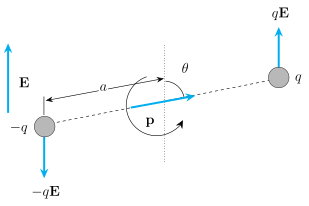
The figure shows a permanent electric dipole placed inside a uniform external electric field . The field is vertical, with a single arrow labelled pointing straight upward at the left side of the diagram.
The dipole consists of two charges: a negative charge at the lower-left and a positive charge at the upper-right. A dashed line connects the two charges, representing the dipole axis. The dipole moment vector points along this axis, from the negative charge toward the positive charge. The separation between the charges is labelled , so the magnitude of the dipole moment is .
A dotted vertical reference line passes through the centre of the dipole. The dipole axis makes an angle with this vertical line (which is parallel to ). Thus, is the angle between and .
Forces and torque:
- On : force acting upward (parallel to ).
- On : force acting downward (antiparallel to ).
These two forces are equal in magnitude but opposite in direction, so the net force on the dipole is zero. However, because the forces act at different points, they form a couple that produces a torque. A curved arrow (torque arc) at the centre of the dipole indicates the direction of rotation — it tends to turn toward the direction of .
Key formula derived from this figure:
The magnitude of the torque is:
The vector form, using the cross product, is:
Here:
- = torque on the dipole (direction: perpendicular to the plane of the paper, coming out of it).
- = electric dipole moment (magnitude , direction from to ).
- = uniform external electric field.
- = angle between and .
Physical idea: …
Drawn by us to help you understand the concept clearly, and verified to make sure it's accurate. For exams, practice from your NCERT textbook's own diagram.
What the Figure Shows
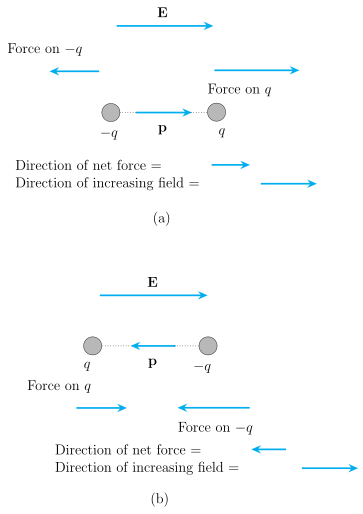
The figure has two stacked panels, (a) and (b), each depicting a dipole (charges and separated by distance ) placed in a non-uniform electric field . The field is represented by plain labelled arrows that increase in length toward the right, indicating that the field strength increases in that direction. Each panel also shows a labelled arrow for the direction of increasing field and another for the direction of net force.
-
Panel (a): The dipole moment is parallel to . The negative charge is on the left, and the positive charge is on the right. The force on (rightward, in the stronger part of the field) is larger than the force on (leftward, in the weaker part). The net force therefore points rightward — toward the increasing field. The forces are drawn above the dipole.
-
Panel (b): The dipole moment is antiparallel to . Now is on the left and on the right. The force on (leftward, in the stronger field) dominates, so the net force points leftward — opposite the direction of increasing field. The forces are drawn below the dipole.
Physical Idea
In a uniform field, the net force on a dipole is zero — only a torque exists. But when the field is non-uniform, the forces on the two charges are unequal in magnitude, producing a net force. The direction of this net force depends on the orientation of relative to :
- If is parallel to , the dipole is pulled toward stronger field.
- If is antiparallel to , the dipole is pushed toward weaker field.
This explains why a charged comb attracts uncharged paper: the comb’s non-uniform field induces a dipole in the paper (with parallel to ), and the net force pulls the paper toward the comb.
Key Formula
The net force on a dipole in a non-uniform field is derived from the forces on each charge. For a dipole of moment (where is the separation and is the unit vector from to ), the net force when is aligned with is:
Here:
- = dipole moment vector (magnitude )
- = gradient operator (measures how changes in space)
- = electric field vector …