Question 67 of 67
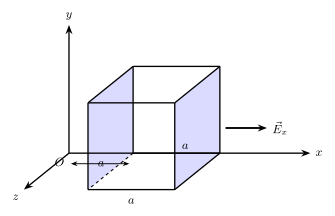
Q.Define electric flux and write its SI unit. The electric field components in the figure shown are : , , where . Calculate the charge within the cube, assuming m.
OR
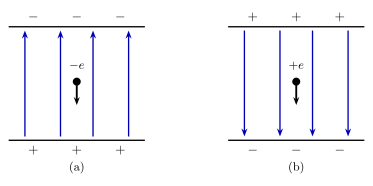
An electron falls through a distance of 1.5 cm in a uniform electric field of magnitude N/C (Fig. a). Calculate the time it takes to fall through this distance starting from rest. If the direction of the field is reversed (fig. b) keeping its magnitude unchanged, calculate the time taken by a proton to fall through this distance starting from rest.
Yanam CbseCBSE Class XII Board 2018Subjective· 3mImportance★★★★★
100% · 67/67 Questions
You're viewing a preview — the full solution, concept, methods & PYQ mapping are locked.
Start your 14-day free trial to unlock the full solution →Nm/C; C.
Definition. Electric flux ; SI unit (equivalently V·m).
Why only two faces. , so flux through the four faces parallel to the x-axis is zero. acts only through the two faces perpendicular to x. The left (near) face is at , the right face at .
Step-by-step.
- Left face (, outward normal ): .
- Right face (, outward normal ): .
- Net flux
- Gauss's law:
OR-alternative (charge in a field). Acceleration ; falling from rest, , with m, N/C. …
Unlock everything free for 14 days
- Full step-by-step solutions
- Concept-first explanations
- Methods, shortcuts & mistakes
- PYQ mapping + timed mock tests
Full access for 14 days. No credit card required.