Physics · Ch 1 — Electric Charges and Fields
Forces Between Multiple Charges
Forces Between Multiple Charges
The Principle of Superposition
Coulomb’s law tells us the force between two isolated charges. But what happens when a charge is surrounded by many others? The answer comes from the principle of superposition, which is experimentally verified:
The total electrostatic force on any one charge due to a system of other charges is the vector sum of the individual Coulomb forces exerted by each of the other charges, taken one at a time. The presence of other charges does not alter the force between any given pair.
This means forces of electrostatic origin add just like mechanical forces — using the parallelogram law of vector addition.
Force on a Charge in a System of Three Charges
Consider three point charges , , and in vacuum. To find the net force on :
- Force due to alone (even though is present):
where is the distance between and , and is the unit vector pointing from to .
- Force due to alone:
- Total force on is the vector sum:
Generalisation to Charges
For a system of stationary charges , the total force on due to all others is:
Using Coulomb’s law for each pair:
This can be written compactly as:
Here:
- = distance between and
- = unit vector pointing from to
The vector sum is performed using the parallelogram law. This principle, together with Coulomb’s law, forms the foundation of all electrostatics.
Worked Example: Three Equal Charges at Vertices of an Equilateral Triangle
Setup: Three charges at vertices of an equilateral triangle of side . A charge (same sign as ) is placed at the centroid O.
Step 1 – Geometry:
Height of triangle .
Distance from vertex to centroid: . By symmetry, .
Step 2 – Forces on :
Each force has magnitude:
Directions:
- from : along
- from : along
- from : along
Step 3 – Vector addition:
and have equal magnitude and are symmetrically placed. Their resultant points along (opposite to ) with magnitude .
Thus:
where is the unit vector along .
Result: The net force on is zero. This is also clear by symmetry — rotating the system by would not change the configuration.
Worked Example: Two and One at Triangle Vertices
Setup: Charges at A and B, at C, forming an equilateral triangle of side .
Step 1 – Magnitude of each pair force:
For any pair, the Coulomb force magnitude is the same:
Step 2 – Force on at A:
- (repulsion from B) acts along BA
- (attraction toward C) acts along AC …
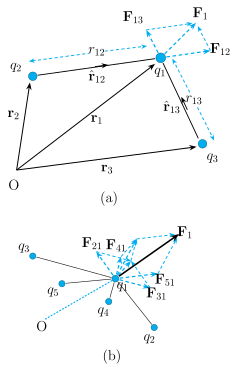
Drawn by us to help you understand the concept clearly, and verified to make sure it's accurate. For exams, practice from your NCERT textbook's own diagram.
What the Figure Shows
The figure has two panels, (a) and (b), both illustrating the principle of superposition for electrostatic forces.
Panel (a) shows a system of three charges , , placed at different points in space. An origin is marked, and each charge has a position vector: , , from . Dashed lines connect to and to , labelled as separation vectors (from to ) and (from to ). Unit vectors and are drawn pointing toward (i.e., along the direction from the other charge to ). The forces (due to ) and (due to ) acting on are shown as arrows. A dashed parallelogram is constructed with and as adjacent sides, and the diagonal gives the resultant force on .
Panel (b) generalises to multiple charges — five charges are shown, with origin at the lower left. Solid spokes radiate from to each of the other charges. The forces on (each pointing away from its source charge) are drawn. A dashed head-to-tail chain of these force vectors is added, and the final vector from the tail of the first to the head of the last gives the resultant .
Physical Idea Taught
The figure teaches that the net electrostatic force on a charge due to many other charges is the vector sum of the individual Coulomb forces, each calculated as if the other charges were absent. This is the principle of superposition. The parallelogram law (panel a) and head-to-tail addition (panel b) are geometric ways to perform this vector sum. The key insight: forces from different charges do not interfere with each other — they simply add as vectors.
Key Formula Developed
The textbook uses this figure to derive the general expression for the force on charge due to other charges :
where:
- is the force on due to ,
- is the distance between and , …