Physics · Ch 1 — Electric Charges and Fields
Electric Field
Electric Field
The Concept of Electric Field
How does one charge exert a force on another without any physical contact? The answer lies in the electric field. A charge (the source charge) creates an electric field in all of the space around it. This field is a physical entity that exists even when no other charge is present. When another charge (the test charge) is placed at any point in this field, the field acts on and produces the electrostatic force.
The electric field at a point is defined as the force per unit positive test charge placed at that point. It is a vector quantity.
Electric Field Due to a Point Charge
Consider a point charge placed at the origin. The electric field it produces at a point with position vector (at a distance from ) is given by:
Where:
- is the permittivity of free space.
- is a unit vector pointing from the source charge to the point where the field is being calculated.
- The magnitude of the field is .
Relation Between Force and Electric Field
The force experienced by a test charge placed in an electric field is:
This is the fundamental definition of the electric field. The SI unit of electric field is N/C (Newton per Coulomb), which is also equivalent to V/m (Volt per meter).
Operational Definition and the Test Charge
To measure the electric field of a source charge , we would ideally place a test charge at a point. However, itself exerts a force on , potentially moving it and altering the field we are trying to measure. To avoid this, we define the electric field using the limit as the test charge becomes infinitesimally small:
In practice, the source charge is held fixed by other forces (e.g., charges on a conductor are held by internal forces), allowing us to use a small test charge without disturbing the source.
Key Properties of the Electric Field
- Independent of the test charge: The field depends only on the source charge and the position , not on the test charge . This is because , so the ratio is constant.
- Direction: …
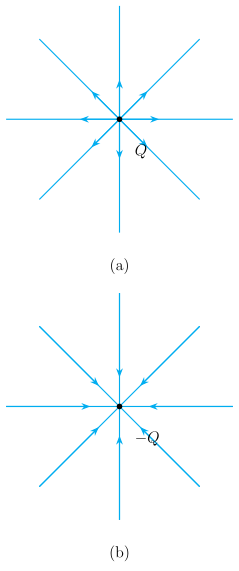
Drawn by us to help you understand the concept clearly, and verified to make sure it's accurate. For exams, practice from your NCERT textbook's own diagram.
What the Figure Shows
The figure has two panels, (a) and (b), each showing a point charge at the centre with eight straight field lines.
- Panel (a): A positive charge is at the centre. Eight straight lines radiate outward from the charge. Each line has an arrowhead midway along its length, pointing away from .
- Panel (b): A negative charge is at the centre. Again, eight straight lines radiate outward, but the arrowheads are midway and point inward toward the charge.
The labels and are placed just beside each charge. There are no axes, scales, or coordinates — the figure is a schematic, not a graph.
Physical Idea Taught
The figure illustrates the direction of the electric field produced by a point source charge.
- For a positive source charge (), the electric field at any point in space points radially outward — away from the charge. This is because a positive test charge would be repelled.
- For a negative source charge (), the electric field points radially inward — toward the charge. A positive test charge would be attracted.
The eight lines are a visual convention: they represent the field direction in different directions around the charge. The arrowheads are placed midway to show the direction clearly, not to indicate any special point. The field exists at every point in space, not just along these lines.
Key Formula Developed with This Figure
The electric field at a point at distance from a point charge is given by:
where:
- is the position vector of the point from the charge,
- is the distance,
- is a unit vector pointing from the charge to the point,
- is the permittivity of free space. …