Q.(a) Explain how the interaction between sea anemone and clownfish is one of the best examples of commensalism in nature.
You're viewing a preview — the full solution, concept, methods & PYQ mapping are locked.
Start your 14-day free trial to unlock the full solution →Concept understanding — Commensalism
Let’s start with something you already know. Imagine you are walking through a busy market. A fruit seller has a cart full of bananas. A small bird hops onto the cart, pecks at a banana that is already a little bruised, and flies away. The seller does not lose anything — that banana was not going to sell anyway. The bird gets a free meal. Neither is harmed, and one of them clearly benefits.
That is the everyday intuition behind commensalism.
The precise meaning
In ecology, commensalism is a type of interaction between two different species where one species benefits and the other species is neither helped nor harmed. The word comes from Latin: com (together) and mensa (table) — literally “eating at the same table.” One diner gets food, the other is not bothered.
The NCERT textbook (Class 12 Biology, Chapter 11) defines it clearly: “Commensalism is the interaction in which one species benefits and the other is neither benefited nor harmed.”
The key point is zero effect on the second species. If the second species is harmed even slightly, it is not commensalism — it becomes parasitism or predation. If both benefit, it is mutualism.
Why does this matter?
You might think this is a small detail, but it shapes how ecosystems work. Many organisms survive by hitchhiking, borrowing shelter, or using leftovers from others without costing them anything. This allows more species to coexist in the same space without direct conflict.
For a commerce or humanities student, think of it like this: a small startup sets up a stall right outside a big shopping mall. The mall’s customers walk past the stall, and some stop to buy. The startup benefits from the foot traffic. The mall loses nothing — it was already getting those customers. That is commensalism in business terms.
Common examples from NCERT and nature
- Barnacles on a whale: Barnacles attach themselves to the skin of a whale. The whale carries them to new feeding grounds, where the barnacles filter food from the water. The whale is not harmed (the barnacles do not feed on the whale) and does not benefit.
- Orchids on a tree: An orchid grows on the branch of a large tree. It gets sunlight and rainwater, but it does not take nutrients from the tree. The tree is unaffected.
- Cattle egrets and grazing cattle: As cattle walk through grass, they stir up insects. The egrets follow and eat those insects. The cattle neither gain nor lose from the egrets’ presence.
In all these cases, the second species (whale, tree, cattle) is completely unaffected — no gain, no loss. That is the single condition that separates commensalism from every other species interaction.
A common confusion …
Part (a): the clownfish gains protection among the anemone's stinging tentacles (immune via its mucus) while the anemone is unaffected — commensalism (+/0).
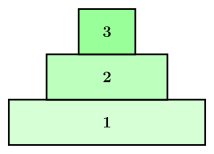
Part (b): 40 phytoplankton → 90 zooplankton → 120 fishes is an inverted pyramid of biomass, possible because producers have low standing crop but high turnover.
Ecological interactions are classified by their effect on each partner. Commensalism is the case where one organism benefits (+) while the other is unaffected (0).
The sea anemone is a cnidarian whose tentacles bear stinging cells (nematocysts) that paralyse most fish. The clownfish, however, has a mucus coating that renders it immune to these stings, so it lives safely among the tentacles. It gains a protected refuge from predators, which will not risk the venomous barrier — a real survival advantage. The anemone, meanwhile, neither gains nor loses: it does not receive food or protection of any consequence and continues its sessile life of capturing plankton and small prey with or without the fish. Because the benefit flows only one way and the anemone is unaffected, this is a textbook example of commensalism rather than mutualism.
If both partners benefited it would be mutualism; if one were harmed it would be parasitism. The anemone's indifference is what makes this commensalism.
Concept understanding — Ecological Pyramid
Picture a real pyramid -- wide at the base, narrowing all the way up to a single point at the top. Ecologists borrow exactly this shape to describe something that has nothing to do with stone: how numbers, weight (biomass), or energy are distributed across the feeding levels of a food chain. This visual model is called an ecological pyramid.
Every ecological pyramid works the same way. In your NCERT textbook (Class 12 Biology, Chapter 12, Ecosystem, section 12.5), the base always represents the producers -- the first trophic level -- and each successive tier above it represents the next trophic level up (herbivores, then primary carnivores, then secondary or top carnivores), with the apex representing the top-level consumer. Three distinct types are studied, because the same food-chain relationship can be measured in three different ways:
- Pyramid of numbers -- plots the count of individual organisms at each trophic level. NCERT's own grassland example is dramatic: nearly 6 million producer plants are needed to support just three top-carnivores at the apex.
- Pyramid of biomass -- plots the standing crop (usually expressed as dry weight, which is more accurate than fresh weight) of organisms at each level, rather than headcount.
- Pyramid of energy -- plots the amount of energy present at each trophic level, measured per unit area, usually annually.
In most ecosystems, all three pyramids come out upright -- producers are more numerous and have more biomass than herbivores, and herbivores more than carnivores -- because energy shrinks at every step up the food chain (the same 10 per cent law behind energy flow: only about 10 per cent of the energy at one trophic level is transferred to the next).
When a pyramid turns upside down -- numbers and biomass pyramids don't always come out upright, and NCERT points to genuine exceptions you're expected to reason through, not just memorise:
- A single large tree can support so many feeding insects that a pyramid of numbers built around it is inverted right at the base -- one producer, many primary consumers.
- The pyramid of biomass in the sea is commonly inverted: at any given moment the standing crop of tiny, fast-reproducing phytoplankton is small, yet it is turning over fast enough to support a much larger standing crop of the zooplankton feeding on it.
The pyramid of energy is the one type that is never inverted -- it is always upright, in every ecosystem, without exception. Energy is lost as heat at every transfer between trophic levels (unlike nutrients, it is never recycled back), so the level below always has to hold more usable energy than the level feeding on it. …
Part (a): the clownfish gains protection among the anemone's stinging tentacles (immune via its mucus) while the anemone is unaffected — commensalism (+/0).
Part (b): 40 phytoplankton → 90 zooplankton → 120 fishes is an inverted pyramid of biomass, possible because producers have low standing crop but high turnover.
An ecological pyramid of biomass plots the standing crop (total dry weight of living matter present at a given moment) at each trophic level. Here:
- Trophic level I — producers (phytoplankton): 40
- Trophic level II — primary consumers (zooplankton): 90
- Trophic level III — secondary consumers (small fishes): 120
Drawn as horizontal bars, the base bar (40) is the smallest and the bars widen upward, giving an inverted pyramid of biomass. …
Unlock everything free for 14 days
- Full step-by-step solutions
- Concept-first explanations
- Methods, shortcuts & mistakes
- PYQ mapping + timed mock tests
Full access for 14 days. No credit card required.