Q.State Kohlrausch's law of independent migration of ions. With the help of a curve, explain why it is not easy to determine for weak electrolytes by extrapolating the concentration molar conductivity curve, as it is for strong electrolytes.
You're viewing a preview — the full solution, concept, methods & PYQ mapping are locked.
Start your 14-day free trial to unlock the full solution →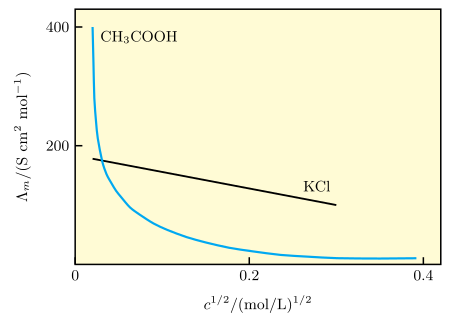
Kohlrausch’s law states that the limiting molar conductivity of an electrolyte is the sum of the independent contributions of its ions. For strong electrolytes, varies linearly with at low concentrations, allowing easy extrapolation to . For weak electrolytes, the curve is steep and non-linear near zero concentration, making direct extrapolation unreliable — so we use Kohlrausch’s law instead.
The core idea: Molar conductivity and its limit
Molar conductivity is the conductivity of a solution containing one mole of electrolyte, placed between electrodes 1 cm apart. As you dilute a solution, increases because ions are more free to move — they experience less interionic attraction. The value at infinite dilution (zero concentration) is called limiting molar conductivity, . This is a fundamental property of the electrolyte, independent of concentration.
The challenge is: how do we find for a weak electrolyte like acetic acid? You cannot simply measure it directly because at very low concentrations, weak electrolytes are only partially dissociated, and the conductivity drops sharply.
Kohlrausch’s law of independent migration of ions
Where and are the numbers of cations and anions per formula unit, and , are their limiting molar conductivities (individual ion contributions). The law says that at infinite dilution, each ion moves independently, and the total conductivity is simply the sum of its parts.
This is powerful because it lets us calculate for any electrolyte from known ion values — even for weak electrolytes that cannot be measured directly.
Why extrapolation works for strong electrolytes but fails for weak ones
- Strong electrolytes (e.g., NaCl, HCl) At low concentrations, they are fully dissociated. The Debye–Hückel–Onsager theory gives a linear relationship:
where is a constant. Plot vs , and you get a straight line at low . Extrapolating to (i.e., ) gives directly. This is reliable and precise.
-
Weak electrolytes (e.g., CHCOOH)
They are only partially dissociated. As you dilute, the degree of dissociation increases, so rises steeply — but not linearly with . The curve is concave upward near the origin, bending sharply. Extrapolating a curve that is not linear is guesswork; a tiny error in the slope near zero gives a huge error in the intercept.
The graph below illustrates this:
Λ_m
^
|                /  (weak electrolyte)
|              /
|            /
|          /
|        /
|      /
|    /  (strong electrolyte — straight line)
|  /
|/
+-------------------> √c
For the weak electrolyte, the curve plunges toward the y-axis so steeply that you cannot reliably draw a tangent to find the intercept. The value of is not accessible by direct extrapolation.
A common mistake is to assume that the vs plot for a weak electrolyte is linear at low concentrations. It is not — the curvature is severe because changes rapidly with dilution. Extrapolating a curved line gives a meaningless intercept.
How Kohlrausch’s law solves the problem …
Unlock everything free for 14 days
- Full step-by-step solutions
- Concept-first explanations
- Methods, shortcuts & mistakes
- PYQ mapping + timed mock tests
Full access for 14 days. No credit card required.