Q.Alcohols have higher boiling points than other compounds, namely hydrocarbons, ethers and haloalkanes of comparable molecular masses. On oxidation, primary alcohols yield aldehydes with mild oxidizing agents and carboxylic acids with strong oxidizing agents. Secondary alcohols yield ketones on oxidation while tertiary alcohols are resistant to oxidation. Ethers may be prepared by dehydration of alcohols and Williamson synthesis. The C−O bond in ethers can be cleaved by hydrogen halides. The presence of −OH group in phenols activates the aromatic ring towards electrophilic substitution and directs the incoming group to ortho and para positions due to resonance effect. In presence of NaOH, phenol generates phenoxide ion which is even more reactive than phenol. Thus, in alkaline medium, phenol undergoes Kolbe's reaction.
🔒You're viewing a preview — the full solution, concept, methods & PYQ mapping are locked.
🔒 Start your 14-day free trial to unlock the full solution →Part (a)Concept understanding — Alcohol Oxidation
Alcohol Oxidation: The Intuition First
Imagine you have a molecule of ethanol — the alcohol in your hand sanitizer or a drink. It has a carbon atom bonded to an –OH group. Now picture that –OH group as a "handle" that can be transformed. Oxidation, in organic chemistry, doesn't always mean adding oxygen — it often means removing hydrogen from a carbon that already has a bond to oxygen. For alcohols, oxidation is like "stripping away" hydrogen atoms from the carbon that holds the –OH, turning the alcohol into a more oxidized functional group.
Think of it this way: a primary alcohol (R–CH₂–OH) has two hydrogens on the carbon with the –OH. If you remove one hydrogen and the hydrogen from the –OH, you get an aldehyde (R–CHO). Remove both hydrogens (and the –OH hydrogen), and you get a carboxylic acid (R–COOH). A secondary alcohol (R–CHOH–R') has only one hydrogen on that carbon — remove it, and you get a ketone (R–CO–R'). A tertiary alcohol has no hydrogen on that carbon — so it cannot be oxidized without breaking the carbon skeleton.
That's the core intuition: oxidation of an alcohol is about removing hydrogens from the carbon bearing the –OH group. The more hydrogens you can remove, the more oxidized the product.
The Precise Statement
Alcohol oxidation is the process in which an alcohol loses hydrogen atoms (dehydrogenation) from the carbon bonded to the –OH group, increasing the number of C–O bonds (or decreasing C–H bonds). The outcome depends on the class of the alcohol:
| Alcohol Class | Structure | Product after oxidation | Reagent example |
|---|---|---|---|
| Primary (1°) | R–CH₂–OH | Aldehyde (R–CHO) then Carboxylic acid (R–COOH) | PCC (stops at aldehyde); K₂Cr₂O₇/H⁺ (goes to acid) |
| Secondary (2°) | R–CHOH–R' | Ketone (R–CO–R') | K₂Cr₂O₇/H⁺, CrO₃, etc. |
| Tertiary (3°) | R₃C–OH | No reaction (under normal conditions) | — |
A common mistake: students think "oxidation" always adds oxygen. For alcohols, it's removal of hydrogen from the carbon with the –OH. The oxygen from the –OH stays — it's the hydrogens that leave.
Why Does Tertiary Alcohol Not Oxidize?
Look at the carbon with the –OH in a tertiary alcohol: it has three carbon groups attached and no hydrogen. To form a C=O bond, you'd need to remove a hydrogen from that carbon — but there is none. The only way to oxidize a tertiary alcohol is to break a C–C bond (strong and difficult), which is not typical oxidation. So in standard organic chemistry, tertiary alcohols are inert to mild oxidizing agents.
A Real-World Analogy
Think of the alcohol carbon as a "parking spot" with a certain number of hydrogen "cars." Primary alcohol has two cars parked. Oxidation is like towing away one car (→ aldehyde) or both cars (→ carboxylic acid). Secondary alcohol has one car — tow it away, and you get a ketone. Tertiary alcohol has zero cars — nothing to tow, so no reaction.
Key Reagents to Remember (for exams)
- PCC (pyridinium chlorochromate): oxidizes 1° alcohols to aldehydes only — stops there.
- K₂Cr₂O₇ / H₂SO₄ (acidified potassium dichromate): oxidizes 1° alcohols all the way to carboxylic acids; 2° alcohols to ketones. (Not to be confused with Jones reagent, which is specifically CrO₃ dissolved in dilute aqueous H₂SO₄, often used in acetone — a related but distinct oxidant with the same general 1°→acid / 2°→ketone outcome.) …
Why this formula?
Alcohol Oxidation: Why the Reactions Work the Way They Do
Alcohol oxidation is a fundamental reaction in organic chemistry, and understanding why it proceeds as it does is crucial for Indian board exams (Class 12, JEE, NEET). Let's break it down step-by-step.
1. The Core Idea: Loss of Hydrogen
Oxidation in organic chemistry means loss of hydrogen (or gain of oxygen). For alcohols, this happens at the carbon bearing the –OH group.
- Primary alcohol (R−CH2OH): Has two hydrogens on the carbon attached to –OH.
- Secondary alcohol (R2CHOH): Has one hydrogen on that carbon.
- Tertiary alcohol (R3COH): Has zero hydrogens on that carbon.
Key insight: The number of hydrogens on the carbon with –OH determines if and how far oxidation can go.
2. Why Primary Alcohols Give Aldehydes (Then Carboxylic Acids)
Step 1: Aldehyde formation
When a primary alcohol (R−CH2OH) is oxidized, the first product is an aldehyde (R−CHO).
Why? The oxidizing agent (like K2Cr2O7 / H2SO4 or PCC) removes two hydrogens:
- One from the –OH group
- One from the carbon atom
The carbon–oxygen bond becomes a double bond (C=O), forming the aldehyde.
R−CH2OH[O]R−CHO+H2O
But why stop here? The aldehyde still has one hydrogen on the carbonyl carbon. If a strong oxidant is present, it can remove that hydrogen too.
Step 2: Carboxylic acid formation
With excess strong oxidant (e.g., K2Cr2O7 / H2SO4, heat), the aldehyde is further oxidized to a carboxylic acid (R−COOH).
R−CHO[O]R−COOH
Why does this happen? The aldehyde's carbonyl carbon is electrophilic (partially positive). Water (from the reaction medium) adds to it, forming a gem-diol intermediate. The oxidant then removes two more hydrogens, giving the acid.
Exam tip: To stop at the aldehyde, use a mild oxidant like PCC (pyridinium chlorochromate) in anhydrous conditions — no water means no gem-diol formation.
3. Why Secondary Alcohols Give Ketones (and Stop)
A secondary alcohol (R2CHOH) has only one hydrogen on the carbon with –OH. Oxidation removes:
- One hydrogen from –OH
- One hydrogen from the carbon
This forms a ketone (R2C=O).
R2CHOH[O]R2C=O+H2O
Why does it stop here? The ketone has no hydrogen on the carbonyl carbon. Without that hydrogen, further oxidation (under normal conditions) is impossible — you'd need to break a C−C bond, which requires much harsher conditions.
Key result: Secondary alcohols cannot be oxidized further than ketones under standard conditions.
4. Why Tertiary Alcohols Do NOT Oxidize
A tertiary alcohol (R3COH) has zero hydrogens on the carbon bearing –OH.
What happens if you try? The oxidant cannot remove any hydrogen from that carbon. The only possible reaction would be breaking a C−C bond, which doesn't happen under normal oxidation conditions.
Result: Tertiary alcohols are resistant to oxidation under mild to moderate conditions. They require strong heating with powerful oxidants (like K2Cr2O7 / H2SO4, heat) to break carbon–carbon bonds — this is destructive oxidation, not useful for synthesis.
5. The "Why" in One Table
| Alcohol Type | Hydrogens on C–OH | Product | Why? |
|---|---|---|---|
| Primary (1∘) | 2 | Aldehyde → Carboxylic acid | Two hydrogens available; aldehyde still has one more |
Part (b)Concept understanding — SN1 and SN2 Mechanism
The Core Idea: Two Ways to Swap a Group
Imagine you have a molecule with a leaving group (like a halogen) attached to a carbon. You want to replace that leaving group with a nucleophile (something that loves positive charge). There are two fundamentally different ways this can happen — like two different ways to replace a lightbulb.
SN2 is like unscrewing the old bulb and screwing in the new one in one smooth motion. SN1 is like first pulling the old bulb out completely, leaving an empty socket, and then putting the new bulb in.
That empty socket — the carbocation — is the key difference.
SN2: One Step, Backside Attack
The name says it all: Substitution, Nucleophilic, Bimolecular. "Bimolecular" means two molecules (the nucleophile and the substrate) are involved in the rate-determining step.
The Mechanism
The nucleophile attacks the carbon from the backside — directly opposite the leaving group. As the nucleophile approaches, the leaving group starts to leave. At the transition state, the nucleophile is partially bonded and the leaving group is partially detached. Then the leaving group departs completely, and the nucleophile is fully bonded.
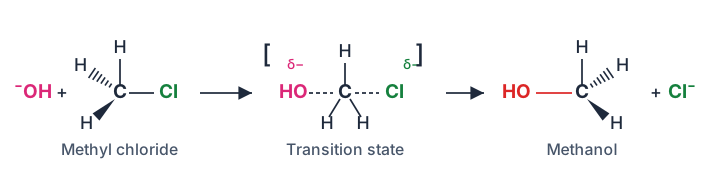
All of this happens in one step — no intermediate.
The Stereochemistry: Inversion
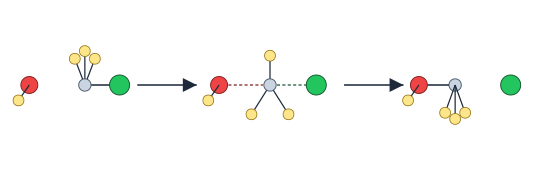
Because the nucleophile attacks from the back, the configuration at the carbon inverts — like an umbrella turning inside out in a strong wind. If you start with an R configuration, you get S (and vice versa). This is called Walden inversion.
What Favours SN2?
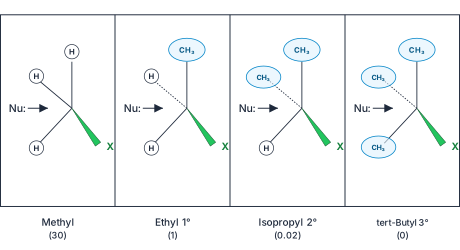
- Primary carbon (least steric hindrance — the backside is wide open)
- Strong nucleophile (needs to push its way in)
- Good leaving group (but not too good — it needs to wait for the nucleophile)
- Polar aprotic solvent (doesn't solvate the nucleophile too tightly)
SN2 is impossible on tertiary carbons — the three bulky groups block the backside completely. The nucleophile simply cannot get close enough.
SN1: Two Steps, Carbocation Intermediate
Substitution, Nucleophilic, Unimolecular. "Unimolecular" means only one molecule (the substrate) is involved in the rate-determining step.
The Mechanism
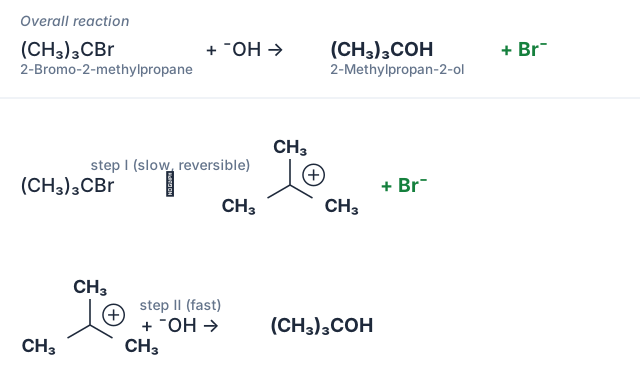
Step 1 (slow, rate-determining): The leaving group leaves on its own, forming a carbocation (a carbon with only six electrons — positively charged and very unstable).
Step 2 (fast): The nucleophile attacks the carbocation. Since the carbocation is flat (trigonal planar), the nucleophile can attack from either side with equal probability.
The Stereochemistry: Racemisation
Because the nucleophile can attack from either face of the flat carbocation, you get a racemic mixture — equal amounts of R and S. If the starting material is optically pure, the product will be optically inactive.
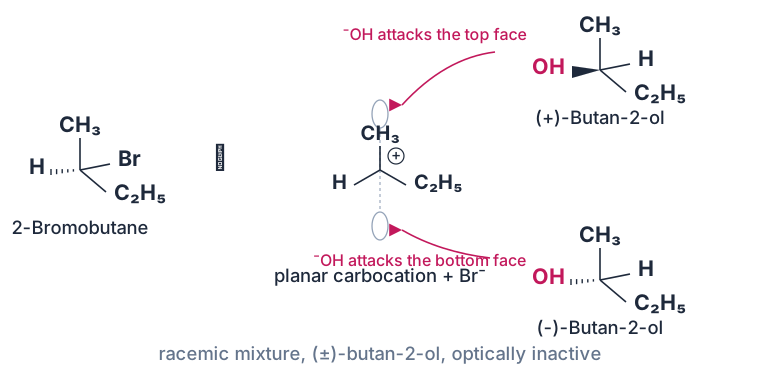
In practice, you often get slightly more inversion than retention (about 60:40) because the leaving group can partially block one face as it departs. But the key idea is loss of stereochemistry.
What Favours SN1?
- Tertiary carbon (the carbocation is stabilised by three alkyl groups — hyperconjugation and inductive effect)
- Weak nucleophile (doesn't need to force its way in — the carbocation is desperate for electrons)
- Excellent leaving group (must be able to leave on its own)
- Polar protic solvent (stabilises the carbocation and the leaving group)
SN1 is impossible on primary carbons — a primary carbocation is so unstable it effectively doesn't exist. The leaving group would never leave on its own.
The Big Comparison Table …
Part (a)
(a) Reagents:
- (i) 1° alcohol → aldehyde (mild oxidant, stops at aldehyde): PCC (pyridinium chlorochromate) in dry CH2Cl2 (or Collins reagent CrO3⋅2py).
- (ii) 1° alcohol → carboxylic acid (strong oxidant): acidified KMnO4 or acidified K2Cr2O7 (/H2SO4).
(b) Kolbe's reaction: phenol → sodium phenoxide (with NaOH); the electron-rich phenoxide reacts with CO2 (electrophile) at the ortho position under pressure, then acidification gives salicylic acid.
C6H5OHNaOHC6H5ONaCO2125∘C,4−7atmo-HO-C6H4-COONaH+o-HO-C6H4-COOH …
(a)(i) 1° alcohol → aldehyde needs mild PCC; (a)(ii) 1° alcohol → acid needs strong acidified KMnO4/K2Cr2O7; (b) Kolbe's reaction carboxylates sodium phenoxide with CO2 to give salicylic acid; (c)(i) 3° alcohols have no α-H so cannot be oxidised; (c)(ii) (CH3)3C-O-C2H5+HI→(CH3)3C-I+C2H5OH.
Part (a)
(a) Reagents for oxidation of a primary alcohol.
- (i) To an aldehyde you must stop at the aldehyde and not over-oxidise, so a mild oxidant used under anhydrous conditions is required: PCC (pyridinium chlorochromate) in dichloromethane, or Collins reagent (CrO3⋅2 pyridine).
- (ii) To a carboxylic acid you need a strong oxidant that carries the oxidation all the way: acidified potassium permanganate (KMnO4/H2SO4) or acidified potassium dichromate (K2Cr2O7/H2SO4).
(b) Kolbe's reaction. Phenol itself is only weakly reactive to electrophiles, but its conjugate base, the phenoxide ion, is strongly activated. Treating phenol with NaOH gives sodium phenoxide, which is then heated with CO2 under pressure; CO2 acts as the electrophile and attacks the ortho position. Acidification liberates salicylic acid (2-hydroxybenzoic acid).
C6H5OHNaOHC6H5O−Na+
C6H5O−Na++CO2125∘C, 4–7 atmo-HO-C6H4-COONaH+o-HO-C6H4-COOH …
Showing the 12 most recent of 41 on this concept.
- CBSE 2026Set A1 markMCQQ.When vapours of an alcohol are passed over hot reduced copper, it gives an alkene. The alcohol is(a) Primary(b) Secondary(c) Tertiary(d) None of these
›Reveal solutionSolution
Over hot reduced copper (573 K), a primary alcohol gives an aldehyde, a secondary gives a ketone, and a tertiary gives an alkene.
When alcohol vapours are passed over hot reduced copper the behaviour depends on the class of alcohol:
- Primary alcohol -> dehydrogenation -> aldehyde
- Secondary alcohol -> dehydrogenation -> ketone …
- CBSE 2026Set ANNUAL1 markQ.Write the name of product obtained when vapour of ethyl alcohol are passed over heated Copper at 573 K.
›Reveal solutionSolution
Passing alcohol vapours over heated copper catalyses either dehydrogenation (for 1° and 2° alcohols) or dehydration (for 3° alcohols), depending on alcohol type.
…
- CBSE 2026Set ANNUAL1 markMCQQ.Dehydration of tertiary alcohols with copper at 573 K gives:(a) Aldehyde(b) Ketone(c) Alkene(d) None of these
›Reveal solutionSolution
Passing alcohol vapours over heated copper at 573 K is a classification test: 1° alcohols → aldehydes, 2° alcohols → ketones, but 3° alcohols (no α-H on the carbinol carbon available for dehydrogenation) undergo dehydration to give an alkene.
When vapours of an alcohol are passed over copper catalyst at 573 K:
- Primary alcohols are dehydrogenated (lose H2) to aldehydes: RCH2OHCu,573KRCHO+H2
- Secondary alcohols are dehydrogenated to ketones: R2CHOHCu,573KR2C=O+H2 …
- CBSE 2026Set ANNUAL1 markMCQQ.When vapour's of a compound X are passed over heated copper, the major product obtained is the acetone. The compound X is:(a) n-Propyl alcohol(b) Iso-propyl alcohol(c) Acetaldehyde(d) Propane
›Reveal solutionSolution
Vapours passed over heated copper dehydrogenate 2° alcohols to ketones; since the product is acetone (a ketone), X must be a secondary alcohol — isopropyl alcohol.
Over heated copper (573 K), alcohols are catalytically dehydrogenated based on their class:
- 1° alcohol → aldehyde
- 2° alcohol → ketone
- 3° alcohol → alkene (dehydration) …
- CBSE 2026Set ANNUAL1 markMCQQ.[Case study] Depending on the molecule involved in controlling the rate of reaction, nucleophilic substitution reaction can be divided in two categories: nucleophilic unimolecular (SN1) and nucleophilic bimolecular (SN2). Alkyl halide reactivity towards SN1 and SN2 reactions depends on a number of variables, including steric hindrance, stability of the intermediate or transition state and solvent polarity. Primary alkyl halides, followed by secondary and tertiary alkyl halide are most favourable to the SN2 reaction mechanism. In the case of SN1 reactions, this order is reversible.(i) Which of the following is most reactive towards nucleophilic substitution reaction ?(a) CHCl3(b) CH2=CHCl(c) ClCH2CH=CH2(d) CH2CH=CHCl
›Reveal solutionSolution
Allyl chloride is most reactive because ionisation of the C–Cl bond gives an allylic carbocation stabilised by resonance with the adjacent C=C double bond, favouring rapid SN1 substitution.
Comparing the four halides:
- CHCl₃ (chloroform): a trihalomethane; it is not a typical alkyl/allyl/vinyl halide substrate for facile nucleophilic substitution under these conditions — its C–H (not a good leaving-group carbon) and its multiple Cl on the same very electron-poor carbon make it comparatively unreactive here.
- CH₂=CHCl (vinyl chloride): the C–Cl bond is attached directly to an sp² carbon of the double bond. This bond has partial double-bond character (due to conjugation of a chlorine lone pair with the π system) and is both shorter and stronger than a normal C–Cl bond; also, any positive charge generated at that carbon cannot be stabilised by the adjacent π system (it would need an empty orbital where the π bond already sits). Vinylic and aryl halides are therefore very unreactive towards nucleophilic substitution. …
- CBSE 2026Set ANNUAL1 markMCQQ.[Case study, continued](ii) Isopropyl chloride undergoes hydrolysis by(a) SN1 and SN2 mechanism(b) SN1 mechanism(c) SN2 mechanism(d) None of the above
›Reveal solutionSolution
Isopropyl chloride is a secondary alkyl halide; secondary halides sit in the intermediate reactivity zone and can react by either SN1 (via a moderately stable secondary carbocation) or SN2 (moderate steric hindrance still allows backside attack), so both mechanisms operate, often simultaneously depending on conditions.
Reactivity trend for nucleophilic substitution:
- Primary halides are sterically unhindered, favouring SN2 (backside attack is easy) but their carbocation would be unstable, disfavouring SN1.
- Tertiary halides are too sterically hindered for backside attack (SN2 is disfavoured) but readily form a stable tertiary carbocation, strongly favouring SN1. …
- CBSE 2026Set ANNUAL1 markMCQQ.The most suitable reagent for the conversion of RCH2OH→RCHO is(a) KMnO4(b) K2Cr2O7(c) LiAlH4(d) PCC (Pyridinium Chlorochromate)
›Reveal solutionSolution
Selective oxidation of a 1° alcohol to an aldehyde (without over-oxidation to the acid) requires an anhydrous, mild oxidant — PCC — rather than a strong aqueous oxidant.
Why KMnO4 and K2Cr2O7 (a, b) fail: these are strong oxidising agents used in aqueous, typically acidified medium. The initially formed aldehyde reacts with water to form a geminal diol (aldehyde hydrate), RCH(OH)2, which is itself readily oxidised further by these strong oxidants to the carboxylic acid, RCOOH. So the reaction cannot be stopped cleanly at the aldehyde stage.
Why LiAlH4 (c) fails: this is a powerful reducing agent (it reduces esters, acids and other carbonyls down to alcohols) — the wrong direction entirely for an oxidation.
…
- CBSE 2026Set ANNUAL1 markMCQQ.Which of the following on heating with aqueous KOH, produces acetaldehyde?(a) CH3CH2Cl(b) CH2ClCH2Cl(c) CH3CHCl2(d) CH3COCl
›Reveal solutionSolution
Only the geminal dihalide CH3CHCl2 hydrolyses to an unstable gem-diol that collapses to the aldehyde; the other substrates give an alcohol, a diol, or a carboxylate instead.
CH3CHCl2 (c), a gem-dihalide (both Cl on the same carbon):
CH3CHCl2+2KOH(aq)→CH3CH(OH)2+2KCl
The geminal diol CH3CH(OH)2 is unstable (two −OH groups on the same carbon) and spontaneously eliminates water:
CH3CH(OH)2→CH3CHO+H2O
Net: CH3CHCl2+2KOH→CH3CHO+2KCl+H2O — acetaldehyde.
Why the others are wrong:
- (a) CH3CH2Cl + aq. KOH undergoes simple nucleophilic substitution to give ethanol, CH3CH2OH — not an aldehyde. …
- CBSE 2026Set ANNUAL1 markMCQQ.Which one of the following is the correct statement?(a) Alkyl halides are more reactive than aryl halides towards nucleophilic substitution reaction(b) Alkyl halides are less reactive than aryl halides towards nucleophilic substitution reaction(c) Nucleophilic substitution reaction proceeds through carbocation(d) Aryl halides cannot be prepared by electrophilic substitution to arenes
›Reveal solutionSolution
Resonance donation of the halogen's lone pair into the aromatic ring strengthens and shortens the aryl C−X bond and makes the ring electron-rich, so alkyl halides are far more reactive than aryl halides toward nucleophilic substitution.
Why aryl halides resist substitution: the halogen's lone pair delocalises into the benzene ring by resonance, giving the C−X bond partial double-bond character — it becomes shorter and stronger than a normal C−X single bond, and harder to break. The electron-rich ring also repels an incoming nucleophile, and backside (SN2-type) attack on the sp2 carbon is sterically/geometrically hindered by the planar ring; an SN1-type pathway would require a highly unstable phenyl cation, which does not form under normal conditions.
Why the other statements are wrong:
- (b) is the exact reverse of the truth. …
- CBSE 2026Set ANNUAL1 markQ.Fill in the blank: In addition of bromine in CCl4 to an alkene resulting in disappearance of reddish brown colour of bromine constitutes, an important method for the detection of ______ in a molecule.
›Reveal solutionSolution
Decolourisation of bromine in CCl4 detects unsaturation (C=C double bond).
An alkene readily adds bromine across its carbon-carbon double bond to form a colourless dibromide:
C=C + Br2 -> Br-C-C-Br
…
- CBSE 2026Set ANNUAL1 markQ.Write True or False: Bromo, iodo and polychloro derivatives of hydrocarbons are heavier than water.
›Reveal solutionSolution
True - these halogen derivatives are denser than water.
The heavy halogen atoms (Br, I) and multiple chlorine atoms greatly increase the molar mass and density of the molecule. As a result, bromo, iodo and polychloro derivatives of hydrocarbons (e.g. bromoform, iodoform, chloroform, …
- CBSE 2025Set 56/5/11 markMCQQ.CH3CH2OH can be converted to CH3CHO by : (A) catalytic hydrogenation (B) treatment with LiAlH4 (C) treatment with PCC (D) treatment with KMnO4
›Reveal solutionSolution
The key idea is that converting ethanol (CH3CH2OH) to ethanal (CH3CHO) is a controlled oxidation of a primary alcohol to an aldehyde. The correct reagent is PCC (pyridinium chlorochromate), which stops at the aldehyde stage without over-oxidizing to a carboxylic acid.
This question tests your understanding of alcohol oxidation — a core reaction in organic chemistry. Ethanol is a primary alcohol. To get an aldehyde, you need to oxidize it partially. The challenge is that many strong oxidizers will push the reaction all the way to the carboxylic acid (acetic acid, CH3COOH). So the trick is choosing a reagent that is mild enough to stop at the aldehyde.
Let’s examine each option.
-
Option (A): Catalytic hydrogenation
Hydrogenation (H2 with a metal catalyst like Pd, Pt, or Ni) is a reduction process. It adds hydrogen across double or triple bonds. Ethanol has no multiple bonds to reduce — it’s already saturated. This would do nothing. So this is wrong.
-
Option (B): Treatment with LiAlH4
Lithium aluminium hydride is a powerful reducing agent. It reduces carbonyl compounds (aldehydes, ketones, acids, esters) to alcohols. Using it on ethanol would be pointless — ethanol is already an alcohol. It cannot oxidize anything. So this is also wrong.
-
Option (C): Treatment with PCC
PCC (pyridinium chlorochromate, C5H5NH+CrO3Cl−) is a mild oxidizing agent specifically designed for the conversion of primary alcohols to aldehydes. It works in anhydrous conditions (typically in dichloromethane) and stops cleanly at the aldehyde stage.
The reaction:
CH3CH2OHPCCCH3CHO
This is the textbook method. So this is correct.
- Option (D): Treatment with KMnO4 …
-
🎓Unlock everything free for 14 days
- ✓Full step-by-step solutions
- ✓Concept-first explanations
- ✓Methods, shortcuts & mistakes
- ✓PYQ mapping + timed mock tests
Full access for 14 days. No credit card required.