Q.(a) Define mutual inductance and write its S.I. unit.
You're viewing a preview — the full solution, concept, methods & PYQ mapping are locked.
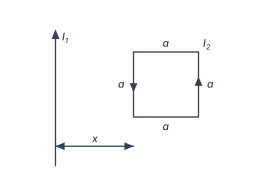
Start your 14-day free trial to unlock the full solution →(a) Mutual inductance quantifies the magnetic coupling between two circuits: the flux linked with one coil per unit current in the other. S.I. unit: henry (H). (b) The near side of the loop carries current antiparallel to the wire (repulsion) while the far side carries current parallel to it (attraction); since the near side is closer, its repulsive force wins and the net force is , directed away from the wire.
Part (a): Mutual Inductance
When two coils or circuits are placed near each other, a current in one produces a magnetic field that threads through the other. Mutual inductance captures this coupling: it is the magnetic flux linked with one coil per unit current flowing in the neighbouring coil. Equivalently, if the current in coil 1 changes at the rate , the emf induced in coil 2 is
The defining relation is
where is the flux through coil 2 due to current in coil 1.
S.I. unit: henry (H), equivalent to weber per ampere (Wb/A) or volt·second per ampere (V·s/A).
Part (b): Force on the Square Loop
Reading the figure. The infinite wire's current points upward. The loop's near side (the side adjacent to the wire, at perpendicular distance ) carries downward — i.e. antiparallel to . Its far side (at distance ) carries upward — parallel to . (The top and bottom sides run perpendicular to the wire and, by symmetry, contribute no net force.)
Magnetic field from the infinite wire
A long straight wire carrying current produces a magnetic field at perpendicular distance :
Force on a current-carrying conductor
A straight segment of length carrying current in a field experiences a force ; for the loop's vertical sides (parallel to the wire), , so . Two long parallel currents attract if they flow in the same direction and repel if they flow in opposite directions.
Step-by-step calculation
1. Near side (distance , current antiparallel to ):
2. Far side (distance , current parallel to ):
3. Top and bottom sides: each lies at a range of distances from the wire, but by symmetry the forces on these two sides are equal in magnitude and opposite in direction — they cancel exactly. …
Unlock everything free for 14 days
- Full step-by-step solutions
- Concept-first explanations
- Methods, shortcuts & mistakes
- PYQ mapping + timed mock tests
Full access for 14 days. No credit card required.