Q.Define the term wavefront. Using Huygen's wave theory, verify the law of reflection.
🔒You're viewing a preview — the full solution, concept, methods & PYQ mapping are locked.
🔒 Start your 14-day free trial to unlock the full solution →Part (a)Concept understanding — Huygens' Principle and Wavefronts
A wavefront is the locus of all points that are in the same phase (state) of vibration at a given instant; because points on a wavefront are all in step, a wavefront is always perpendicular to the direction of the wave's propagation (the ray). A point source at a finite distance produces spherical wavefronts, a line (extended) source produces cylindrical wavefronts, and any source located effectively at infinity produces plane wavefronts. Huygens' principle is a geometrical construction rule stating that every point on a wavefront acts as a source of secondary spherical wavelets, spreading outward with the wave's own speed; the new wavefront at a later time t is the common forward tangent (the 'envelope') of all these secondary wavelets, each having grown to radius ct from its originating point. This construction correctly reproduces spherical wavefronts from a nearby point source and plane wavefronts from a distant source, and it explains how a wavefront propagates without needing to track individual rays. Its one acknowledged shortcoming is that it …
Part (b)Concept understanding — Refraction and Snell's Law
Refraction and Snell's Law
When light crosses the boundary between two transparent media its speed changes, so the ray bends at the surface. The bending is governed by Snell's law, which relates the angle of incidence i (measured from the normal) in medium 1 to the angle of refraction r in medium 2:
n1sini=n2sinr
Here n=c/v is the (absolute) refractive index of a medium, always ≥1 for ordinary matter.
Which way does it bend?
- Going into a denser medium (n2>n1): light slows down, sinr<sini, so the ray bends toward the normal.
- Going into a rarer medium (n2<n1): the ray bends away from the normal.
- At normal incidence (i=0) the ray passes straight through, and a ray never bends past the normal for ordinary media.
Across a stack of layers (e.g. air → turpentine → water), apply Snell's law at each interface in turn. Since nair<nwater<nturpentine, a ray descending from air bends toward the normal on entering the turpentine and then away from the normal on entering the (less dense) water. …
Part (a)
Wavefront: the continuous locus of all points of a medium vibrating in the same phase (e.g. a surface joining all crests at an instant).
Law of reflection (Huygens). Plane wavefront AB hits mirror XY; while the wavelet from A travels to form the reflected front, B advances to C on the mirror with BC=vt, and the wavelet from A reaches D with AD=vt. The reflected wavefront is CD. In right triangles ABC and ADC: BC=AD=vt, AC common, so they are congruent ⇒∠BAC=∠DCA, i.e. angle of incidence = angle of reflection, i=r (and incident ray, reflected ray, normal are coplanar). …
Part (a): a wavefront is a surface of constant phase; Huygens' construction of the reflected wavefront proves the angle of incidence equals the angle of reflection (i=r).
Part (b): refractive index is n=c/v; Huygens' construction for a wave passing denser → rarer gives sini/sinr=v1/v2=n2/n1 (Snell's law), with the ray bending away from the normal.
Part (a) — Wavefront and the law of reflection
Wavefront. A wavefront is the continuous surface joining all points of a medium that are in the same phase of vibration. Huygens' principle: every point of a wavefront is a source of secondary spherical wavelets, and the new wavefront is their envelope.
Verifying i=r. Let a plane wavefront AB strike a plane mirror XY, the incident rays making angle i with the normal. Point A reaches the mirror first and emits a wavelet into the same medium (speed v). In the time t that B travels to C on the mirror, BC=vt, the wavelet from A has radius AD=vt. The reflected wavefront is the tangent CD to that wavelet.
Compare right triangles ABC and ADC (right angles at B and D):
- BC=AD=vt,
- AC is common. …
Showing the 12 most recent of 55 on this concept.
- CBSE 2026Set V11 markMCQQ.According to Huygen's principle, speed of the secondary wavelets is :(a) twice that of the wave(b) zero(c) same as that of the wave(d) infinite
›Reveal solutionSolution
(c) same as that of the wave …
- CBSE 2026Set A1 markMCQQ.The refractive index of water is 1.33. What will be the speed of light in water? (A) 1.33 × 10^8 m/s (B) 4 × 10^8 m/s (C) 2.25 × 10^8 m/s (D) 3 × 10^8 m/s
›Reveal solutionSolution
Speed in a medium = c/n = (3 × 10⁸)/1.33 ≈ 2.25 × 10⁸ m/s.
The refractive index of a medium is the ratio of the speed of light in vacuum to that in the medium:
n=vc⇒v=nc
…
- CBSE 2026Set A1 markMCQQ.The wavefront due to a point source at a finite distance from the source is (A) plane (B) circular (C) cylindrical (D) spherical
›Reveal solutionSolution
A point source radiates uniformly outward, giving spherical wavefronts (they become nearly plane only very far away).
A wavefront is the surface joining points of the same phase. A point source sends out disturbances equally in every direction, so at any finite distance the set of in-phase points forms a sphere centred on the source — a ** …
- CBSE 2026Set ANNUAL1 markMCQQ.The refractive indices of glass and water with respect to air are 3/2 and 4/3, respectively. The refractive index of glass w.r.t. water will be(a) 8/9(b) 9/8(c) 7/6(d) 6/7
›Reveal solutionSolution
ng/w=ng/a/nw/a=(3/2)/(4/3)=9/8.
Refractive index of glass w.r.t. water can be obtained by combining the refractive indices w.r.t. air:
…
- CBSE 2026Set ANNUAL1 markMCQQ.The phase difference between any two points on a wavefront is(a) 0°(b) 45°(c) 90°(d) 120°
›Reveal solutionSolution
A wavefront is defined as the locus of points that are in the same phase of oscillation, so the phase difference between any two points on it is zero.
By definition, a wavefront is a surface of constant phase - every point on it has travelled the same optical path length from the source and is therefore oscillating in exactly the same …
- CBSE 2026Set ANNUAL1 markMCQQ.Refraction takes place due to(a) change in the speed of light(b) no change in the speed of light(c) change in the colour of light(d) polarization
›Reveal solutionSolution
Light bends when it crosses into a medium where its speed is different; that speed change is the fundamental cause of refraction.
When light travels from one medium into another (e.g. air into glass), its speed changes because the two media have different optical densities (different refractive indices). According to Snell's law, n1sin(theta1) = n2sin(theta2), and refractive index n = c/v (speed of light in vacuum divided by speed in the medium). Because the speed v changes at the boundary, the direction of the light ray bends - this bending is refraction. If the speed did no …
- CBSE 2026Set ANNUAL1 markMCQQ.The concept of secondary wavelets was given by(a) Fresnel(b) Newton(c) Huygens(d) Maxwell
›Reveal solutionSolution
Huygens' principle says every point of a wavefront is itself a source of secondary wavelets, and the new wavefront is their common tangent surface.
Christiaan Huygens proposed that every point on an existing wavefront can be regarded as a source of new, secondary spherical wavelets that spread out in the forward direction with the speed of the wave in that medium. The surface that is tangential to all these secondary wavelets at any later instant gives the new position of the wavefront. This principle (Huygens' principle) is used to explain reflection, refraction, and diffraction of light p …
- CBSE 2026Set ANNUAL1 markMCQQ.The optical density of turpentine is higher than that of water while its mass density is lower. Figure shows a layer of turpentine floating over water in a container. Which of the following four rays incident on turpentine in figure, the path shown is correct?(a) 1(b) 2(c) 3(d) 4
›Reveal solutionSolution
Since turpentine is optically the densest of the three (n(turpentine) > n(water) > n(air)), a ray must bend toward the normal at the air–turpentine surface, then bend away from the normal (but not all the way back) at the turpentine–water surface.
The question states the optical density (refractive index) order is turpentine > water > air (even though turpentine's mass density is lower than water's, which is why it floats — optical density and mass density are unrelated). Refraction at each interface follows Snell's law, n1sinθ1=n2sinθ2:
- Air → Turpentine: going into an optically denser medium, the ray bends towards the normal (angle decreases).
- Turpentine → Water: water is rarer than turpentine, so going into it the ray bends away from the normal (angle increases) compared to its path inside turpentine. …
- CBSE 2026Set ANNUAL1 markMCQQ.The phase difference between two points located on the same wavefront is:(a) 2π(b) 0(c) π(d) π/2
›Reveal solutionSolution
A wavefront is, by definition, the locus of points that are all at the same stage (phase) of their vibration, so the phase difference between any two of its points is zero.
A wavefront is defined as the continuous locus of all points in a medium that are oscillating in the same phase, having been disturbed by the wave at the same instant relative to the source (e.g. a sphere for a point source, or a plane far from the source). Since every point on a wavefront is, by construction, at the identical stage of its oscillation cycle, the phase difference between any two such points …
- CBSE 2026Set ANNUAL1 markQ.Draw the diagram of wave front produced by a point source of light.
›Reveal solutionSolution
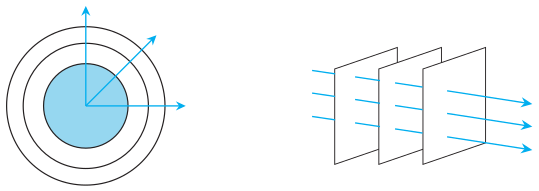
Figure — Explicit 'Draw the diagram of wave front produced by a point source' hard gate. Catalog fig-10-1 is exactly a A point source produces spherical wavefronts.
A point source of light emits waves equally in all directions, so at any given instant, all the points at the same distance from the source are vibrating in the same phase. The locus of these points — the wavefront — is therefore a sphere centred on the source, and as time progresses, this spherical wavefront expands outward with radius increasing at t …
- CBSE 2026Set ANNUAL1 markQ.In phenomenon of refraction of light, which property of it remains unchanged ?
›Reveal solutionSolution
In refraction, frequency stays constant; speed and wavelength change.
When light travels from one medium into another, its speed changes (v = c/n) and consequently its wavelength changes (λ = v/f). However, the frequency f is determined by the source of light and does not change when the wave crosses the boundary — the number of wavefronts arriving per second must equal the number leaving per second ( …
- CBSE 2025Set ANNUAL1 markMCQQ.Assertion (A): A light wave can be considered to travel from one point to another along a straight line. Reason (R): Wavelength of light is very small compared to size of ordinary objects in daily life.(a) Both A and R are correct and R is the correct explanation of A.(b) Both A and R are correct but R is not correct explanation of A.(c) A is correct but R is incorrect.(d) A and R both are incorrect.
›Reveal solutionSolution
Ray (straight-line) propagation of light is a good approximation exactly because light's wavelength is far smaller than the objects/apertures it interacts with in everyday life.
Assertion (A) is true: over everyday distances and apertures, light can be treated as travelling in straight lines (rays) — this is the basis of ray/geometrical optics. Reason (R) is also true: the wavelength of visible light (~400–700 nm) is indeed extremely small compared to the size of ordinary objects and apertures encountered in daily life. R correctly explains A: diffraction effects (bending of waves around obstacles/edges) become significant only when the size of an obstacle or aperture is com …
🎓Unlock everything free for 14 days
- ✓Full step-by-step solutions
- ✓Concept-first explanations
- ✓Methods, shortcuts & mistakes
- ✓PYQ mapping + timed mock tests
Full access for 14 days. No credit card required.