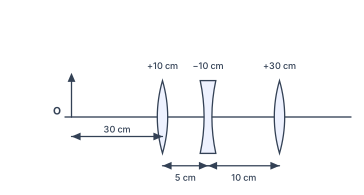
Q.(a) Describe any two characteristic features which distinguish between interference and diffraction phenomena. Derive the expression for the intensity at a point of the interference pattern in Young's double slit experiment.
🔒You're viewing a preview — the full solution, concept, methods & PYQ mapping are locked.
🔒 Start your 14-day free trial to unlock the full solution →Part (a)Concept understanding — Double Slit Interference
Double Slit Interference: From Ripples to Light
Imagine dropping two stones into a still pond at the same time, a short distance apart. Watch the ripples spread. Where a crest from one stone meets a crest from the other, the water rises higher. Where a crest meets a trough, the water flattens out. That is interference — waves adding or cancelling.
Now replace the water with light. Replace the stones with two narrow slits cut into a barrier. Shine a single colour of light (say, red laser light) onto the slits. On a screen behind the barrier, you do not see two bright spots. Instead, you see a pattern of alternating bright and dark bands — like a striped zebra crossing made of light.
That pattern is double slit interference. It is the single most convincing proof that light behaves as a wave.
The Core Idea
Light from a single source passes through two narrow slits. Each slit acts as a new source of waves. These two sets of waves spread out and overlap. At any point on the screen, the light you see is the sum of the waves from slit 1 and slit 2.
Whether they add (bright) or cancel (dark) depends on one thing: the path difference — how much farther one wave has travelled compared to the other.
For constructive interference (bright band): path difference = nλ (whole number of wavelengths)
For destructive interference (dark band): path difference = (n+21)λ (half-integer number of wavelengths)
Here λ is the wavelength of the light, and n=0,1,2,…
The Geometry
Let the slits be separated by distance d. The screen is far away at distance D (D≫d). For a point on the screen at angle θ from the centre:
- The path difference Δx=dsinθ
- Bright bands occur when dsinθ=nλ
- Dark bands occur when dsinθ=(n+21)λ
The position y of the n-th bright band on the screen (measured from the centre) is:
yn=dnλD
The spacing between consecutive bright bands (fringe width) is:
β=dλD
Fringe width β=dλD
What This Tells You
- Larger λ → wider fringes (red light spreads more than blue)
- Larger D → wider fringes (screen further away spreads the pattern)
- Smaller d → wider fringes (slits closer together spread the pattern more)
If you cover one slit, the pattern vanishes — you get a single blurry blob. The stripes only appear when both slits are open, proving that the light from the two slits is interfering.
Why It Matters
Double slit interference is not a classroom toy. It is the foundation of:
- Young's experiment (1801) — which settled the debate: light is a wave
- Diffraction gratings — used in spectrometers to identify elements by their light …
Why this formula?
Double Slit Interference: Why the Formula Holds
Let's build the understanding from first principles — not just memorise the formula, but see why it must be true.
1. The Core Idea: Path Difference Creates Phase Difference
Imagine two narrow slits S1 and S2, separated by distance d, illuminated by a single coherent source. Light from each slit travels to a point P on a screen at distance D (where D≫d).
- The two waves start in phase at the slits (same source).
- They travel different distances to reach P.
- This path difference Δx causes a phase difference Δϕ.
Key relation:
Δϕ=λ2π⋅Δx
Why? Because one full wavelength λ corresponds to a phase change of 2π radians.
2. Finding the Path Difference
From the geometry (see diagram in any textbook):
- For a point P at angle θ from the central axis, the extra distance travelled by the wave from the farther slit is approximately:
Δx=dsinθ
Why approximate? Because we assume D≫d, so the two paths are nearly parallel. This is the Fraunhofer (far-field) approximation — valid for most exam setups.
3. Condition for Constructive Interference (Bright Fringes)
Waves interfere constructively when they arrive in phase:
Δϕ=2πm(m=0,±1,±2,…)
Using Δϕ=λ2π⋅dsinθ, we get:
λ2π⋅dsinθ=2πm
Cancel 2π to obtain the bright fringe condition:
dsinθ=mλ
- m is called the order of the fringe.
- m=0 gives the central bright fringe (straight ahead).
4. Condition for Destructive Interference (Dark Fringes)
Waves interfere destructively when they arrive out of phase by π (half a cycle):
Δϕ=(2m+1)π
Substitute again:
λ2π⋅dsinθ=(2m+1)π
Cancel π to get the dark fringe condition:
dsinθ=(m+21)λ
5. From Angle to Position on Screen
For small angles (typical in exam problems), sinθ≈tanθ=Dy, where y is the distance from the central maximum on the screen.
Bright fringe position:
ym=dmλD
Dark fringe position:
ym=d(m+21)λD …
Part (b)Concept understanding — Total Internal Reflection
Total Internal Reflection: When Light Decides to Stay Home
Imagine you're running on a beach toward the water. On sand, you run fast. The moment you hit the water, your speed drops — the water "resists" more. If you run at a shallow angle toward the waterline, your legs will suddenly slow down, and your body will twist. That twist is refraction — light bending when it changes speed between two media.
Now imagine the reverse: you're swimming in the water, heading toward the shore. You're moving slower in water, and you want to get out onto the fast sand. If you approach the shore at a very shallow angle — almost parallel to the beach — you might never make it out. The sudden speed-up as you hit the sand could "reflect" you back into the water. That's the intuition for total internal reflection.
The Core Idea
Light normally passes from one transparent medium to another (say, from water to air) and bends away from the normal — because it speeds up. But if the angle of incidence in the slower medium is large enough, the light can't escape. It gets completely reflected back inside the first medium. No light transmits. That's total internal reflection.
Total internal reflection (TIR) occurs only when light travels from a denser (slower) medium to a rarer (faster) medium, and the angle of incidence exceeds a critical value.
The Two Conditions (Memorise These)
For TIR to happen, both must be true:
-
Light must go from a denser medium to a rarer medium (e.g., glass → air, water → air, diamond → air).
Denser means higher refractive index (n). Light slows down in a denser medium.
-
Angle of incidence (i) must be greater than the critical angle (C).
The critical angle is the angle of incidence in the denser medium for which the angle of refraction in the rarer medium is exactly 90∘.
The Critical Angle — The Tipping Point
Look at the diagram in your mind: a ray in water heading toward the surface. As you increase the angle of incidence, the refracted ray in air bends more and more away from the normal. At some specific angle C, the refracted ray skims exactly along the surface — angle of refraction =90∘.
sinC=ndensernrarer
For water (n=1.33) to air (n=1.00):
sinC=1.331.00≈0.75⇒C≈48.6∘
So if you shine a light from water into air at an angle greater than about 49∘ from the normal, the light will not leave the water at all. It reflects back down — perfectly.
What Actually Happens at the Boundary?
- i<C: Most light refracts out; a little reflects (normal partial reflection).
- i=C: Refracted ray grazes the surface; transmitted intensity is nearly zero.
- i>C: No transmitted ray. All the light energy reflects back into the denser medium. The reflection is 100% — no absorption, no transmission.
TIR is not the same as ordinary reflection from a mirror. In TIR, there is no silvering or coating. The reflection happens because the wave cannot exist in the rarer medium — it's forced back. This gives perfect reflection with zero energy loss, unlike a metal mirror which absorbs some light.
--- …
Why this formula?
Total Internal Reflection: Why the Key Formulas Hold
Total Internal Reflection (TIR) is a fascinating optical phenomenon where light, instead of escaping from a denser medium into a rarer one, gets completely reflected back into the denser medium. Let's build the understanding from first principles.
1. The Foundation: Snell's Law
The entire story begins with Snell's Law:
n1sinθ1=n2sinθ2
Where:
- n1 = refractive index of the denser medium (e.g., glass, water)
- n2 = refractive index of the rarer medium (e.g., air)
- θ1 = angle of incidence (in denser medium)
- θ2 = angle of refraction (in rarer medium)
Key fact: n1>n2 (light travels from denser to rarer).
2. The Critical Angle: Where Refraction "Bends" to 90°
As θ1 increases, θ2 increases faster (because n1>n2). At some special angle, θ2 becomes exactly 90∘ — the refracted ray grazes the surface.
Set θ2=90∘ in Snell's Law:
n1sinθc=n2sin90∘
Since sin90∘=1:
sinθc=n1n2
Why this formula?
It's not arbitrary — it's the limit of Snell's Law. The critical angle θc is the largest incidence angle for which refraction is still possible. Beyond this, Snell's Law would demand sinθ2>1, which is impossible — no real angle satisfies it.
3. Beyond the Critical Angle: Why TIR Occurs
When θ1>θc:
- Snell's Law gives sinθ2=n2n1sinθ1>1
- No real θ2 exists
- Physics says: the wave cannot "fit" into the rarer medium
- Result: All energy is reflected back into the denser medium
This isn't a failure of Snell's Law — it's a physical boundary where the wave's behaviour changes from propagating to evanescent (decaying).
4. The Condition for TIR (Exam-Ready Summary)
For Total Internal Reflection to occur, both conditions must hold:
- Light travels from denser to rarer medium (n1>n2) …
Part (a)
Two features distinguishing interference from diffraction
- Origin: interference arises from the superposition of two (or more) discrete coherent sources (the two slits); diffraction arises from the superposition of infinitely many secondary wavelets from a single continuous wavefront/aperture.
- Fringes: interference fringes are equally spaced and (for equal sources) of equal intensity; in single-slit diffraction the central maximum is twice as wide as the others and the intensity of successive maxima falls off rapidly.
Intensity in YDSE. Two coherent waves y1=acosωt and y2=acos(ωt+ϕ) superpose:
y=2acos2ϕcos(ωt+2ϕ),A=2acos2ϕ.
Since I∝A2, with I0∝a2,
I=4I0cos22ϕ.
Single-slit numerical. a=3×10⁻³ m, λ=620 nm, D=1.5 m.
First minimum: x1=aλD=3.1×10⁻⁴ m.
Third maximum: x3=2a7λD=1.085×10⁻³ m. …
Part (a): Interference = two discrete coherent sources with equal, equally-spaced fringes; diffraction = one continuous wavefront with a central maximum twice as wide and rapidly falling side maxima. YDSE intensity I=4I0cos2(ϕ/2); the first-minimum-to-third-maximum separation is 7.75×10⁻⁴ m. Part (b): TIR needs denser→rarer travel with i>ic, where sinic=1/n; the three-lens system throws the image to the focus of the third lens, 30 cm to its right.
Part (a)
Interference vs diffraction
| Feature | Interference | Diffraction |
|---|---|---|
| Source of superposition | two discrete coherent sources (two slits) | infinitely many secondary wavelets from one continuous aperture |
| Fringes | equally spaced, equal intensity (equal sources) | central maximum twice as wide; intensity of side maxima falls rapidly |
Intensity in Young's double-slit experiment
Let the two coherent waves reaching a point P be
y1=acosωt,y2=acos(ωt+ϕ),
where the phase difference ϕ=λ2πΔ for path difference Δ=dsinθ.
Superposing,
y=y1+y2=a[cosωt+cos(ωt+ϕ)]=2acos2ϕcos(ωt+2ϕ).
The resultant amplitude is A=2acos2ϕ. Since intensity ∝ amplitude2, writing I0∝a2,
I=4I0cos22ϕ=4I0cos2(λπdsinθ).
Maxima (I=4I0) occur for ϕ=2nπ (Δ=nλ); minima (I=0) for ϕ=(2n+1)π (Δ=(n+21)λ).
Single-slit numerical
Given a=3 mm=3×10⁻³ m, λ=620 nm=620×10−9 m, D=1.5 m.
Minima: asinθ=nλ⇒xn=anλD. First minimum (n=1):
x1=3×10−3620×10−9×1.5=3.1×10⁻⁴ m.
Secondary maxima: asinθ≈(m+21)λ⇒xmax,m=2a(2m+1)λD. Third maximum (m=3):
x3=2a7λD=2×3×10−37×620×10−9×1.5=1.085×10⁻³ m.
Separation: …
Showing the 12 most recent of 66 on this concept.
- CBSE 2026Set 55/1/11 markMCQQ.The shape of the interference fringes in Young's double-slit experiment, when the distance between the slit and the screen is very large as compared to the slit-separation, is nearly (A) straight (B) parabolic (C) circular (D) hyperbolic
›Reveal solutionSolution
When the screen is very far from the slits compared to their separation, points of constant path difference lie on nearly straight lines parallel to the slits, making the fringes straight.
The key to understanding fringe shape lies in recognizing what an interference fringe actually represents: it is the locus of all points on the screen where the path difference from the two slits is constant.
In Young's double-slit experiment, we have two coherent sources S1 and S2 separated by distance d. A point P on the screen at distance D from the slits will show constructive or destructive interference depending on the path difference Δ=∣S2P−S1P∣.
For a bright fringe of order n, we need Δ=nλ. The question is: what is the shape of the curve connecting all points P that satisfy this condition?
Geometry of path difference
Consider a point P on the screen at coordinates (x,y) if we place the origin midway between the slits. The two slits are at positions roughly (0,±d/2,0) in 3D space, and the screen is at distance D along the perpendicular.
The exact path difference is:
Δ=D2+(y−d/2)2+x2−D2+(y+d/2)2+x2
This is the general equation for a hyperbola in the xy-plane. So strictly speaking, fringes are hyperbolic curves.
The far-field approximation
Now comes the crucial condition: D≫d (screen distance much larger than slit separation).
When D is very large, we can use the binomial approximation. For the path from S2 to P:
S2P=D1+D2(y−d/2)2+x2≈D+2D(y−d/2)2+x2
Similarly for S1P. The path difference becomes:
Δ≈2D(y−d/2)2−(y+d/2)2=2D−2yd=−Dyd
(The x2 terms cancel out.)
For constant path difference Δ=nλ, we get:
y=−dnλD=constant …
- CBSE 2026Set 55/2/11 markMCQQ.Two statements are given – one labelled Assertion (A) and the other Reason (R). Select the correct answer from the codes below: (A) Both (A) and (R) are true and (R) is the correct explanation of (A). (B) Both (A) and (R) are true, but (R) is not the correct explanation of (A). (C) (A) is true, but (R) is false. (D) (A) is false and (R) is also false. Assertion (A) : Light added to light can produce darkness. Reason (R) : When two coherent light waves interfere, there is darkness at the position of destructive interference.
›Reveal solutionSolution
Interference of coherent light waves can indeed produce darkness at points of destructive interference; both statements are true and the reason correctly explains the assertion. The answer is (A).
Why light can produce darkness
The assertion sounds paradoxical at first—how can adding light to light create darkness? The resolution lies in understanding that light is a wave phenomenon, and waves don't simply add arithmetically in intensity. Instead, they superpose according to their phase relationship.
When two coherent light waves (waves with a constant phase relationship) meet, their electric field amplitudes add vectorially. If they arrive in phase, the amplitudes reinforce (constructive interference, brighter light). If they arrive exactly out of phase—crest meeting trough—the amplitudes cancel (destructive interference), and the resultant intensity becomes zero or near-zero. This is darkness produced by adding light to light.
The reason statement captures precisely this mechanism: destructive interference between coherent waves creates regions of darkness.
Examining the statements
-
Assertion (A): "Light added to light can produce darkness"
This is experimentally verified in phenomena like Young's double-slit experiment, thin-film interference, and Newton's rings. At certain positions on the screen or observation plane, the intensity drops to zero despite light arriving from two sources. The statement is true.
-
Reason (R): "When two coherent light waves interfere, there is darkness at the position of destructive interference"
Destructive interference occurs when the path difference between two coherent waves is an odd multiple of half-wavelengths:
Δ=(m+21)λ,m=0,1,2,… …
-
- CBSE 2026Set 55/3/11 markMCQQ.In which of the following does total internal reflection NOT occur ? (A) Twinkling of stars (B) Brilliance of diamonds (C) Optical fibre (D) Reflecting prism
›Reveal solutionSolution
Total internal reflection requires light to travel from a denser to a rarer medium at an angle greater than the critical angle. Twinkling of stars involves refraction through atmospheric layers of varying density, not TIR. The answer is (A).
Total internal reflection is a phenomenon that occurs when light traveling in a denser medium strikes the boundary with a rarer medium at an angle greater than the critical angle. At this point, instead of refracting into the second medium, all the light reflects back into the denser medium. The key conditions are: light must go from higher to lower refractive index, and the angle of incidence must exceed the critical angle θc=sin−1(n2/n1) where n1>n2.
Let's examine each option to see where this principle applies:
-
Twinkling of stars: Starlight enters Earth's atmosphere and passes through layers of air with slightly different temperatures and densities. As light moves through these layers, it undergoes refraction — bending at each boundary because the refractive index changes gradually. Sometimes light bends toward regions of higher density, sometimes toward lower density, but it continues to propagate through the atmosphere. The random fluctuations in atmospheric density cause the apparent position and brightness of stars to change rapidly, creating the twinkling effect. This is purely refraction, not total internal reflection.
-
Brilliance of diamonds: A diamond has a very high refractive index (n≈2.42). When light enters a diamond and strikes the internal faces, it often does so at angles greater than the critical angle (which is quite small, around 24.4° for diamond-air interface). The light then undergoes total internal reflection multiple times inside the diamond before emerging, creating the characteristic sparkle and brilliance. …
-
- CBSE 2026Set V11 markMCQQ.For total internal reflection of light :(a) light should be travelling from rarer medium to denser medium(b) light should be travelling from denser medium to rarer medium(c) light should be incident along the normal(d) angle of incidence should be equal to 90∘
›Reveal solutionSolution
(b) light should be travelling from denser medium to rarer medium …
- CBSE 2026Set DS1 markMCQQ.If critical angle in a medium be α, then for total internal reflection, the angle of incidence β should be:i) β<αii) β>αiii) β=αiv) β≤α
›Reveal solutionSolution
TIR occurs only for angles of incidence larger than the critical angle, so β>α.
Concept. When light travels from a denser to a rarer medium, at the critical angle α the refracted ray just grazes the surface (angle of refraction =90∘). If the angle of incidence is increased beyond this critical angle, refraction is no longer possible and the light is completely reflected back into the denser medium — this is total internal reflection.
…
- CBSE 2026Set A1 markMCQQ.The phase difference φ is related to path difference λ by (A) (λ/π)φ (B) (π/λ)φ (C) (λ/2π)φ (D) (2π/λ)φ
›Reveal solutionSolution
Phase difference = (2π/λ) × path difference.
The fundamental relation between phase difference (Δϕ) and path difference (Δx) is
Δϕ=λ2πΔx.
…
- CBSE 2026Set A1 markMCQQ.For destructive interference, the path difference should be equal to (A) nλ (B) (2n+1)λ/2 (C) zero (D) infinity
›Reveal solutionSolution
Destructive interference occurs when the path difference is an odd multiple of λ/2.
Two waves interfere destructively (cancel) when they arrive exactly out of phase, i.e. a phase difference of π,3π,5π,…. In terms of path difference this means an odd multiple of half a wavelength:
…
- CBSE 2026Set ANNUAL1 markQ.The displacement of water molecules at any instant on the surface of water at nodal lines is ______.
›Reveal solutionSolution
Nodal lines are where two overlapping waves are always exactly out of phase, so their displacements cancel completely at every instant, leaving zero net displacement.
When two coherent water-wave sources produce overlapping ripples, at points on a nodal line the crest of one wave always coincides with the trough of the other (path difference = odd multiple of half wavelength), so d …
- CBSE 2026Set ANNUAL1 markQ.When light passes from a denser medium to a rarer medium, and the angle of incidence equals the critical angle, what is the angle of refraction?
›Reveal solutionSolution
The critical angle is DEFINED as the angle of incidence at which the refracted ray just grazes the interface, making the angle of refraction exactly 90 degrees.
When light travels from a denser medium towards a rarer medium, it bends away from the normal. As the angle of incidence is increased, the angle of refraction increases faster and eventually reaches 90 degrees (the refracted ray travels right along the boundary between the two media) - the angle of incidence at which this happens is called the critical angle (theta_c). By …
- CBSE 2026Set ANNUAL1 markQ.Answer in one word/sentence: What is the phenomena that causes a bubble in water to shine brightly?
›Reveal solutionSolution
Air bubbles in water appear to shine brightly (like silver) due to total internal reflection of light at the water-air interface of the bubble.
Light travelling in the denser medium (water) strikes the surface of the air bubble (a rarer medium) at angles greater than the critical angle for the water-air interface. Since it cannot refract out, it is totally internal …
- CBSE 2025Set 55/5/11 markMCQQ.Two coherent light waves, each having amplitude a, superpose to produce an interference pattern on a screen. The intensity of light as seen on the screen varies between: (A) 0 and 2a2 (B) 0 and 4a2 (C) a2 and 2a2 (D) 2a2 and 4a2
›Reveal solutionSolution
When two coherent waves of equal amplitude a interfere, the resultant amplitude varies from 0 (destructive) to 2a (constructive); since intensity is proportional to the square of amplitude, the intensity range is 0 to 4a2.
The heart of this problem lies in understanding how wave superposition affects intensity. When two coherent waves meet, they don't simply add their intensities — instead, their amplitudes add vectorially, and the resulting intensity depends on the square of this net amplitude.
For light waves, intensity I is proportional to the square of the amplitude: I∝A2. If we set the proportionality constant to unity for simplicity (which is standard when comparing relative intensities), then I=A2.
Now let's trace what happens when two coherent waves, each with amplitude a, interfere.
The amplitude addition principle
At any point on the screen, the two waves arrive with some phase difference δ (which depends on the path difference). The resultant amplitude is found by vector addition:
Anet=a1+a2
where a1 and a2 are the individual wave amplitudes treated as phasors. For two waves of equal amplitude a with phase difference δ:
Anet=a2+a2+2a⋅acosδ=a2(1+cosδ)
Using the identity 1+cosδ=2cos2(δ/2):
Anet=2acos2δ
Finding the intensity extremes
- Maximum amplitude (constructive interference): When δ=0,2π,4π,… (waves in phase), we have cos(δ/2)=1, so:
Amax=2a
The maximum intensity is:
Imax=Amax2=(2a)2=4a2 …
- CBSE 2025Set 55/6/11 markMCQQ.Two coherent waves, each of intensity I0, produce interference pattern on a screen. The average intensity of light on the screen is: (A) zero (B) I0 (C) 2I0 (D) 4I0
›Reveal solutionSolution
Interference redistributes light energy across the screen but cannot create or destroy it, so the average intensity equals the sum of the two individual intensities: I0+I0=2I0. The correct option is (C).
When two coherent waves meet, they produce bright and dark fringes. At some points they add constructively (bright), at others destructively (dark). The question asks for the average intensity over the whole screen — not the maximum or minimum at any particular point.
The key insight is energy conservation. The two sources together deliver a fixed amount of energy to the screen. Interference only redistributes this energy — concentrating it in bright fringes and depleting it in dark ones — it cannot create or destroy energy. So the average over the pattern must equal what the two waves would deliver independently.
Let's confirm this with the intensity formula.
- Write the resultant intensity at a point. For two coherent waves of intensity I0 each, meeting with phase difference δ:
I=I0+I0+2I0⋅I0cosδ=2I0(1+cosδ)
This varies from Imax=4I0 (at δ=0,2π,…) down to Imin=0 (at δ=π,3π,…).
- Average over the pattern. As you move across the screen, the phase difference δ sweeps uniformly through all values from 0 to 2π:
⟨I⟩=2I0(1+⟨cosδ⟩)
-
Evaluate the average of cosine.
Over a complete cycle, ⟨cosδ⟩=0.
-
Conclude.
⟨I⟩=2I0(1+0)=2I0 …
🎓Unlock everything free for 14 days
- ✓Full step-by-step solutions
- ✓Concept-first explanations
- ✓Methods, shortcuts & mistakes
- ✓PYQ mapping + timed mock tests
Full access for 14 days. No credit card required.