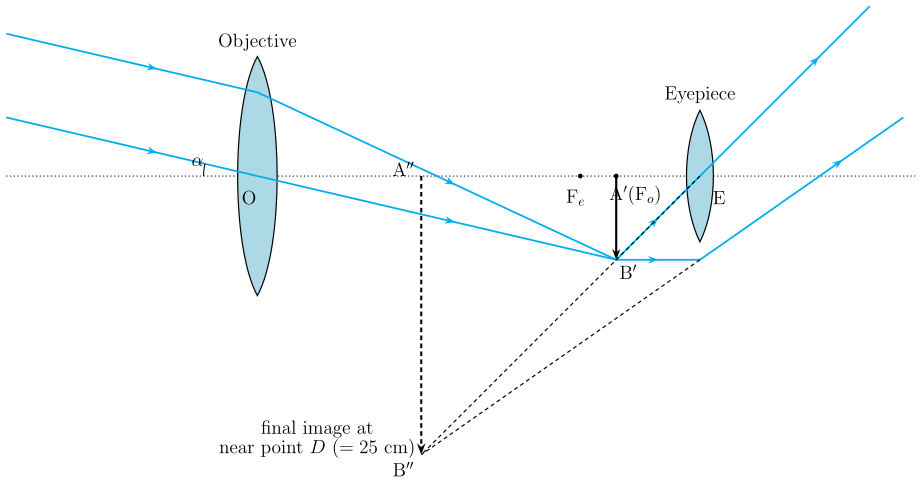
Q.Draw a labelled ray diagram of an astronomical telescope in the near point adjustment position. A giant refracting telescope at an observatory has an objective lens of focal length 15 m and an eyepiece of focal length 1.0 cm. If this telescope is used to view the Moon, find the diameter of the image of the Moon formed by the objective lens. The diameter of the Moon is m, and the radius of lunar orbit is m.
You're viewing a preview — the full solution, concept, methods & PYQ mapping are locked.
Start your 14-day free trial to unlock the full solution →The telescope’s objective forms a real image of the Moon at its focal plane. Using the small-angle approximation, the image diameter is , where is the Moon’s angular diameter. The result is .
Concept and intuition
An astronomical telescope works by collecting light from a distant object with a large objective lens (or mirror) and then magnifying the real image formed at the focal plane using an eyepiece. In the near point adjustment (also called normal adjustment for relaxed eye, but here the near point adjustment means the final image is formed at the near point of the eye, 25 cm away), the eyepiece is moved slightly so the final virtual image is at the least distance of distinct vision. However, the question specifically asks for the diameter of the image formed by the objective lens alone — that is the real, intermediate image. This depends only on the objective’s focal length and the angular size of the Moon, not on the eyepiece.
The Moon is so far away that rays from any point on it arrive nearly parallel. The objective lens brings these parallel rays to a focus at its focal plane. The Moon’s angular diameter (the angle it subtends at Earth) is tiny, so the image size is simply (small-angle approximation: in radians).
Step-by-step solution
1. Find the angular diameter of the Moon
The Moon’s actual diameter and its distance from Earth (radius of lunar orbit) . The angular diameter in radians is:
Calculate:
Always use radians for small angles — it directly gives the image size when multiplied by focal length. No need to convert to degrees.
2. Image diameter from the objective
The objective focal length . The real image of the Moon formed at the focal plane has diameter:
Convert to centimetres:
3. Ray diagram for near point adjustment (qualitative)
While the calculation above does not require the diagram, the question asks for it. Here’s how to draw it:
- Draw the objective lens (large, convex) on the left. Mark its principal axis. …
Unlock everything free for 14 days
- Full step-by-step solutions
- Concept-first explanations
- Methods, shortcuts & mistakes
- PYQ mapping + timed mock tests
Full access for 14 days. No credit card required.