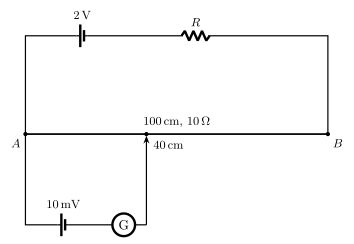
Q.A potentiometer can measure emf of a cell because (A) the sensitivity of potentiometer is large. (B) no current is drawn from the cell at balance. (C) no current flows in the wire of potentiometer at balance. (D) internal resistance of cell is neglected.
A potentiometer measures emf accurately because at the balance point no current is drawn from the cell being tested, ensuring the terminal voltage equals the true emf. The answer is (B).
Why a potentiometer can measure emf
The fundamental challenge in measuring the emf of a cell is that any measuring device that draws current will cause a voltage drop across the cell's internal resistance. What you measure is then the terminal voltage , not the true emf .
A potentiometer solves this elegantly through its null method. At the balance point, the potential difference across a length of the potentiometer wire exactly matches the emf of the test cell. When these are equal and opposite, no current flows through the test cell. With zero current, there's no drop across the internal resistance, so the terminal voltage is the emf.
This is the conceptual heart of why potentiometers work as emf-measuring instruments.
Examining each option
-
Option (A): Sensitivity
Sensitivity determines how precisely you can locate the balance point (how much the galvanometer deflection changes per unit length). High sensitivity improves measurement precision, but it doesn't address the fundamental issue of why the measurement gives emf rather than terminal voltage. A sensitive voltmeter still draws current and still measures terminal voltage, not emf.
-
Option (B): No current from the cell at balance
This is the key. At balance, the galvanometer shows zero deflection because no current flows in the galvanometer circuit. By Kirchhoff's laws, this means no current is drawn from the test cell either. With , the voltage drop across internal resistance is , so the terminal voltage equals the emf:
The potentiometer measures the potential difference that would exist if no current were drawn—which is precisely the definition of emf.
-
Option (C): No current in the potentiometer wire
This is incorrect. Current does flow through the potentiometer wire itself (from the driver cell). The potentiometer wire carries a steady current that creates the potential gradient. What matters is that no current flows through the test cell at balance, not that the wire is current-free.
-
Option (D): Internal resistance neglected
The beauty of the potentiometer is that we don't need to neglect internal resistance—we automatically account for it. The method works regardless of the internal resistance value because we ensure zero current. We're not approximating; we're measuring under conditions where internal resistance has no effect.
Don't confuse "no current in the galvanometer circuit" with "no current in the potentiometer wire." The driver circuit maintains a steady current through the wire to establish the potential gradient; the null condition refers only to the test-cell branch.
The correct option is (B): no current is drawn from the cell at balance, ensuring the measured voltage equals the true emf.
Unlock everything free for 14 days
- Full step-by-step solutions
- Concept-first explanations
- Methods, shortcuts & mistakes
- PYQ mapping + timed mock tests
Full access for 14 days. No credit card required.