Q.(a) Two cells of emf and have their internal resistances and , respectively. Deduce an expression for the equivalent emf and internal resistance of their parallel combination when connected across an external resistance . Assume that the two cells are supporting each other.
You're viewing a preview — the full solution, concept, methods & PYQ mapping are locked.
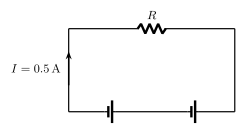
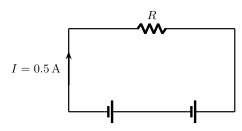
Start your 14-day free trial to unlock the full solution →When two cells in parallel support each other, they act as a single equivalent cell with emf and internal resistance . For two identical 5 V cells with 2 Ω internal resistance across a 10 Ω load, the terminal voltage is V ≈ 4.55 V.
Understanding Parallel Combination of Cells
When two cells are connected in parallel and "support each other," they both try to drive current in the same direction through the external load. This is different from opposing cells, where one would fight the other.
The key insight: each cell contributes current to the load according to its emf and the total resistance it sees. The parallel combination behaves like a single equivalent cell, and we need to find its effective emf and internal resistance by analyzing the circuit systematically.
(a) Deriving the Equivalent Cell Parameters
Let's denote the current through the external resistance as , and the currents from cells 1 and 2 as and respectively.
1. Apply Kirchhoff's current law at the junction
The total current through is the sum of individual cell currents:
2. Write the terminal voltage in terms of each cell
Both cells are in parallel, so they share the same terminal voltage across their combination. For each cell, the terminal voltage relates to its emf by:
3. Solve for individual currents
From the voltage equations:
4. Express total current in terms of terminal voltage
Substituting into :
5. Rearrange to match the standard cell equation
Multiply through by :
This has the form , where:
The equivalent internal resistance is simply the parallel combination of and , which makes physical sense. The equivalent emf is a weighted average of the two emfs, weighted by the other cell's internal resistance. …
Unlock everything free for 14 days
- Full step-by-step solutions
- Concept-first explanations
- Methods, shortcuts & mistakes
- PYQ mapping + timed mock tests
Full access for 14 days. No credit card required.