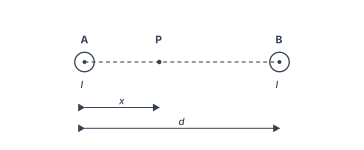
Q.Two long straight parallel wires A and B separated by a distance , carry equal current flowing in same direction as shown in the figure.
You're viewing a preview — the full solution, concept, methods & PYQ mapping are locked.
Start your 14-day free trial to unlock the full solution →Two parallel wires carrying current in the same direction produce opposing magnetic fields in the region between them. The net field is zero at the midpoint and reverses direction across it.
Concept: Magnetic Field from Parallel Currents
When two long straight wires carry current in the same direction, they attract each other—a fact you've likely seen. But what happens to the magnetic field in the space between them?
Each wire creates a circular magnetic field around itself (right-hand thumb rule: thumb along current, fingers curl in the direction of ). The key insight is that between the wires, these two fields point in opposite directions. Wire A's field at point P circles A and points one way; wire B's field at P circles B and points the opposite way. The net field is the vector difference of the two.
(a) Finding the Magnetic Field at Point P
- Field due to wire A alone Wire A is at distance from P. The magnitude of the magnetic field it produces at P is
Using the right-hand rule with current flowing upward in A, the field at P (to the right of A) points into the page (or downward in the plane perpendicular to the wires).
- Field due to wire B alone Wire B is at distance from P. Its field magnitude at P is
With current also upward in B, the field at P (to the left of B) points out of the page (or upward in the perpendicular plane).
- Net field: vector subtraction Since and are antiparallel at P, the net field is their difference. Taking the direction of as positive (into the page):
Factoring out common terms:
- Special case: the midpoint At , both terms are equal, so . The two wires produce equal and opposite fields at the center, canceling perfectly.
The sign of tells you the direction: positive when wire A dominates (P closer to A), negative when wire B dominates (P closer to B).
(b) Graphical Variation of with
To sketch for , analyze the behavior at key points and limits:
-
As (P very close to wire A):
The term while remains finite. Thus .
-
At (midpoint):
exactly, as shown above.
-
As (P very close to wire B):
Now is finite, but , so . …
Unlock everything free for 14 days
- Full step-by-step solutions
- Concept-first explanations
- Methods, shortcuts & mistakes
- PYQ mapping + timed mock tests
Full access for 14 days. No credit card required.