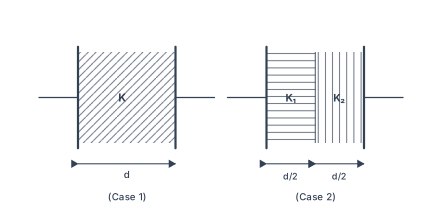
Q.The space between the plates of a parallel plate capacitor is completely filled in two ways. In the first case, it is filled with a slab of dielectric constant . In the second case, it is filled with two slabs of equal thickness and dielectric constants and respectively as shown in the figure. The capacitance of the capacitor is same in the two cases. Obtain the relationship between , and .
You're viewing a preview — the full solution, concept, methods & PYQ mapping are locked.
Start your 14-day free trial to unlock the full solution →The key idea is that inserting two dielectrics of equal thickness is equivalent to placing two capacitors in series. Equating the capacitance of the single-slab case to the two-slab case gives the harmonic mean relation: .
Why this approach works
When you fill a parallel-plate capacitor completely with a dielectric, the capacitance simply multiplies by the dielectric constant : . That’s straightforward.
But when you fill the gap with two different dielectrics of equal thickness, something interesting happens. Each dielectric slab occupies half the gap, so each slab acts like its own tiny capacitor — with half the plate separation. And because these two "sub-capacitors" share the same conducting plates (the original plates are at the top and bottom), the charge on the top plate must flow through both dielectrics to reach the bottom plate. That’s the hallmark of a series combination.
So the problem reduces to: find the equivalent capacitance of two capacitors in series, each with plate separation and dielectric constants and , then set that equal to the single-slab case.
Step-by-step solution
1. Write the capacitance for Case 1 (single slab)
For a parallel-plate capacitor of plate area and plate separation , completely filled with a dielectric of constant :
This is our reference.
2. Model Case 2 as two capacitors in series
In the second case, the gap is split into two equal layers, each of thickness , stacked one on top of the other as shown in the figure — the top layer has dielectric constant , the bottom layer .
Each layer forms a capacitor with the same plate area but half the separation. So:
- Capacitance of the top slab:
- Capacitance of the bottom slab:
Since these two capacitors share the same conducting plates (the top plate is one electrode, the bottom plate is the other, and the interface between dielectrics is an equipotential surface), they are in series.
A common mistake is to treat the two dielectrics as being in parallel. That would happen if the dielectrics were placed side-by-side (filling different horizontal strips), not stacked vertically. Here they are stacked, so the charge must pass through both — that’s series.
3. Combine the series capacitors
For two capacitors in series, the equivalent capacitance is: …
Unlock everything free for 14 days
- Full step-by-step solutions
- Concept-first explanations
- Methods, shortcuts & mistakes
- PYQ mapping + timed mock tests
Full access for 14 days. No credit card required.