Biology · Ch 11 — Enhancement of Food Production
Microbes in Energy Generation
Microbes in Energy Generation
Many developing countries actively encourage the installation of biogas plants as a way of meeting their energy needs. Biogas is a non-conventional, renewable source of energy, generated through microbial fermentation, and it serves as both a domestic and an industrial fuel. Chemically, it is a gas mixture dominated by methane (roughly 50–60%) and carbon dioxide (roughly 30–40%), with a smaller proportion of hydrogen sulphide (0–3%) and traces of other gases such as carbon monoxide, nitrogen and hydrogen; because of its methane content, biogas is highly inflammable and burns readily as a fuel.
Feedstock. A wide range of organic waste can be used to generate biogas — plant waste, animal waste, domestic waste, agricultural waste, municipal waste and forestry waste are all named — but cattle dung, which is a particularly rich source of cellulose, is by far the most commonly employed substrate in Indian biogas plants.
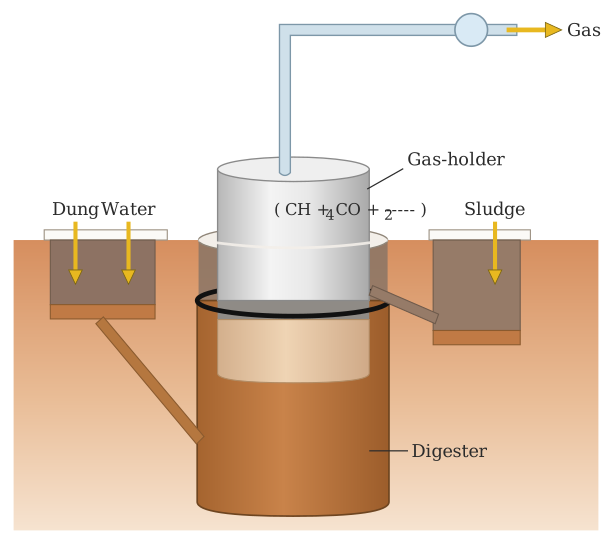
Plant design. The two most widely used biogas plant designs in India are the KVIC model and the IARI model. A typical plant fed with cattle dung consists of a digester, built from concrete bricks and cement or from steel, and partly buried in the ground, together with a cylindrical gas holder or gas tank positioned above it to collect the gas as it is produced. Raw material — cattle dung — is introduced through a side opening in the digester called the charge pit.
Drawn by us to help you understand the concept clearly, and verified to make sure it's accurate. For exams, practice from your textbook's own diagram.
What this figure shows. This figure is a cross-sectional diagram of a typical dome-type biogas plant, showing the charge pit through which a slurry of cattle dung and water is fed, the underground digester chamber where anaerobic bacteria break the slurry down in stages to produce biogas, the gas-holder dome above the digester that collects the mixture of methane and carbon dioxide produced, and the point from which spent sludge (later used as fertiliser) is periodically removed.
11.13: Fig. 11.13 — Biogas Plant. …
The three stages of anaerobic digestion. Inside the digester, anaerobic microbes convert the raw slurry into biogas through three linked biochemical stages. In hydrolysis (or solubilisation), the initial stage, cattle dung is first mixed with an equal proportion of water to form a slurry, which is then fed into the digester; here, anaerobic hydrolytic bacteria such as Clostridium and Pseudomonas break down complex carbohydrates into simple sugars, proteins into amino acids, and lipids into fatty acids. In acidogenesis, facultative anaerobic (acidogenic) bacteria together with obligate anaerobic organisms convert these simpler organic molecules further into acids such as formic acid and acetic acid, along with hydrogen and carbon dioxide gas. In methanogenesis, the final stage, strictly anaerobic methanogenic bacteria — Methanobacterium and Methanococcus among them — convert the acetate, hydrogen and carbon dioxide produced in the earlier stages into methane, carbon dioxide, water and other products; it is this final methanogenic step that actually generates the flammable methane gas that makes biogas useful as a fuel.
The book summarises methanogenesis in three reactions: 12 CH3COOH (acetic acid) -> 12 CH4 + 12 CO2; 4 HCOOH (formic acid) -> CH4 + 3 CO2 + 2 H2O; and CO2 + 4 H2 -> CH4 + 2 H2O. …