Biology · Ch 11 — Enhancement of Food Production
Tissue Culture
Tissue Culture
Plant tissue culture is not a single technique but a whole collection of related techniques, which together have grown into an important branch of plant biotechnology. In tissue culture, isolated cells, tissues or organs of a plant — collectively referred to as the explant — are grown 'in vitro' (literally, 'in glass', meaning outside the plant, in a lab vessel) on a solid or liquid nutrient medium, under strictly controlled aseptic conditions of light, humidity and temperature.
The entire technique rests on one core biological principle: totipotency, the inherent ability of a single living plant cell to grow, divide, redivide and ultimately give rise to a whole new plant, genetically identical to the plant it came from. This idea was first proposed by Gottlieb Haberlandt in 1902, who conceived the concept of in vitro cell culture and plant morphogenesis, well before the technology to actually achieve it existed.
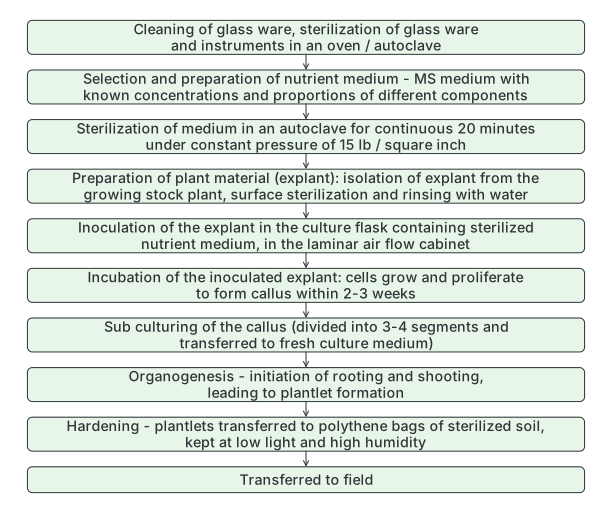
The culture medium and conditions. The nutrient medium used must supply everything the isolated explant would otherwise get from the whole plant: essential minerals, sources of carbohydrate, protein and fat, water, plant growth hormones, vitamins, and, for solid (callus) culture, agar as a gelling agent. The most commonly used medium worldwide is MS medium (Murashige and Skoog medium). Because the explant has no protective outer tissue and no immune system of its own, absolute sterility (asepsis) is essential to prevent contamination by unwanted micro-organisms: glassware is sterilised using detergents and a hot-air oven; the nutrient medium is sterilised in an autoclave under a constant pressure of about 15 lb per square inch for a continuous 20 minutes; the explant itself is surface-sterilised by treatment with 20% ethyl alcohol and 0.1% mercuric chloride; and the inoculation chamber (a laminar-air-flow cabinet) is sterilised by running a UV lamp for about an hour before the explant is actually inoculated onto the medium. Other conditions are also carefully controlled: temperature is kept around 18–20°C, the medium's pH is kept around 5 to 5.8, and, for suspension cultures particularly, continuous aeration is maintained.
Tissue culture can be classified in two independent ways. Based on the type of explant used, there is cell culture, organ culture and embryo culture. Based on the physical state of the growth medium, there is callus culture, on a solid medium, and suspension culture, in a liquid medium.
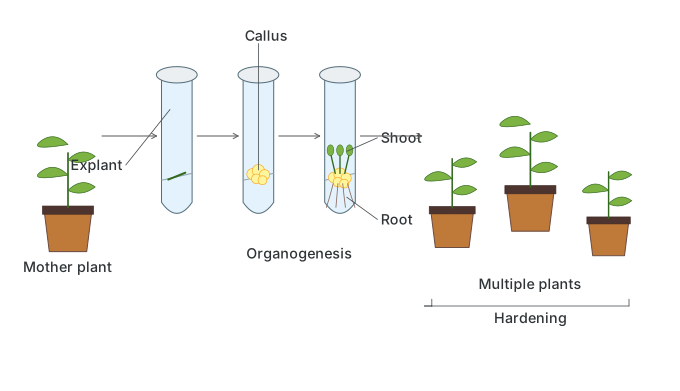
Callus culture. On a solid medium, the explant's cells lose their original tissue organisation and instead divide and redivide repeatedly to form an undifferentiated mass of cells called a callus, which is maintained on the solid medium without needing any shaking or agitation. This callus can then be induced to organise itself into organs — first roots (rhizogenesis) and then shoots (caulogenesis) — a process called organogenesis, ultimately producing a complete new plantlet.
Drawn by us to help you understand the concept clearly, and verified to make sure it's accurate. For exams, practice from your textbook's own diagram.
What this figure shows. This diagram illustrates the sequence of stages in raising a new plant from a single explant using the callus-culture route of plant tissue culture. It begins with a healthy mother plant from which a small explant is excised, which is then placed on nutrient medium where it proliferates into an undifferentiated mass of cells called callus. The callus is induced to undergo organogenesis, first forming shoots and then roots, giving rise to a small plantlet. The final stage shown is hardening, in which the delicate lab-raised plantlets are gradually acclimatised to normal soil and outdoor humidity and light conditions before …
Suspension culture. Here, small groups of cells or even single cells are grown directly in liquid medium, which is kept in constant motion by shakers (agitators) so that the medium and the suspended cells mix continuously.
Both callus and suspension cultures eventually die out if they are simply left as they are, since the medium's nutrients are used up and metabolic waste products build up; this is why regular sub-culturing — transferring a portion of the culture onto fresh medium — is essential to keep any given culture line alive and growing indefinitely. …
Drawn by us to help you understand the concept clearly, and verified to make sure it's accurate. For exams, practice from your textbook's own diagram.
What this figure shows. This flow chart lays out the entire practical tissue-culture protocol as a sequence of steps: cleaning and sterilising glassware and instruments in an oven or autoclave, preparing the nutrient medium (typically MS medium) in the correct proportions, sterilising that medium in an autoclave under constant pressure for a fixed time, preparing the explant by isolating it from a growing stock plant and surface-sterilising and rinsing it, inoculating the explant into the sterile medium inside a laminar-air-flow cabinet, incubating it so the explant cells proliferate into callus over roughly two to three weeks, sub-culturing the callus onto fresh medium if it needs to be maintained for longer, inducing organogenesis (rooting and shooting) to form a plantlet, hardening the plantlet in humid, low-light conditions inside polythene …