Biology · Ch 11 — Enhancement of Food Production
Role of Microbes as Biofertilizers
Role of Microbes as Biofertilizers
Fertilizers are the nutrients required for plant growth, and by extension for the productivity of any cultivated crop; using them effectively is one of the central pillars of the Green Revolution's success. Fertilizers fall into two broad categories: inorganic (chemical) fertilizers, which are synthetic mixtures of mineral NPK (nitrogen, phosphorus, potassium) salts blended in defined proportions and applied to the field, and organic (biological) fertilizers — farmyard manure (FYM), compost and green manure — which are biological in origin. Non-judicious or excessive use of chemical fertilizers is a real hazard: it pollutes soil, air and groundwater, and it makes the soil progressively more acidic, whereas the organic alternatives generally build up soil fertility more gently and sustainably.
Biofertilizers are a further, specifically microbial category, increasingly used by farmers alongside organic farming practices for more sustainable agricultural production: they are commercial, ready-to-use preparations of living bacterial or fungal cultures — mostly, though not exclusively, nitrogen-fixing organisms drawn from bacteria, cyanobacteria and fungi — that, when applied to plants, soil or composting pits, enrich the soil's nutrient quality through their own biological activity. Compared with chemical fertilizers, biofertilizers are cost-effective and eco-friendly, and they play a genuinely important role in maintaining soil fertility and agricultural sustainability over the long term.
Classification by function. On the basis of what they actually do, biofertilizers are grouped into four types.
- Nitrogen-fixing biofertilizers: microorganisms, called diazotrophs, that convert atmospheric nitrogen gas into usable nitrogenous compounds (nitrites and nitrates) via ammonia. These are of two kinds — symbiotic nitrogen-fixers, such as Rhizobium, Anabaena and Frankia, which are generally associated with the underground root systems of higher plants; and free-living or non-symbiotic nitrogen-fixers, such as Azotobacter, Azospirillum, Nostoc, Clostridium, Beijerinkia and Klebsiella, which fix nitrogen independently in the soil without needing to live inside a plant.
- Phosphate-solubilising biofertilizers: bacterial species — Pseudomonas striata, Bacillus polymyxa, Agrobacterium, Micrococcus and Aspergillus species among them — that convert insoluble inorganic phosphate compounds, such as rock phosphate, into forms plants can actually absorb.
- Compost-making biofertilizers: composting is the natural process that turns organic material into a dark, nutrient-rich substance called compost or humus, and it depends on a whole community of micro-organisms — bacteria, fungi, actinobacteria, protozoa and rotifers — to break down the raw organic matter into finished compost.
- Cyanobacterial biofertilizers: many cyanobacteria (blue-green algae) — Anabaena, Nostoc, Plectonema and Oscillatoria among them — are aquatic or terrestrial, free-living or symbiotic, aerobic, photosynthetic, and capable of fixing nitrogen, whether they are heterocystous or non-heterocystous forms. Anabaena, Nostoc and Tolypothrix are associated with lichens, and Anabaena additionally forms a specific symbiosis with plants such as Azolla and Cycas.
Do you know?
Classification of biofertilizers. On a different axis, biofertilizers are also classified by the broad group of organism involved, as bacterial fertilizers (which include both eubacteria and cyanobacteria, and are further sub-divided by function into nitrogen-fixing, phosphate-solubilising and compost-making types — cyanobacterial fertilizers specifically fall under the nitrogen-fixing function) and fungal fertilizers, which essentially means mycorrhizal fungi, sub-divided by function into ectomycorrhizae and endomycorrhizae.
Key biofertilizer organisms, in detail. Rhizobium species are rod-shaped, motile, aerobic, gram-negative, non-spore-forming, nitrogen-fixing bacteria that carry Nod genes and Nif genes; they form a symbiotic association specifically with the roots of leguminous plants, inducing the formation of root nodules, multiplying inside them, and fixing atmospheric nitrogen there into organic forms the plant can use as a nutrient — R. leguminosarum is specific to pea, and R. phaseoli is specific to beans, illustrating that different Rhizobium strains are matched to different legume hosts. Azotobacter is a well-known free-living, aerobic, non-photosynthetic, non-nodule-forming nitrogen-fixing bacterium closely associated with the roots of grasses and certain other plants; it is used as a biofertilizer for non-leguminous plants, especially rice, cotton and vegetables. Azospirillum is likewise a free-living, aerobic, nitrogen-fixing bacterium, associated instead with the roots of corn, wheat and jowar; it fixes a genuinely substantial quantity of nitrogen — roughly 20 to 40 kg per hectare — in non-leguminous plants such as cereals, millets, cotton and oilseed crops. Anabaena is a genus of multicellular, filamentous cyanobacteria that also exists as free-floating plankton; besides fixing nitrogen on its own, it forms symbiotic relationships with certain plants, notably the coralloid roots of Cycas and the thallus of Anthoceros. Nitrogen fixation in Anabaena takes place inside specialised, colourless cells called heterocysts. Azolla is a free-floating water fern, consisting of a floating rhizome (stem) bearing small, overlapping, bilobed leaves and trailing roots; each leaf shows a dorsal and a ventral lobe, and within the dorsal lobe's internal cavity, filaments of Anabaena live and fix nitrogen, in what is effectively a permanent plant–cyanobacterium partnership. Because of this, Azolla itself can be used directly as a biofertilizer in rice fields, where it grows on the flooded paddy water and its fixed nitrogen becomes available to the crop.
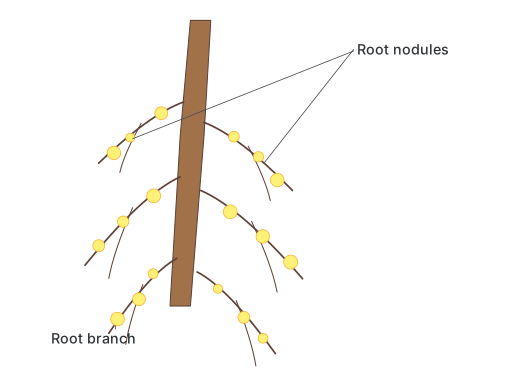
Drawn by us to help you understand the concept clearly, and verified to make sure it's accurate. For exams, practice from your textbook's own diagram.
What this figure shows. This figure shows the root system of a typical leguminous plant such as a pulse or bean, highlighting the small swollen root nodules that stud its finer root branches. These nodules are the visible external sign of the symbiotic relationship between the plant and nitrogen-fixing Rhizobium bacteria living inside …
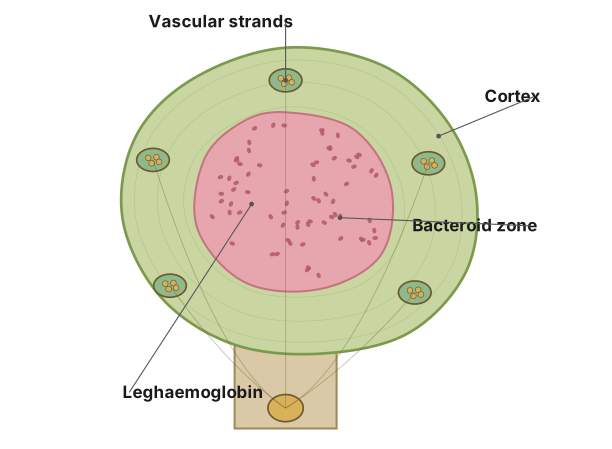
Drawn by us to help you understand the concept clearly, and verified to make sure it's accurate. For exams, practice from your textbook's own diagram.
What this figure shows. This figure is a transverse section through a single root nodule, showing its internal organisation — the outer nodule tissue continuous with the root's own xylem and phloem, and the central zone of cortical cells packed with colonies of nitrogen-fixing bacteria, which is the actual site where atmospheric nitrogen is converted into a form the plant can use.
11.16: Fig. 11.16 — T.S. of Root Nodule. …
Use your brain power
Why are healthy root nodules pink in colour?
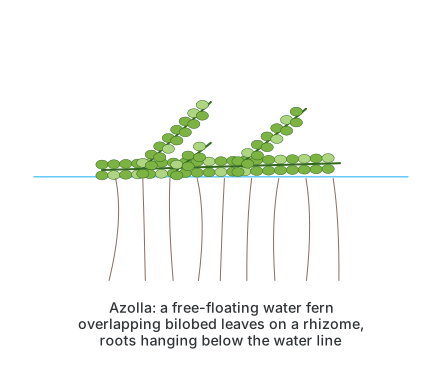
Drawn by us to help you understand the concept clearly, and verified to make sure it's accurate. For exams, practice from your textbook's own diagram.
What this figure shows. This figure shows the free-floating water fern Azolla as a whole plant, with its floating, branched rhizome bearing small overlapping bilobed leaves and its roots hanging down into the water, illustrating the general growth habit of this fern, which is deliberately grown in rice fields as …
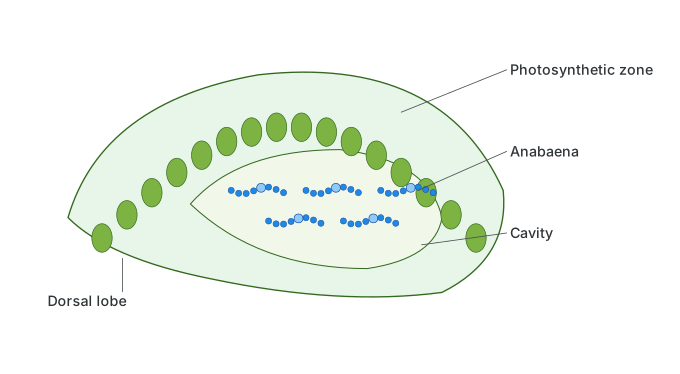
Drawn by us to help you understand the concept clearly, and verified to make sure it's accurate. For exams, practice from your textbook's own diagram.
What this figure shows. This figure is a longitudinal section through a single bilobed leaf of Azolla, showing the dorsal lobe with its internal, air-filled cavity and photosynthetic zone in which filaments of the cyanobacterium Anabaena live symbiotically; it is inside this cavity that Anabaena fixes atmospheric nitrogen, which the fern then makes use of, and this partnership is what makes Azolla valuable as a natural biofertilizer in paddy …
…