Biology · Ch 11 — Enhancement of Food Production
Role of Microbes in Industrial Production
Role of Microbes in Industrial Production
Beyond the microbes used directly in food preparation, an enormous range of commercially important products — alcoholic beverages, organic acids, vitamins, growth hormones, enzymes and antibiotics — are manufactured industrially through microbial fermentation. Producing any of these on a commercial scale requires growing the chosen microorganism, or a defined mixture of microorganisms, inside a large vessel called a fermenter, whose main job is to provide a carefully controlled environment (temperature, aeration, nutrient supply) in which the microbe can grow and manufacture the desired product efficiently.
a. Production of alcoholic beverages. A beverage, alcoholic or otherwise, is any liquid prepared and consumed for drinking, and includes familiar examples such as tea, coffee, beer and wine, several of which act as mild stimulants. Alcoholic beverages specifically are the products of alcoholic fermentation carried out on specific substrates, a practice known in India since Vedic times, roughly 5000 to 7000 BC. Yeasts, especially Saccharomyces cerevisiae var. ellipsoidis (commonly called brewer's yeast), have been used since time immemorial to ferment malted cereals and fruit juices into ethanol, producing beverages such as wine, beer, whiskey, brandy and rum. Wine and beer are produced without any further distillation, whereas whiskey, brandy and rum are distilled beverages, made stronger by distilling the fermented product. Large-scale industrial alcohol production uses a tubular tower fermenter. Yeast fermentation also underlies several traditional Indian and regional drinks: a coastal South Indian drink is made by fermenting the sugary sap tapped from palm and coconut palm trees, and Goa's traditional wine, known as 'fenny', is made by fermenting the fleshy pedicels of the cashew fruit.
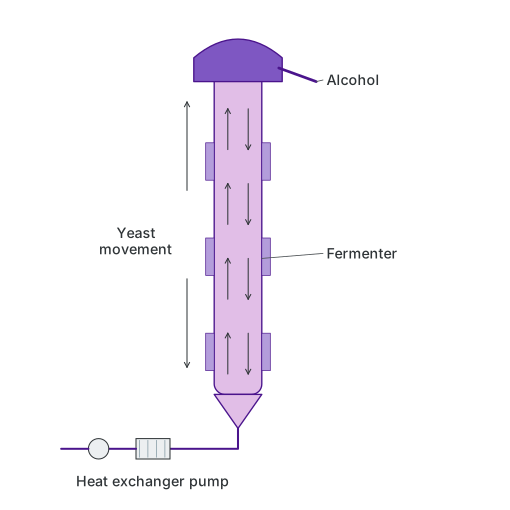
Drawn by us to help you understand the concept clearly, and verified to make sure it's accurate. For exams, practice from your textbook's own diagram.
What this figure shows. This figure is a schematic of a tubular tower fermenter of the type used for large-scale industrial production of alcohol, showing the tall fermenter vessel in which yeast is kept in constant circulating movement as it ferments the substrate, a heat-exchanger pump that removes the heat generated during fermentation to keep the temperature suitable for the yeast, and the outlet through which the al …
Activity
Label the different parts of the fermenter and mention the functions of each part.
b. Production of organic acids. Microbes are also used industrially to manufacture specific organic acids, either directly from glucose (as with gluconic acid) or as end products formed from intermediates like pyruvate or ethanol. Citric acid and gluconic acid are both produced using Aspergillus niger; fumaric acid is produced using Rhizopus arrhizus; and acetic acid (vinegar) is produced using Acetobacter aceti. These acids go on to serve quite different downstream purposes — citric acid is used in confectionery, fumaric acid is used as a wetting agent in resins, and gluconic acid is used medicinally to help keep calcium ions in solution.
c. Production of vitamins. Vitamins are complex, nitrogen-containing organic compounds needed by the body in small amounts to carry out a wide range of life-sustaining functions; because the human body cannot synthesise most of them (vitamin D being the one exception), they must be supplied through the diet. Microbes are capable of synthesising many vitamins and are therefore used for their commercial manufacture — thiamine, riboflavin, pyridoxine, folic acid, pantothenic acid, biotin, vitamin B12, ascorbic acid (vitamin C), beta-carotene (pro-vitamin A) and ergosterol (pro-vitamin D) are all named. Specific pairings given are vitamin B2, made using either Neurospora gossypii or Eremothecium ashbyi; vitamin B12, made using Pseudomonas denitrificans; and vitamin C, made using Aspergillus niger.
Can you recall?
- What are antibiotics?
- Who invented the first antibiotic?
d. Production of antibiotics. Antibiotics are probably the single most important group of compounds manufactured by industrial microorganisms, and most of them are secondary metabolites — compounds produced by the microbe in small amounts, mainly during a later growth phase, that are not required for the microbe's own growth but happen to inhibit the growth of other, competing microbial pathogens. Because of this inhibitory action, antibiotics have great therapeutic value and are central to medical treatment; they are broadly antibacterial or antifungal in their action, and have dramatically improved humanity's capacity to treat once-deadly diseases such as plague, whooping cough, diphtheria and leprosy. Well-documented antibiotic-microbe pairings include chloromycetin from Streptomyces venezuelae, erythromycin from Streptomyces erythreus, penicillin from Penicillium chrysogenum, streptomycin from Streptomyces griseus, griseofulvin from Penicillium griseofulvum, bacitracin from Bacillus licheniformis, and oxytetracycline (also called terramycin) from Streptomyces aurifaciens.
| Antibiotic | Producing microorganism |
|---|---|
| Chloromycetin | Streptomyces venezuelae |
| Erythromycin | Streptomyces erythreus |
| Penicillin | Penicillium chrysogenum |
| Streptomycin | Streptomyces griseus |
| Griseofulvin | Penicillium griseofulvum |
| Bacitracin | Bacillus licheniformis |
Do you know?
Antibiotics are actually secondary metabolites, produced during the idiophase (the later, stationary phase of growth) and not required by the micro-organism for its own growth. The type of substrate and the type of micro-organism together decide which secondary metabolite is produced.
Use your brain power
Can antibiotics kill viruses? …