Biology · Ch 11 — Enhancement of Food Production
Microbes in Sewage Treatment
Microbes in Sewage Treatment
Sewage is the general term for waste matter carried off through drainage systems — a municipal waste stream that includes human excreta, household waste, dissolved organic matter, and a genuinely wide range of pathogenic microbes (bacteria, viruses, protozoans, nematodes and microfungi). It is further swollen by discharge from hospitals and slaughterhouses, by animal dung, and by industrial waste — which itself can carry toxic dissolved organic and inorganic chemicals from sources such as textile mills, chemical plants, pharmaceutical manufacturing, dairies, canning and brewing operations, meat-packing plants, tanneries and oil refineries.
Composition. Despite carrying this wide mix of contaminants, sewage is, by mass, overwhelmingly water — roughly 99.5% to 99.9% — with only about 0.1% to 0.5% made up of suspended and dissolved inorganic and organic matter. The exact composition varies considerably depending on which industries and sources are contributing to it in a given area.
Micro-organisms present. Sewage carries a wide range of micro-organisms — bacteria, viruses, fungi, protozoa, algae and nematodes — whose exact numbers and types fluctuate with the composition and source of the waste. Raw sewage can contain millions of bacteria per millilitre, including coliform bacteria, faecal streptococci, and anaerobic spore-forming bacilli, most of which originate in the human intestinal tract; because several of these organisms and their relatives cause serious disease — dysentery, cholera, typhoid, polio and infectious hepatitis are all named as possible agents present in sewage — waste water absolutely must be treated before it is released into the environment or made available for reuse.
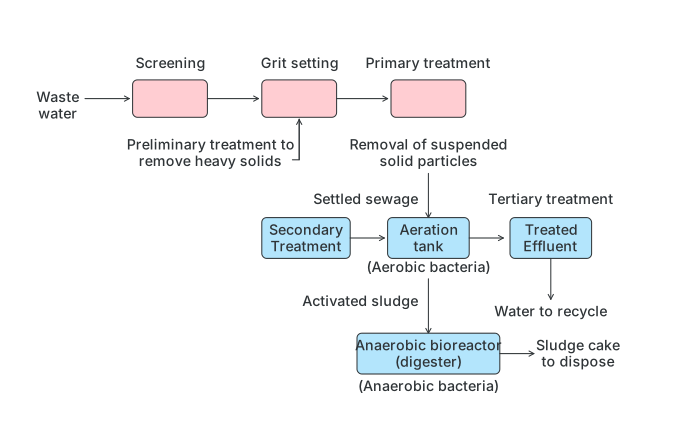
The four stages of sewage treatment.
- Preliminary treatment, consisting of screening and grit removal. Screening passes the incoming sewage through screens or nets in dedicated screening chambers, which physically trap larger suspended and floating objects — these must be removed before the water reaches biological treatment. The grit chamber, positioned after screening, contains large stones and brick ballast; as the filtered sewage passes through, coarse particulate matter (grit) settles out under gravity.
- Primary treatment (physical treatment). The screened, grit-free sewage is pumped into a primary sedimentation tank, where suspended solids and organic matter settle out under gravity — roughly 50–70% of the solids settle here, and coliform bacterial numbers fall by roughly 30–40% simply through this settling. The settled organic material is called primary sludge and is removed mechanically. The remaining supernatant (the primary effluent) still contains large amounts of dissolved organic matter and micro-organisms, and needs further, biological treatment.
- Secondary treatment (biological treatment). The primary effluent is passed into large aeration tanks, where it is continuously and mechanically agitated while air is pumped in. Under these aerobic conditions, aerobic bacteria grow vigorously and form flocs — loose, mesh-like masses of bacteria held together by slime and fungal hyphae — and as these bacteria grow they consume the bulk of the remaining organic matter in the effluent. Because this organic matter is what drives up the effluent's Biochemical Oxygen Demand (BOD, a measure of how much oxygen microbes would use up breaking it down), removing it here significantly lowers the BOD of the water.
- Tertiary treatment. Once BOD has been substantially reduced, the water is passed into a settling tank, where the bacterial flocs are allowed to settle out as what is now called activated sludge. A small portion of this activated sludge is recycled back into the aeration tank (to keep it seeded with active bacteria for the next batch of incoming effluent), while the larger remaining portion is pumped into large anaerobic sludge digesters. Here, anaerobic bacteria digest the bacteria and fungi present in the sludge, and this anaerobic digestion releases gases such as methane, hydrogen sulphide and carbon dioxide. The liquid effluent coming out of the digester is chlorinated, which kills remaining pathogenic bacteria, before being released into natural water bodies such as rivers and streams; the solid material left over, the digested sludge, is disposed of separately.
Drawn by us to help you understand the concept clearly, and verified to make sure it's accurate. For exams, practice from your textbook's own diagram.
What this figure shows. This flow diagram shows the full path of municipal wastewater through a treatment plant: preliminary treatment (screening to remove large floating debris and grit settling to remove coarse particles), primary treatment where suspended solids settle out as sludge, secondary/biological treatment in an aeration tank where aerobic bacteria form flocs and consume the dissolved organic matter, lowering the BOD, and tertiary treatment where the resulting sludge settles as activated sludge, part of which is recycled to the aeration tank while the rest passes into an anaerobic bioreactor/digester; the diagram also shows the two end products of the whole process — treated effluent, some of which can be recycled, and a sludge cake left over from …
…