Biology · Ch 4 — Molecular Basis of Inheritance
DNA Fingerprinting
DNA Fingerprinting
Genes present on chromosomes determine the characters of an organism and their inheritance. Because of the recombination of paternal and maternal genes we differ from our parents, and differences also arise from the infrequent mutations that occur during gamete formation (cell division). Every individual therefore has a unique genetic make-up, which may be called its fingerprint. The technique developed to identify a person with the help of DNA restriction analysis is known as DNA profiling or DNA fingerprinting; it was first given by the British geneticist Dr. Alec Jeffreys in 1984.
DNA fingerprinting is based on the identification of the nucleotide sequences in this wonder molecule. About 99.9% of the nucleotide sequence is the same in all persons; only some short sequences differ from person to person. Every person shows unusual sequences of 20-100 base pairs repeated several times, termed Variable Number of Tandem Repeats (VNTRs). The length of the VNTR regions differs in each individual and is the key factor in DNA profiling. The steps involved are:
- Isolation of DNA: DNA is recovered from the cells or tissues of the body (host); only a small amount of tissue such as blood, hair roots or skin is required.
- Restriction digestion: the isolated DNA is treated with restriction enzymes, which cut it into small fragments of variable length - a phenomenon called Restriction Fragment Length Polymorphism (RFLP).
- Gel electrophoresis: the DNA samples are loaded on an agarose gel under an electric field; the negatively charged fragments move to the positive pole at a rate that depends on their length, forming bands. The dsDNA is split into ssDNA by alkali treatment.
- Southern blotting: a technique for detecting a specific DNA sequence, developed by E. Southern. The separated fragments are transferred to a nylon membrane or nitrocellulose filter paper placed over the gel and soaked with filter paper overnight.
- Selection of DNA probe: a known sequence of single-stranded DNA, the DNA probe, obtained from organisms or prepared by the cDNA method and labelled with radioactive isotopes.
- Hybridization: the probe is added to the nitrocellulose filter carrying the host DNA; the single-stranded probe pairs with the complementary base sequence of the host DNA, forming DNA-DNA hybrids on the filter, and the remaining probe fragments are washed off.
- Photography: the filter is photographed on X-ray film by autoradiography and the film is analysed for the presence of hybrid DNA.
Know the scientists : Dr. Lalji Singh (1947 - 2017)
Father of DNA fingerprinting in India. He was instrumental in making DNA fingerprinting mainstream in India for research and forensic applications. He obtained a DNA probe from the Y chromosome of the female banded krait snake (in this snake the female is XY and the male YY); the unique segment obtained, banded krait minor (BKM-DNA), was used to develop the probe for the indigenous DNA fingerprinting technique.
…
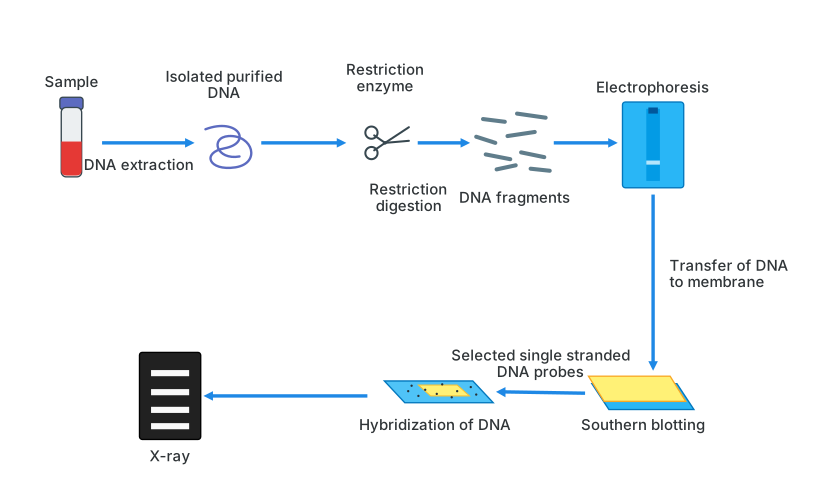
Drawn by us to help you understand the concept clearly, and verified to make sure it's accurate. For exams, practice from your textbook's own diagram.
What this figure shows. A flowchart of the DNA fingerprinting procedure: a biological sample is used to extract and purify DNA, which is cut with restriction enzymes (restriction digestion) into fragments; the fragments are separated by size using gel electrophoresis; the separated fragments are transferred from the gel onto a membrane by Southern blotting; a labelled single-stranded DNA probe is then hybridised to complementary fragments on the membrane; and finally the membrane is exposed to X-ray film (auto …