Biology · Ch 3 — Inheritance and Variation
Chromosomes and Mechanism of Inheritance
Chromosomes and Mechanism of Inheritance
Can you recall?
- Is there a similarity between the parents and offsprings?
- What are the roles of chromosomes in living organisms?
- How are hybrid seeds produced?
- Which are the chromosomal disorders?
Heredity is the process by which parents pass genetic information to their offspring, generation after generation. Remarkably, the basic rules governing this transmission were worked out well before anyone had actually seen a chromosome or knew what a gene physically was. That breakthrough came from Gregor Mendel, a peasant farmer's son born in Moravia in 1822, who used the technique of hybridisation — deliberately crossing plants that differed in specific traits — to arrive at an accurate explanation of how inheritance works.
Mendel worked with the garden pea (Pisum sativum) and focused on seven easily distinguishable traits: seed shape (round/wrinkled), seed colour (yellow/green), pod shape (inflated/constricted), pod colour (green/yellow), flower colour (purple/white), flower position (axial/terminal) and plant height (tall/short). He studied these traits one at a time, then in combinations of two or three, and — crucially — he counted his results and expressed them as ratios rather than just describing them qualitatively.
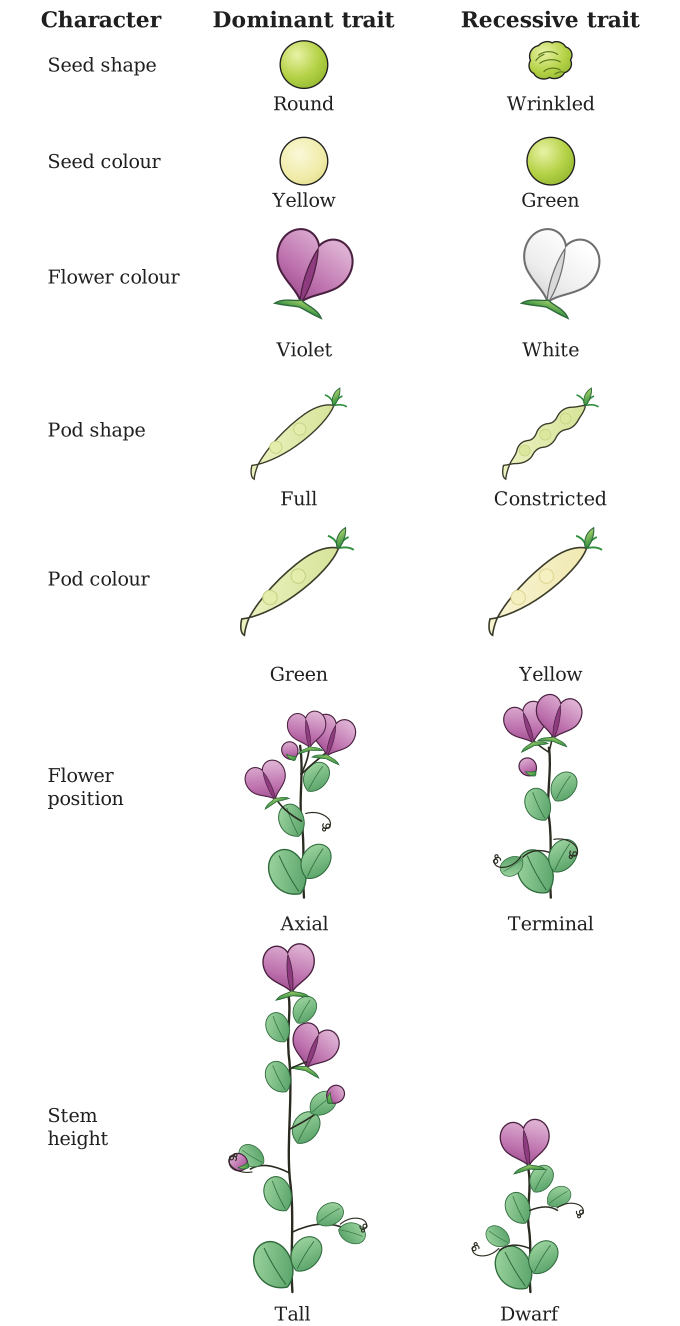
Do you know? Seven pairs of contrasting visible characters in the pea plant, dominant form first: seed shape round / wrinkled; seed colour yellow / green; pod shape inflated / constricted; pod colour green / yellow; flower colour purple / white; flower location axial / terminal; plant height tall / short (dwarf).
From this data Mendel proposed that traits are not passed on as a physical blend of parental material but through discrete 'factors' contributed by each parent's gametes. These factors occur in pairs in the parent and separate cleanly from one another during gamete formation, without mixing — a radical idea for his time, later confirmed and named by Correns in 1900 when Mendel's factors were renamed genes. Reasons for Mendel's Success :
- His experiments were carefully planned and used large samples.
- He carefully recorded the number of plants of each type and expressed his results as ratios.
- In the pea plant the contrasting characters are easily recognised.
- Each of the seven characters he chose is controlled by a single factor, and these factors lie on separate chromosomes and are transmitted from generation to generation.
- He introduced the concepts of dominance and recessiveness.
Before learning about Mendel's experiments, let us get acquainted with the genetic terms and symbols used in this chapter. (The MSBSHSE syllabus for this chapter runs parallel to the NCERT/CBSE Class 12 chapter on the principles of inheritance and variation, so the same vocabulary serves both.)