Biology · Ch 4 — Molecular Basis of Inheritance
The Genetic Material is DNA
The Genetic Material is DNA
By the early 1900s geneticists knew that genes control inherited traits, that genes sit on chromosomes, and that chromosomes are made mainly of DNA and protein -- but most researchers initially assumed protein, being large, chemically varied and complex, was the genetic material, while DNA was wrongly thought to be a small, simple, monotonous molecule. Over about 25 years (1928-1952), three landmark experiments overturned this view.
Griffith's experiments : In 1928 the British medical officer Frederick Griffith experimented on Streptococcus pneumoniae, the bacterium that causes pneumonia in humans and other mammals, using two strains (genetic varieties) while looking for a cure for pneumonia, then a common cause of death:
i. the virulent, smooth, pathogenic and encapsulated S type;
ii. the non-virulent, rough, non-pathogenic and non-capsulated R type.
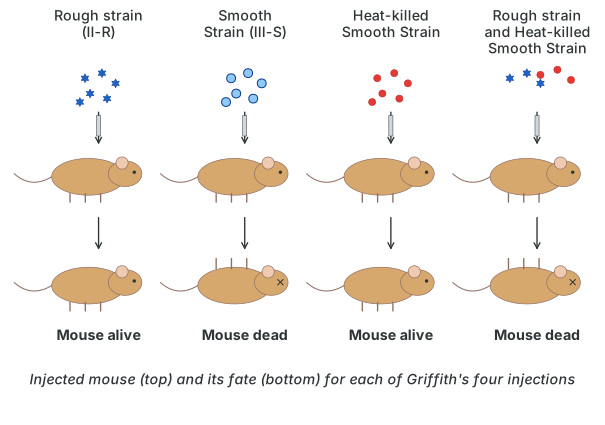
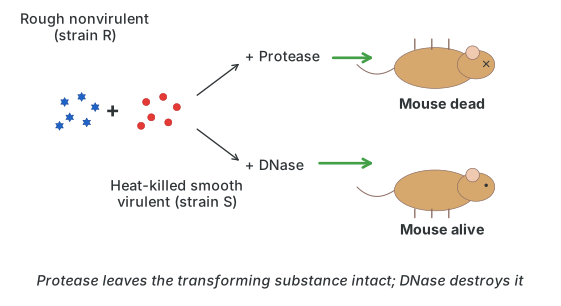
Griffith conducted four experiments on these bacteria. Live R bacteria left mice healthy; live S bacteria killed them; heat-killed S bacteria alone were harmless; but a mixture of heat-killed S bacteria with live R bacteria killed the mice, and live S bacteria could be recovered from their blood. Griffith concluded that some 'transforming principle' had passed from the dead S cells into the living R cells and permanently converted them into the virulent form. Treating the mixture with protein-digesting or RNA-digesting enzymes did not stop this transformation, but treating it with a DNA-digesting enzyme (DNase) did -- pointing to DNA as the transforming substance, though this alone did not convince every biologist.
Drawn by us to help you understand the concept clearly, and verified to make sure it's accurate. For exams, practice from your textbook's own diagram.
What this figure shows. A four-panel schematic of Griffith's 1928 mouse experiments with Streptococcus pneumoniae. It shows a mouse surviving after injection with live rough (R) non-virulent bacteria, a mouse dying after injection with live smooth (S) virulent bacteria, a mouse surviving after injection with heat-killed S bacteria alone, and a mouse dying after injection with a mixture of heat-killed S bacteria plus live R bacteria -- the result that revealed a heritable 'transforming principle' …
Drawn by us to help you understand the concept clearly, and verified to make sure it's accurate. For exams, practice from your textbook's own diagram.
What this figure shows. A diagram summarising the follow-up transformation test: heat-killed smooth (S, virulent) bacteria are mixed with live rough (R, non-virulent) bacteria and treated either with the DNA-digesting enzyme DNase or with the protein-digesting enzyme protease before injection into mice. When DNase is added the mixture fails to transform R into S and the mouse survives; when protease is added instead, transformation still occurs and the mouse dies -- showing t …
Avery, McCarty and MacLeod's experiment: In 1944, after some ten years of research, the U.S. microbiologists Oswald T. Avery, Colin M. MacLeod and Maclyn McCarty (all at the Rockefeller University, New York) gave the first experimental evidence that DNA is the genetic material (the transforming principle): they purified DNA, RNA, and protein separately from heat-killed S-strain cells and tested each against live R-strain bacteria. Only the purified DNA fraction was able to transform harmless R bacteria into virulent S bacteria, directly identifying DNA as Griffith's transforming principle. …
Drawn by us to help you understand the concept clearly, and verified to make sure it's accurate. For exams, practice from your textbook's own diagram.
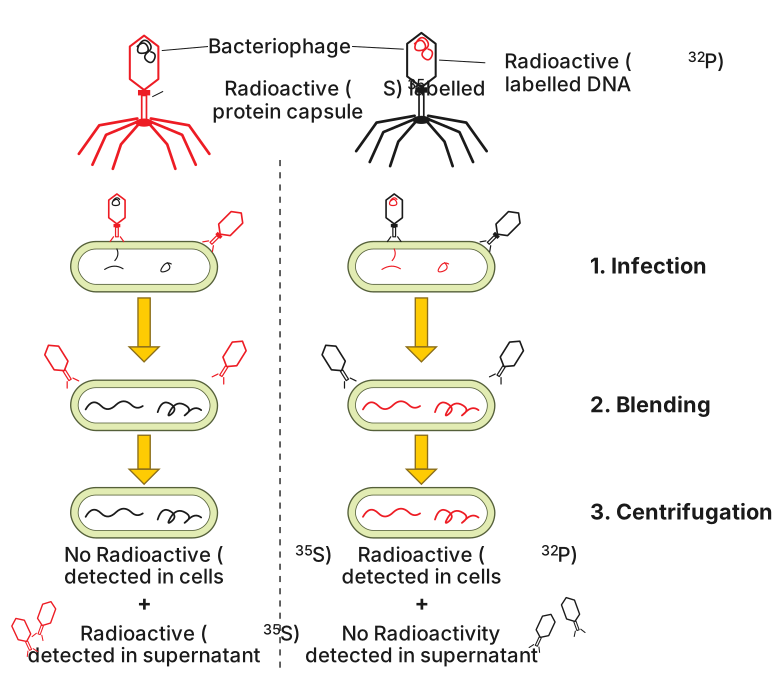
What this figure shows. A flow diagram of the 1952 blender experiment: bacteriophages are grown with either radioactive phosphorus-32 (labelling their DNA core) or radioactive sulphur-35 (labelling their protein coat). After the labelled phages infect E. coli, the mixture is agitated in a blender to shear off the empty viral coats and then centrifuged to separate the heavier bacterial cells (pellet) from the lighter coat material (supernatant). The panel shows that 32P-labelled DNA is recovered inside the bacterial cells while 35S-labelled protein stays in the supernatant, …