Biology · Ch 4 — Molecular Basis of Inheritance
Operon Concept
Operon Concept
The operon is a transcriptional control mechanism of gene regulation. Francois Jacob and Jacques Monod (1961) explained that metabolic pathways are regulated as a unit. For example, when lactose is provided in the culture medium of E. coli, the cell induces the production of three enzymes necessary for the digestion of lactose:
i. beta-galactosidase: digests lactose into galactose and glucose.
ii. beta-galactoside permease: permits lactose molecules to enter the cell.
iii. Transacetylase (beta-galactoside acetyltransferase): transfers an acetyl group from acetyl Co-A to galactoside.
The synthesis of these three enzymes is controlled by a long segment of DNA known as the operon. It consists of an operator site O and three structural genes z, y and a; the action of the structural genes is regulated by the operator with the help of a repressor protein, produced by the gene i (inhibitor), known as the regulator gene. Gene expression depends on whether the operator is switched on or off: if it is on, the genes z, y and a are transcribed by RNA polymerase into a single mRNA. Each structural gene is known as a cistron, and the long mRNA covering several cistrons is polycistronic. Switching the operator on or off is accomplished by the repressor protein: when it attaches to the operator and blocks it, the switch is off and the structural genes are not expressed.
Lac operon : The lactose (lac) operon of E. coli is an inducible operon: it is switched on when the chemical inducer, lactose, is present in the medium. It consists of the following components: 1. regulator gene (repressor gene), 2. promoter gene, 3. operator gene, 4. structural genes, and 5. the inducer, which is not a component of the operon.
- Regulator gene : controls the operator gene in cooperation with the inducer present in the cytoplasm. It precedes the promoter gene and need not lie immediately adjacent to the operator. It produces the repressor protein, which binds to the operator gene and represses (stops) its action; it is also called the regulator protein.
- Promoter gene : precedes and lies adjacent to the operator gene. It marks the site at which RNA polymerase binds; when the operator is turned on the enzyme moves over the operator and transcription of the structural genes starts. The promoter's base sequence determines which strand of DNA acts as the template.
- Operator gene : precedes and lies adjacent to the structural genes, and controls their functioning. When it is turned on by the inducer the structural genes produce mRNA; it is turned off by the product of the repressor gene.
- Structural gene : when lactose is added to the E. coli culture the structural genes produce mRNA, which in turn produces polypeptides on the ribosomes; these act as the enzymes that catabolise lactose in the cell. There are three structural genes in the sequence lac-z (1), lac-y (2) and lac-a (3), producing beta-galactosidase, beta-galactoside permease and transacetylase respectively.
- Inducer : a chemical in the cytoplasm (allolactose) that inactivates the repressor. When the lac operon is switched on, the inducer joins the repressor protein and prevents it from binding to the operator; the operator is free, and RNA polymerase can move from the promoter to the structural genes via the operator. …
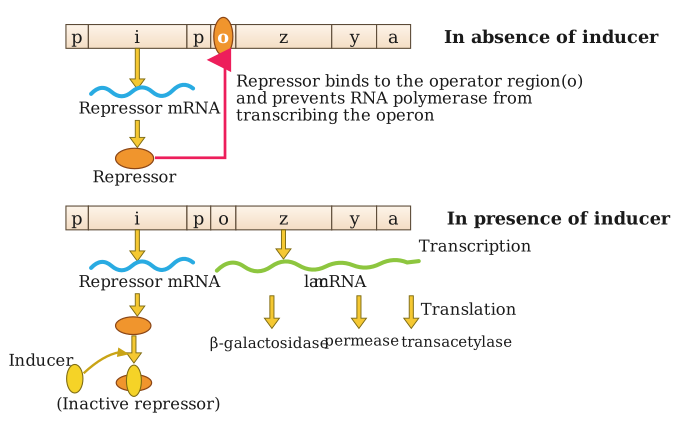
Drawn by us to help you understand the concept clearly, and verified to make sure it's accurate. For exams, practice from your textbook's own diagram.
What this figure shows. A two-panel diagram comparing the lac operon in the absence and presence of inducer. In the 'inducer absent' panel, the regulatory gene's repressor protein is shown bound to the operator, physically blocking RNA polymerase so the structural genes are not transcribed and no mRNA or enzymes are made. In the 'inducer present' panel, allolactose is shown binding the repressor and inactivating it, freeing the operator so RNA polymerase can move from the promoter across the operator into the structural genes, producing a polycistroni …