Biology · Ch 4 — Molecular Basis of Inheritance
DNA Replication
DNA Replication
The DNA molecule regulates and controls all the activities of the cell; because of its unique structure it controls the synthesis of the cell's other molecules, and when the cell reproduces the DNA must duplicate itself so that it is distributed equally to the daughter cells. As the carrier of genetic information, DNA performs two important functions:
a. Heterocatalytic function : when DNA directs the synthesis of molecules other than itself, e.g. the synthesis of RNA (transcription) and of protein (translation).
b. Autocatalytic function : when DNA directs the synthesis of DNA itself, e.g. replication.
The process by which DNA duplicates itself is called replication; it forms two copies identical to each other and to the parent DNA. In eukaryotes replication takes place only once per cell cycle, in the S-phase of interphase. DNA replicates by the semiconservative mode, a model proposed by Watson and Crick on the basis of the antiparallel and complementary nature of the two strands. The steps are:
1. Activation of Nucleotides: The four deoxyribonucleotides present in the nucleoplasm (dAMP, dGMP, dCMP and dTMP) are activated by ATP in the presence of the enzyme phosphorylase, forming the deoxyribonucleotide triphosphates dATP, dGTP, dCTP and dTTP. The process is called phosphorylation.
2. Point of Origin or Initiation point: Replication begins at a specific point 'O' (origin) and terminates at a point 'T'; the origin is flanked by 'T' sites. The unit of DNA in which replication occurs is called a replicon. Prokaryotes have only one replicon; eukaryotes have several replicons in tandem. At the point 'O' the enzyme endonuclease temporarily nicks one strand of the DNA in its sugar-phosphate backbone (a phosphodiester bond).
3. Unwinding of DNA molecule: The enzyme DNA helicase breaks the weak hydrogen bonds near 'O'; the strands separate and unwind. The unwinding is bidirectional and continues as a Y-shaped replication fork, and each separated strand acts as a template. The separated strands are prevented from recoiling by single-strand binding proteins (SSBP), which stay attached to both strands to facilitate the synthesis of the new polynucleotide strands.
4. Replicating fork: The point formed by the unwinding and separation of the two strands looks like a Y-shaped fork, the replicating (replication) fork. The strain imposed by unwinding is relieved by a super-helix-relaxing enzyme.
5. Synthesis of new strands: Each separated strand acts as a mould (template) for a new complementary strand. Synthesis begins with a small RNA molecule, the RNA primer, which associates with the 3' end of the template strand and attracts complementary nucleotides from the nucleoplasm. These bind to the template by hydrogen bonds (A = T or T = A; G = C or C = G) and are joined by phosphodiester bonds into a polynucleotide strand. The synthesis is catalysed by the enzyme DNA polymerase, and the new strand is always formed in the 5' to 3' direction.
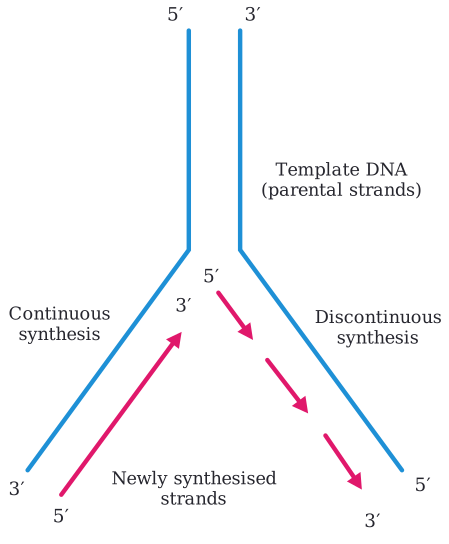
6. Leading and Lagging strand: The template strand with a free 3' end is the leading template and the one with a free 5' end is the lagging template. Replication always starts at the C-3 end of the template and proceeds towards its C-5 end; because the parental strands are antiparallel, both new strands are formed 5' to 3'. The new strand that grows continuously towards the replicating fork is the leading strand; the one that grows discontinuously, away from the fork, is the lagging strand.
Maturation of Okazaki fragments : On the lagging template DNA is synthesised as small pieces called Okazaki fragments (after the scientist Okazaki), which are joined by the enzyme DNA ligase. The RNA primers are removed and replaced by DNA with the help of DNA polymerase-I in prokaryotes and DNA polymerase-alpha in eukaryotes. Finally DNA gyrase (topoisomerase) rewinds the double helix to form the daughter DNA molecules.
Drawn by us to help you understand the concept clearly, and verified to make sure it's accurate. For exams, practice from your textbook's own diagram.
What this figure shows. A diagram of the replication fork showing the parental DNA double helix separating into two template strands, each of which directs synthesis of a new complementary strand by base pairing (A with T, G with C). One new strand (the leading strand) is shown being synthesised continuously toward the fork, while the other (the lagging strand) is synthesised discontinuously, away from the fork, as short RNA-primed Okazaki fragments -- together illustrating why each daughter molecule ends up with one …
7. Formation of daughter DNA molecules: At the end of replication two daughter DNA molecules are formed. In each, one strand is parental and the other is entirely new, so 50% is contributed by the mother DNA; hence the replication is described as semiconservative.
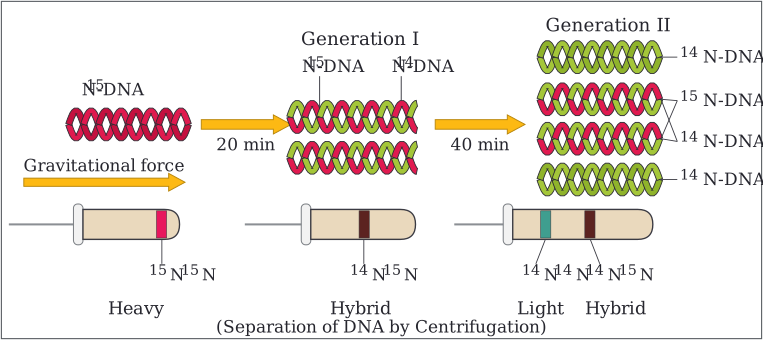
Experimental confirmation : In a newly formed DNA molecule one strand is old (conserved) and the other newly synthesised, which is why the mode is called semiconservative. It was proved experimentally by Matthew Meselson and Franklin Stahl (1958) using the equilibrium-density-gradient centrifugation technique:
- Meselson and Stahl (1958) set out to verify the semiconservative mode of replication.
- E. coli cells growing in 14N were transferred to a 15N (heavy isotopic nitrogen) medium and allowed to replicate for several generations. Their DNA was centrifuged in 6 M CsCl and the position of the equilibrium density-gradient band was recorded. …
Drawn by us to help you understand the concept clearly, and verified to make sure it's accurate. For exams, practice from your textbook's own diagram.
What this figure shows. A diagram interpreting the Meselson-Stahl centrifugation results across generations: E. coli grown in heavy 15N medium initially shows a single heavy 15N-15N density band; after one round of replication in normal 14N medium, all the DNA forms a single intermediate hybrid 14N-15N band; after a second round, two bands appear in equal amounts, one hybrid 14N-15N band and one light 14N-14N band -- a pattern that matches the semiconservative model and rules out the conservative and dispe …