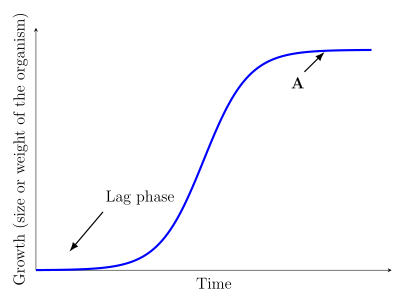
Q.With the help of a suitable diagram, describe the logistic population growth curve.
You're viewing a preview — the full solution, concept, methods & PYQ mapping are locked.
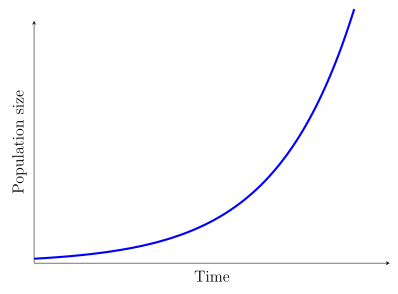
Start your 14-day free trial to unlock the full solution →Step 1. Why logistic growth occurs. Unlike exponential growth, which assumes unlimited resources, logistic growth describes what happens when a population lives in a habitat with genuinely LIMITED resources such as food and space. As the population's density increases, competition among individuals for those finite resources intensifies too, which progressively slows the rate at which the population can keep growing. Step 2. The four phases of the curve. Plotting population density (N, vertical axis) against time (t, horizontal axis) for such a population produces a sigmoid, or S-shaped, curve made up of four phases in sequence: first a lag phase, where growth is slow because the population is still small; then a log or exponential phase, where growth accelerates rapidly while resources are still comparatively abundant relative to population size; then a diminishing-growth phase, where the rate of increase slows down as rising density brings rising competition for the now-limiting resources; and finally a stationary phase, where the curve flattens out entirely once the population has reached the maximum size the habitat's resources can support. Step 3. Carrying capacity (K). This ceiling is called the habitat's carrying capacity, K, for that species -- the maximum population size the available resources in that habitat can sustain, beyond which no further growth is possible; in the equation form, growth slows progressively as N approaches K. Step 4. Why it is considered realistic. Because resources available to almost any real animal population are ultimately finite and become limiting sooner or later, ecologists consider the logistic model -- not the unconstrained exponential model -- the more realistic description of how populations actually grow in nature; in this process, competition effectively weeds o …
Unlock everything free for 14 days
- Full step-by-step solutions
- Concept-first explanations
- Methods, shortcuts & mistakes
- PYQ mapping + timed mock tests
Full access for 14 days. No credit card required.