Biology · Ch 5 — Origin and Evolution of Life
a. Genetic Variations
a. Genetic Variations
Genetic variation refers to any change in the genes present in a population, or in the relative frequency of those genes (alleles), and it is generated by several distinct mechanisms:
i. Gene mutation. A sudden, permanent, heritable change is called a mutation. Mutation can affect an individual gene, the physical structure (morphology) of a chromosome, or the total number of chromosomes present. A mutation confined to a single gene is called a point mutation or gene mutation, and it typically changes the organism's phenotype, thereby producing variation.
ii. Genetic recombination. In sexually reproducing organisms, during the formation of gametes, genetic material is exchanged between the non-sister chromatids of homologous chromosomes — a process called crossing over — which produces new combinations of genes and hence new variation. When gametes carrying these newly recombined genes then unite at fertilisation, the resulting offspring can show a wide range of phenotypic variation, and the frequency of particular alleles in the population changes as a result.
iii. Gene flow. Gene flow is the movement of genes into or out of a population, which can happen through the physical migration of whole organisms, through the dispersal of gametes (such as pollen), or through the movement of DNA segments between organisms (transformation). Like the other mechanisms, gene flow alters a population's gene frequency and can therefore drive evolutionary change.
iv. Genetic drift. Any random fluctuation in allele frequency that occurs in a natural population purely by chance — rather than through selection — is called genetic drift. For example, if a natural disaster such as an earthquake, flood or fire severely reduces the size of a population, particular alleles can be eliminated from that population purely by chance, simply because the individuals carrying them happened not to survive. Smaller populations are considerably more susceptible to genetic drift than large ones, since a chance event affects a much larger proportion of a small population's total gene pool. …
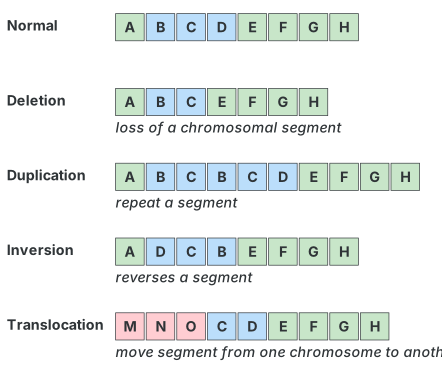
Drawn by us to help you understand the concept clearly, and verified to make sure it's accurate. For exams, practice from your textbook's own diagram.
What this figure shows. A schematic showing a normal chromosome with segments labelled A through H, alongside four altered versions demonstrating each type of chromosomal aberration: one with a middle segment (D) missing entirely (deletion), one with a segment (B-C) repeated twice in a row (duplication), one with a segment reversed end-to-end so its internal order runs backwards (inversion), and one where an unrelated set of segments (labelled M-N-O) from a different, non-homologous chromosome ha …