Biology · Ch 5 — Origin and Evolution of Life
b. Natural Selection
b. Natural Selection
According to Darwin, natural selection is the principal driving force behind evolution. It works because genetic variation is constantly arising within a population; individuals that are 'fittest' for their current environment gain a selective advantage and are correspondingly more likely to produce more offspring than the rest of the population, so that the 'fit' continue to enjoy greater survival and reproductive success while new species gradually emerge over time. Put another way, natural selection is simply the process by which better-adapted organisms grow and leave behind more offspring than their less well-adapted counterparts — bringing about evolutionary change by favouring the differential reproduction of particular genes, and thereby shifting gene frequencies from one generation to the next. Selection acting continuously against harmful mutations can also produce a stable mutation balance, in which the frequency of a harmful recessive allele in the gene pool remains roughly constant, generation after generation, because new mutant copies arising by chance are matched by ongoing selective removal. …
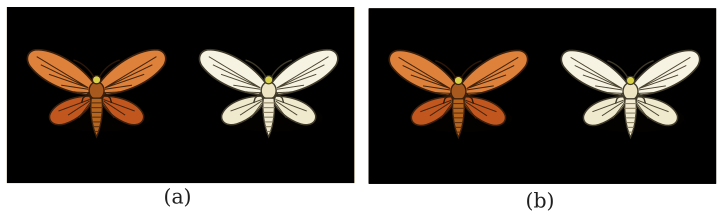
Drawn by us to help you understand the concept clearly, and verified to make sure it's accurate. For exams, practice from your textbook's own diagram.
What this figure shows. A before-and-after comparison of peppered moths resting on tree trunks: on a lichen-covered, pale tree trunk before industrialisation, a pale-and-speckled Biston betularia moth blends in almost invisibly while a dark Biston carbonaria moth stands out starkly to a predatory bird; on a soot-blackened trunk after industrial pollution killed the lichen, the situation reverses — the dark moth now blends in while the pale moth is conspicuous — illustrating how a changed environment flips which colour form …