Biology · Ch 5 — Origin and Evolution of Life
A. Palaeontology
A. Palaeontology
A. Palaeontology : Palaeontology is the study of ancient life through the fossils that ancient organisms have left behind — the preserved dead remains of plants and animals that lived at various times in the past, now found within different geological rock layers. Because fossils record the actual physical forms that once existed, the study of fossils provides the most convincing and most direct evidence available for evolution. Fossils form within sedimentary rocks, within amber (a yellowish, hardened fossil resin), within ice, and within peat bogs. During the process of fossilisation, primitive, ancestral forms of an organism tend to be found in the older, deeper geological layers, while more advanced, later forms are found occupying the more recent, upper layers — giving palaeontologists a rough but genuine timeline of change.
- The study of fossils provides the most convincing and direct evidence of evolution.
- Fossils are formed in sedimentary rocks, amber (yellowish fossil resin), ice, peat bogs, etc.
- During fossilization the primitive forms of organisms occupy the older, lower layers and the advanced forms the upper, more recent layers of the earth.
Types of fossils :
- Actual remains : the most common type of fossil. Plant, animal and human bodies embedded in the permafrost of the arctic or in alpine snow remain preserved in their actual state, e.g. the woolly mammoth in Siberia; amber (hardened resin) contains the preserved bodies of many insects and arthropods.
- Moulds : hardened encasements formed around the outer parts of organic remains that later decayed, leaving cavities; the body parts decay but the impression remains and becomes permanent, e.g. footprints.
- Cast : hardened pieces of mineral matter deposited in the cavities of moulds.
- Compressions : the internal structure is absent but a thin carbon film indicates the outline of the external features.
Significance of Palaeontology :
- It is useful in the reconstruction of phylogeny.
- It helps in studying the various forms and structures of extinct animals.
- It provides the record of missing links between two groups of organisms.
- It helps in the study of the habits of extinct organisms.
- Palaeontology provides the following types of evidence.
Connecting link (missing link) : These are fossil forms that is transitional, or intermediate, between two groups of organisms, showing recognisable characters belonging to both groups and thereby indicating the evolutionary line connecting them — Seymouria (a connecting link between amphibians and reptiles) and Archaeopteryx (a connecting link between reptiles and birds) are the two classic examples.
Archaeopteryx lithographica : It is a fossilized, crow-sized, toothed bird found in the Jurassic rocks of Germany. It is known as the missing link between reptiles and birds because it shows characters of both.
Reptilian characters :
- Presence of a long tail, claws and scales on the body.
- Single-headed ribs.
- Abdominal ribs are present, which look like the ribs of a crocodile.
- Jaws with homodont teeth.
- Sternum without a keel.
- Bones are solid (non-pneumatic).
- Hind limbs had four clawed digits.
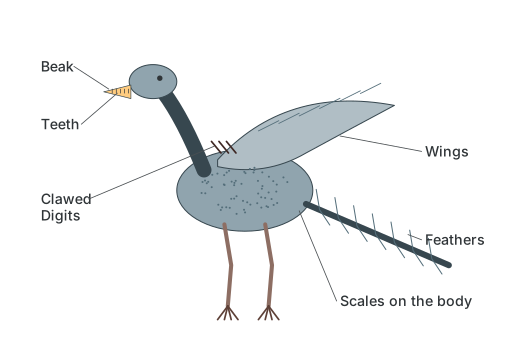
Drawn by us to help you understand the concept clearly, and verified to make sure it's accurate. For exams, practice from your textbook's own diagram.
What this figure shows. A skeletal reconstruction of Archaeopteryx, a crow-sized fossil animal, drawn to show it possessing an unusual mixture of features: a long bony tail, clawed digits on its wings, scales on parts of the body and teeth in its jaws (all reptilian traits) alongside clearly feathered, wing-shaped forelimbs (an avian trait) — visually making the case for why this Jurassic-rock fossil is treate …
Avian characters :
- Feathery exoskeleton.
- Forelimbs are modified into wings.
- Jaws are modified into a beak.
- Skull bones are completely fused.
- Large rounded cranium.
- Cranium with large orbits and a single condyle.
- Limb bones are bird-like.
- Hind limbs with four toes, the first toe opposable.
Thus it is very clear that birds evolved from reptiles; Huxley justified this by calling birds 'glorified reptiles'. …