Biology · Ch 2 — Reproduction in Lower and Higher Animals
Parturition
Parturition
Humans are viviparous, giving birth to live young; parturition is this process of giving birth to a baby. The physical activities involved — uterine and abdominal contractions, dilation of the cervix, and passage of the baby — are collectively called labour, and labour is accompanied by localised discomfort or agony called labour pains.
Parturition is controlled by a complex neuroendocrine mechanism. Signals originating from the fully formed foetus and placenta cause mild uterine contractions, accompanied by a rise in the estrogen-to-progesterone ratio and an increase in oxytocin receptors on the uterine muscles. The fully developed foetus itself signals for uterine contractions by secreting adrenocorticotropic hormone (ACTH) from its pituitary and corticosteroids from its adrenal gland; this triggers the release of oxytocin from the mother's pituitary gland, which acts on the uterine muscles and produces vigorous uterine contractions, leading to expulsion of the baby. It involves the following three steps:
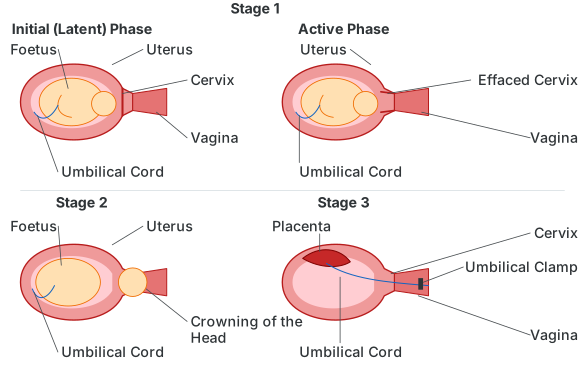
1. Dilation stage : Uterine contractions begin at the top of the uterus, forcing the baby towards the cervix; the contractions are accompanied by pain caused by compression of blood vessels. Oxytocin-driven contractions become progressively stronger through a stimulatory reflex, and as the baby is pushed down, its head comes to lie against the cervix, which dilates, along with similar dilation of the vagina. This stage can normally last for several hours and ends with the rupture of the foetal amniotic membrane.
Drawn by us to help you understand the concept clearly, and verified to make sure it's accurate. For exams, practice from your textbook's own diagram.
What this figure shows. A three-panel sequence of the birth process: Stage 1 shows the foetus positioned within the uterus as the cervix effaces and dilates during the initial (latent) and active phases of labour; Stage 2 shows the foetus, still attached by the umbilical cord, moving through the dilated cervix and vagina with crowning of the head; Stage 3 shows the placenta and umbilical cord being expelled from the …
…