Biology · Ch 2 — Reproduction in Lower and Higher Animals
Fertilization (Syngamy)
Fertilization (Syngamy)
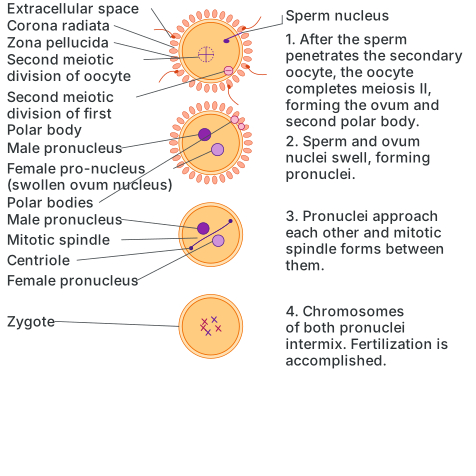
Sexual reproduction primarily involves the formation and fusion of gametes; fertilization is this later process — the fusion of the haploid male and female gametes, resulting in the formation of a diploid (2n) zygote. As in other mammals, fertilization in humans is internal, and it usually takes place in the ampulla of the fallopian (uterine) tube; the resulting fertilized egg, or zygote, goes on to develop into an embryo, a process that occurs within the uterus.
Drawn by us to help you understand the concept clearly, and verified to make sure it's accurate. For exams, practice from your textbook's own diagram.
What this figure shows. A four-panel sequence showing the events of fertilization at the level of the egg — first, the sperm penetrating the corona radiata and zona pellucida to reach the secondary oocyte, which then completes meiosis II, forming the ovum and a second polar body; next, the swollen sperm and ovum nuclei forming separate pronuclei; then the two pronuclei approaching each other as a mitotic spindle forms between them, with a centriole visible; and finally, the chromosomes of both pronuclei in …
Always Remember
Indian law under the Hindu Marriage Act has defined the marriageable age of a boy and a girl: at the time of marriage the minimum age must be 21 years for a boy and 18 years for a girl.
Always Remember
- The secondary oocyte (egg) is ovulated after the LH surge at about the middle of the menstrual cycle, day 14.
- The egg (arrested at metaphase II) reaches the ampulla of the uterine tube 12-24 hours after ovulation; the cilia and the fimbriae of the fallopian tube direct it to the ostium. …