Chemistry · Ch 11 — Alcohols, Phenols and Ethers
Chemical properties of Alcohols and Phenols
Chemical properties of Alcohols and Phenols
This section develops the full chemistry of the O-H and C-O bonds in alcohols, and the characteristic ring chemistry of phenols, across four groups of reactions. Laboratory tests: alcohols are neutral to litmus while phenols turn blue litmus red (revealing phenol's weak acidity); alcohols do not react with aqueous NaHCO3 or NaOH but do liberate H2 gas with reactive metals like Na or K (a positive test for an alcoholic -OH), while phenols specifically dissolve in NaOH (but not in the weaker base NaHCO3) to form water-soluble sodium phenoxide, which is reprecipitated as phenol on acidification; phenols additionally give a diagnostic deep purple/violet/green colouration with neutral FeCl3 (the ferric-phenoxide colour test, which alcohols do not give); and the Lucas test (conc. HCl + ZnCl2) distinguishes primary, secondary and tertiary alcohols by how quickly the clear reagent turns turbid as the corresponding, water-insoluble alkyl chloride forms (tertiary reacts almost instantly, secondary more slowly, primary only on heating). Reactions breaking the O-H bond -- acidic character: phenol ionises to a modest extent in water because the resulting phenoxide ion is resonance-stabilised (its negative charge delocalised onto the ring's ortho and para carbons through five resonance structures), while an alcohol's alkoxide conjugate base is instead DEstabilised by the electron-donating inductive (+I) effect of its alkyl group(s), so alcohols remain essentially neutral in water; electron-withdrawing ring substituents (like -NO2) further stabilise the phenoxide by resonance and so make the phenol MORE acidic than plain phenol (p-nitrophenol > phenol), while electron-donating groups make it LESS acidic. Esterification: both alcohols and phenols form esters with carboxylic acids (H+ catalysed, reversible), with acid anhydrides (also giving a carboxylic-acid by-product), and with acid chlorides (needing pyridine present to neutralise the HCl by-product); the acetate ester specifically is termed an 'acetyl derivative', and aspirin (acetylsalicylic acid, made by acetylating salicylic acid's phenolic -OH with acetic anhydride) is the chapter's worked pharmaceutical example. Reactions breaking the C-O bond of alcohols: with hydrogen halides (reactivity HI > HBr > HCl, and tertiary > secondary > primary alcohols) and with phosphorus halides (PCl5, PX3), both giving alkyl halides; acid-catalysed dehydration (conc. H2SO4/H3PO4/alumina) to the more substituted (Saytzeff) alkene as major product, via a three-step E1 mechanism (protonation, rate-determining loss of water to a carbocation, then fast deprotonation); and oxidation, where primary alcohols give aldehydes with PCC/CrO3 (or go all the way to carboxylic acids with stronger oxidants like KMnO4/K2Cr2O7/HNO3), secondary alcohols give ketones with CrO3, and tertiary alcohols strongly resist oxidation (breaking C-C bonds only under forcing conditions), with the same 1 degree-to-aldehyde/2 degree-to-ketone pattern also seen when alcohol vapours are simply dehydrogenated over hot copper metal (while a tertiary alcohol dehydrates, rather than dehydrogenates, over hot copper). Reactions specific to phenols: because the ring-activating, ortho-/para-directing -OH group makes phenol far more reactive toward electrophilic aromatic substitution than benzene itself, phenol undergoes ready halogenation (2,4,6-tribromophenol in water; mono ortho-/para-bromophenol in a less polar solvent), nitration (o-/p-nitrophenol with dilute HNO3; 2,4,6-trinitrophenol/picric acid with concentrated HNO3), and sulfonation (o-phenolsulfonic acid at room temperature, the more stable p-isomer at 373 K); the Reimer-Tiemann reaction (CHCl3 + aqueous NaOH, then acid) installs a -CHO group ortho to -OH to give salicylaldehyde ( …
What this figure shows. Three diagnostic laboratory tests. Litmus test: aqueous alcohol solutions are neutral to litmus (neither red nor blue litmus changes colour), while aqueous phenol solutions turn blue litmus red, revealing phenol's (weak) acidic character. Reaction with bases: phenol does not react with aqueous NaHCO3 (Ar-OH + NaHCO3(aq) -> no reaction, since phenol is too weak an acid to displace carbonic acid) but does dissolve in aqueous NaOH to form water-soluble sodium phenoxide (Ar-OH + NaOH(aq) -> ArONa(aq) + H2O), which is reprecipitated as phenol on acidification with HCl; alcohols show no reaction with either NaHCO3 or NaOH, but their very weak acidic character is revealed instead by reaction with an active metal (2R-OH + 2Na -> 2R-ONa + H2 gas), the liberated hydrogen gas serving as a positive test for an alcoholic -OH group. Ferric chloride test: phenols specifically give a deep purple/violet/green colouration with neutral FeCl3 solution, forming ferr …
What this figure shows. The Lucas test distinguishes 1 degree, 2 degree and 3 degree alcohols using Lucas reagent (concentrated HCl + anhydrous ZnCl2), which converts the alcohol to the corresponding, water-insoluble alkyl chloride (R-OH --HCl/ZnCl2--> R-Cl). Because the starting alcohol is soluble in the reagent but the alkyl-chloride product is not, the clear solution turns turbid (cloudy) as the reaction proceeds. Tertiary alcohols react fastest, turning the reagent turbid almost instantaneously; secondary alcohols turn it turbid more slowly, over some minutes; primary alcohols react slowest of all and only turn turbid on heating -- so the SPEED of tu …
Drawn by us to help you understand the concept clearly, and verified to make sure it's accurate. For exams, practice from your textbook's own diagram.
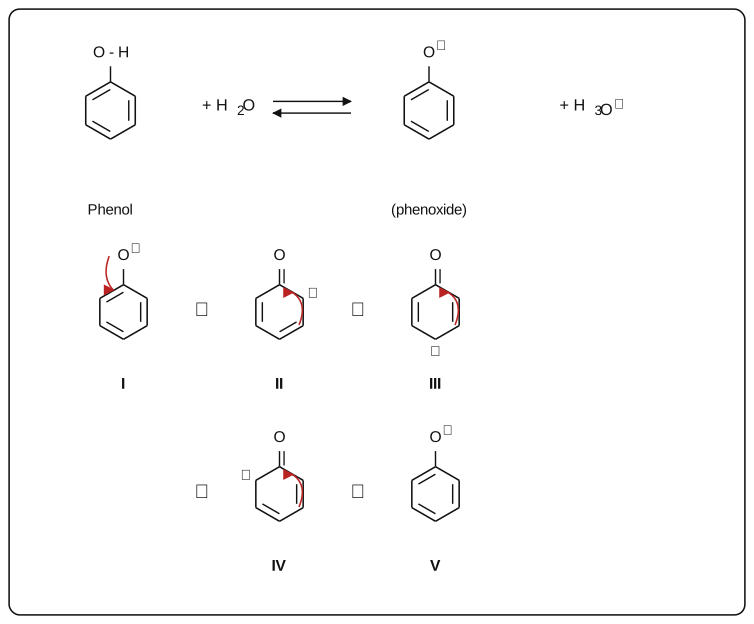
What this figure shows. Contrasts the ionisation equilibria: an alcohol, R-OH + H2O <=> R-O(-) + H3O+, where the alkoxide conjugate base is destabilised by the electron-donating inductive (+I) effect of its attached alkyl group(s), so the equilibrium lies far to the left and alcohols behave as essentially neutral in water; versus phenol, C6H5-OH + H2O <=> C6H5-O(-) + H3O+, where the resulting phenoxide ion is instead resonance-stabilised, its negative charge delocalised over the ring (onto the ortho and para ring carbons as well as the oxygen) through five resonance contributing structures, allowing phenol to ionise to a moderate extent and show a …
Worked out. Worked example: rank CH3-CH2-OH, (CH3)3C-OH, C6H5-OH and p-NO2-C6H4-OH in decreasing order of acid strength and justify. Solution: the two phenols are more acidic than the two alcohols because a phenoxide ion is resonance-stabilised while an alkoxide is not. Among the alcohols, the conjugate base of ethanol is destabilised by the +I effect of one alkyl group, while tert-butoxide is destabilised by the +I effect of three alkyl groups, so tert-butyl alcohol is the weaker acid of the two. Among the phenols, p-nitrophenoxide has six resonance contributing structures (one placing the negative charge directly on an electronegative nitro oxygen, an especially stable arrangement) versus phenoxide's five, so p-nitrophenol is the stronger acid. Overall …
Drawn by us to help you understand the concept clearly, and verified to make sure it's accurate. For exams, practice from your textbook's own diagram.
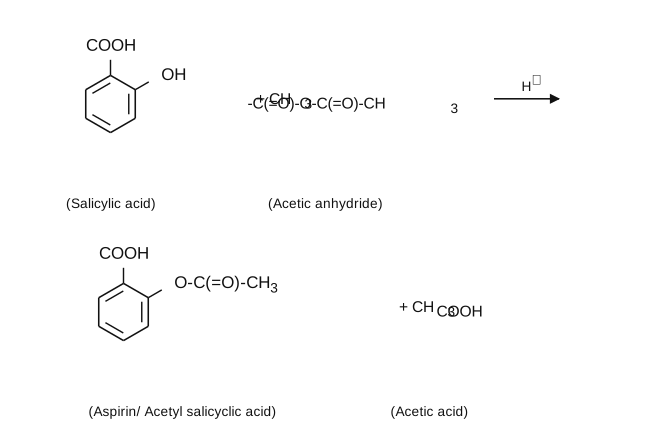
What this figure shows. Alcohols and phenols both form esters on reaction with a carboxylic acid (R-OH/Ar-OH + HOOC-R', H+ catalyst, reversible, driven forward by removing water), with an acid anhydride (R-OH/Ar-OH + (R'CO)2O, H+ catalyst, giving the ester plus a carboxylic acid by-product), or with an acid chloride (R-OH/Ar-OH + Cl-CO-R', with pyridine present as a base to mop up the HCl by-product). The acetate ester specifically is called an 'acetyl derivative', and the number of acetyl groups introduced by acetylation reveals the number of -OH groups originally present. Aspirin (acetylsalicylic acid) is given as the worked example: salicylic acid (a benzene ring bearing both -OH and -COOH) is acetylated with acetic anhydride to give aspirin (the phenolic -OH …
What this figure shows. Alcohols react with hydrogen halides (HX) to give alkyl halides, with reactivity order among the halides HI > HBr > HCl (HCl needs anhydrous ZnCl2 as catalyst, while HBr and HI react without any catalyst) and reactivity order among alcohol classes tertiary > secondary > primary. Alcohols likewise react with phosphorus pentachloride (PCl5) and phosphorus trihalides (PX3) to give alkyl halides directly. Both reaction families proceed by breaking the alcohol's C-O bond, in contrast to esterificatio …
Drawn by us to help you understand the concept clearly, and verified to make sure it's accurate. For exams, practice from your textbook's own diagram.
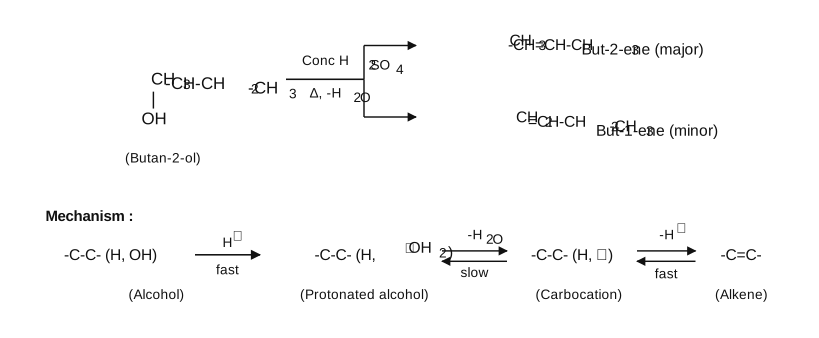
What this figure shows. Alcohols heated with concentrated H2SO4, phosphoric acid, or alumina undergo dehydration to an alkene plus water, with the more highly substituted (Saytzeff) alkene forming as the major product. The three-step E1 mechanism: Step 1, fast protonation of the -OH oxygen by H+ gives a protonated alcohol (R-O+H2); Step 2, slow loss of water from the protonated alcohol gives a carbocation intermediate (the rate-determining step); Step 3, fast removal of a beta-hydrogen (by a base/another molecule) forms the C=C double bond of the alke …
Worked out. Worked example: write the reaction showing major and minor products formed on heating butan-2-ol with concentrated sulfuric acid. Solution: CH3-CH(OH)-CH2-CH3, heated with conc. H2SO4, loses water to give but-2-ene, CH3-CH=CH-CH3, as the major product (the more substituted, internal alkene, per Saytzeff's rule) and but-1-ene, CH2=CH-CH2-CH3, as the minor product (the less substituted, terminal alkene). …
What this figure shows. Primary alcohols on oxidation with PCC (pyridinium chlorochromate) or CrO3 give aldehydes (R-CH2-OH -> R-CHO); with stronger, non-selective oxidants (nitric acid, KMnO4, or K2Cr2O7) the oxidation does not stop at the aldehyde and instead proceeds all the way to the carboxylic acid with the same carbon count (R-CH2-OH -> [R-CHO] -> R-COOH). Secondary alcohols oxidised with chromic anhydride (CrO3) give ketones (R-CH(OH)-R' -> R-CO-R'). Tertiary alcohols resist oxidation under ordinary conditions; strong oxidants at high temperature instead break C-C bonds, giving a mixture of smaller carboxylic acids. Separately, passing alcohol vapours over hot copper (573 K) dehydrogenates primary alcohols to aldehydes and secondary alcohols to ketones by oxidation, while a tertiary alcohol instead undergoes dehydration (loses water) over hot copper to give an alkene, sin …
Worked out. Worked example: write and explain reactions to convert propan-1-ol into propan-2-ol. Solution: first, propan-1-ol is dehydrated over Al2O3 at 623 K to propene (CH3-CH2-CH2-OH -> CH3-CH=CH2); second, propene undergoes Markovnikov (acid-catalysed) hydration -- conc. H2SO4 followed by water -- to give propan-2-ol (CH3-CH=CH2 -> CH3-CH(OH)-CH3), since the more stable secondary carbocation intermediate directs the -OH to the centr …
Worked out. Worked example: an organic compound liberates hydrogen on reaction with sodium metal, and forms an aldehyde of molecular formula C2H4O on oxidation with PCC; name the compounds and give the equations. Solution: C2H4O as an aldehyde must be CH3-CHO (acetaldehyde), so the starting alcohol (which oxidises to it) must be CH3-CH2-OH (ethyl alcohol/ethanol). The two reactions: 2CH3-CH2-OH + 2Na -> 2CH3-CH2-O-Na + H2 (sodium ethoxide, liberating hydrogen and confirming the alcoholic -OH by the sodium-metal test); and CH3-CH2-OH --PCC, [O]--> CH3-CHO + H2O …
Drawn by us to help you understand the concept clearly, and verified to make sure it's accurate. For exams, practice from your textbook's own diagram.
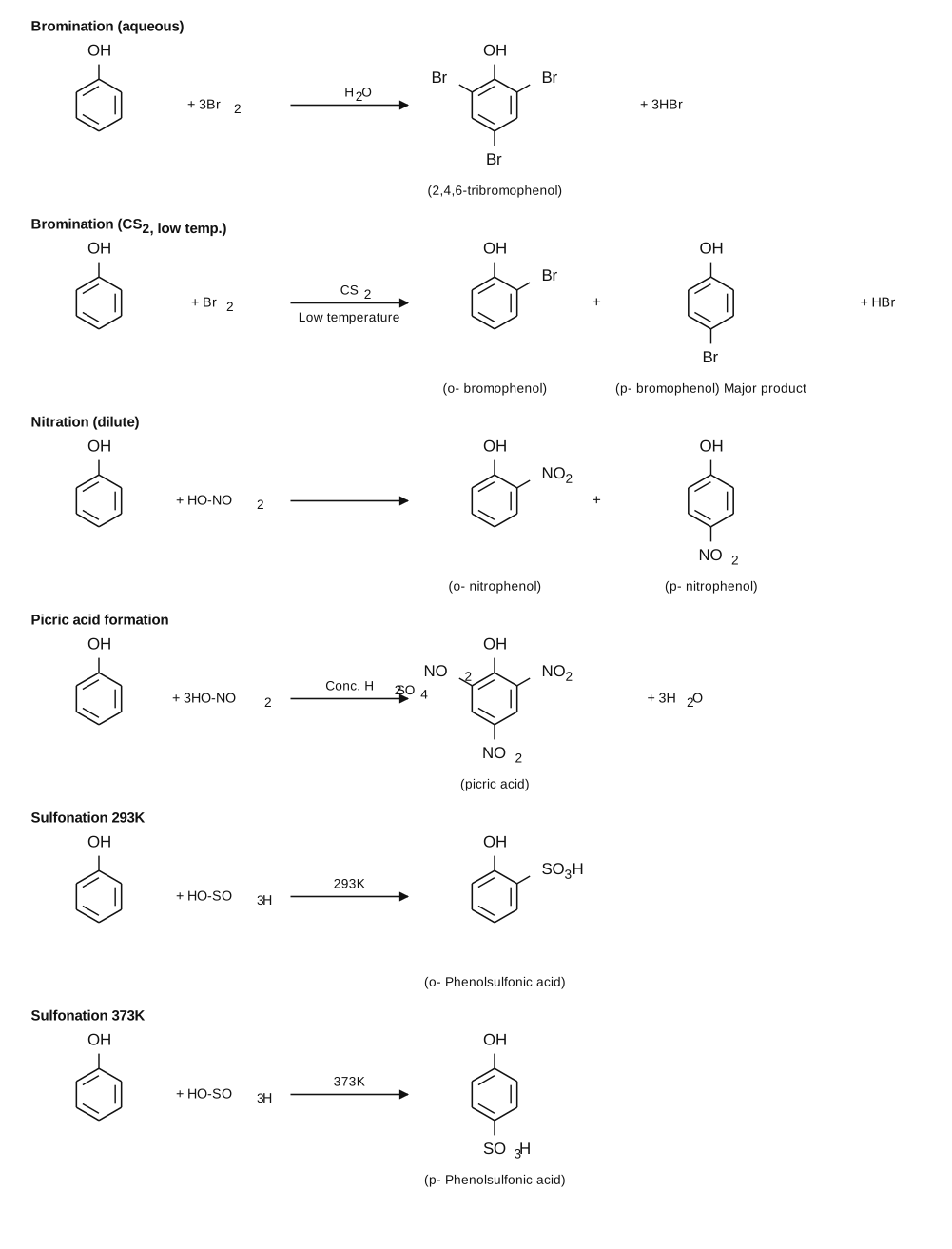
What this figure shows. Phenol undergoes electrophilic aromatic substitution more readily than benzene because the ring-activating, ortho-/para-directing -OH group raises the electron density at those positions. Halogenation: phenol with aqueous bromine gives 2,4,6-tribromophenol directly (all three activated positions substituted, plus 3 HBr by-product), whereas in a less polar solvent (CHCl3, CCl4 or CS2) at low temperature, only mono-bromination occurs, giving a mixture of ortho- and para-bromophenol (para as major product); chlorine reacts analogously. Nitration: dilute HNO3 at low temperature gives a mixture of ortho- and para-nitrophenol; concentrated HNO3 instead nitrates all three activated positions to give 2,4,6-trinitrophenol (picric acid). Sulfonation: concentrated H2SO4 at room temperature (293 K) gives mainly o-phenolsulfonic acid (the kinetic product), while at a higher temperature ( …
Drawn by us to help you understand the concept clearly, and verified to make sure it's accurate. For exams, practice from your textbook's own diagram.
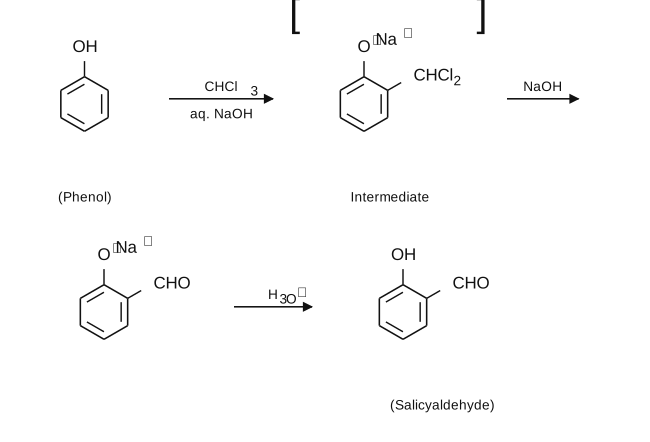
What this figure shows. Phenol treated with chloroform (CHCl3) in aqueous NaOH, followed by acidic hydrolysis, gives salicylaldehyde (2-hydroxybenzaldehyde) -- the Reimer-Tiemann reaction. Mechanism sketch: phenol is first deprotonated by NaOH to sodium phenoxide; NaOH also converts CHCl3 into the electrophilic dichlorocarbene, which attacks the activated ortho position of the phenoxide ring to give an intermediate bearing a -CHCl2 group ortho to the -ONa; this intermediate hydrolyses (loses both chlorines, first to -CHO on treatment with more NaOH, i.e. an ortho-CHO sodium phenoxide) and final acidification with H3O+ liberates the neutral salicylaldehyde product (ortho -OH and -CHO on the ring). The text adds that using carbon tetrachloride (CCl4) in …
Drawn by us to help you understand the concept clearly, and verified to make sure it's accurate. For exams, practice from your textbook's own diagram.
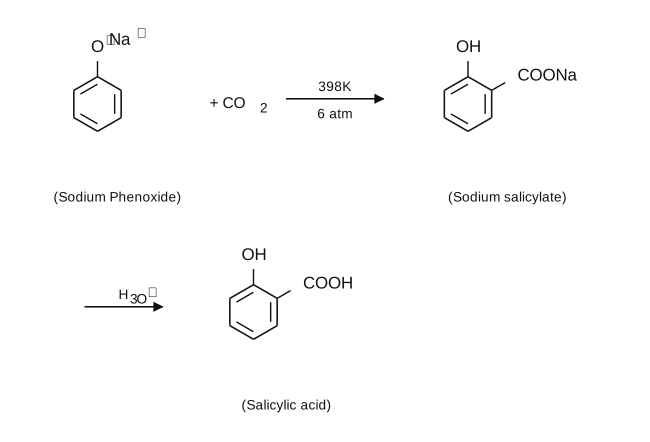
What this figure shows. Sodium phenoxide treated with carbon dioxide under pressure (6 atm, 398 K), followed by acidic hydrolysis, gives salicylic acid (o-hydroxybenzoic acid) -- the Kolbe reaction. Scheme: sodium phenoxide + CO2 (6 atm, 398 K) gives sodium salicylate (the ring's ortho position bonded to a -COONa group, ortho to the original -ONa); acidification with H3O+ then converts this to salicylic acid (ortho -OH and -COOH). A Do-you-know box explains why this reaction needs sodium phenoxide rather than phenol itself: the phenoxide ion is a stronger nucleophile/more reactive toward electrophilic substitution than neutral phenol, which is what lets it react …
Drawn by us to help you understand the concept clearly, and verified to make sure it's accurate. For exams, practice from your textbook's own diagram.
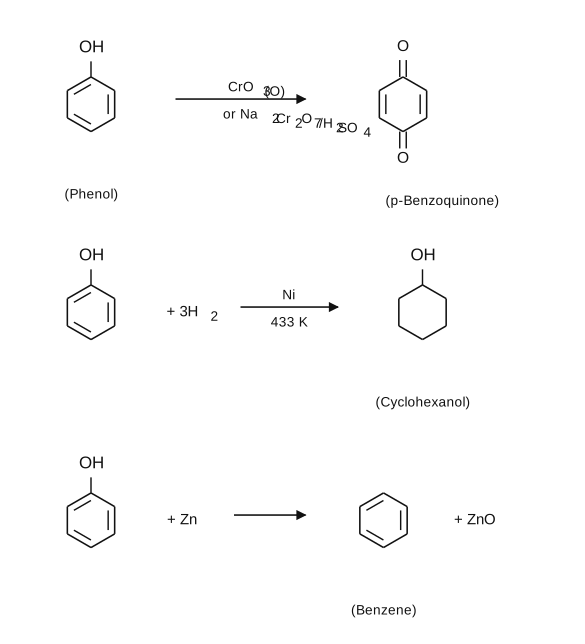
What this figure shows. Three further reactions of phenol. Oxidation: phenol treated with chromic anhydride (CrO3) or sodium dichromate in the presence of H2SO4 is oxidised to p-benzoquinone (the ring converted to a cyclohexadiene-1,4-dione); phenol also oxidises slowly on its own in air, giving a dark-coloured mixture. Catalytic hydrogenation: phenol plus hydrogen (3 H2), passed as vapour over a nickel catalyst at 433 K, is reduced all the way to cyclohexanol (the aromatic ring itself is hydrogenated, not just the -OH). Reduction with zinc dust: phenol heated with zinc dust is reduced to benzene, the -OH group being removed entirely (with zinc oxide, ZnO, as the by-product) -- the reaction used, e …