Chemistry · Ch 11 — Alcohols, Phenols and Ethers
Physical Properties of alcohols and phenols
Physical Properties of alcohols and phenols
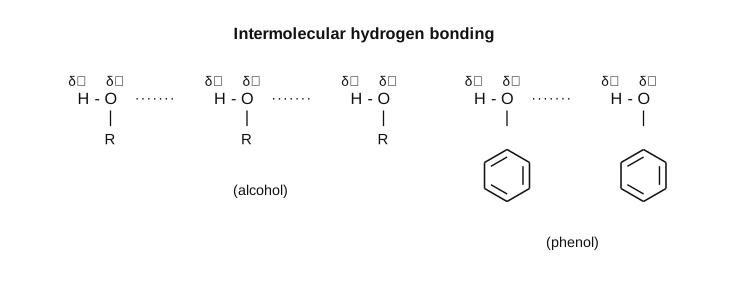
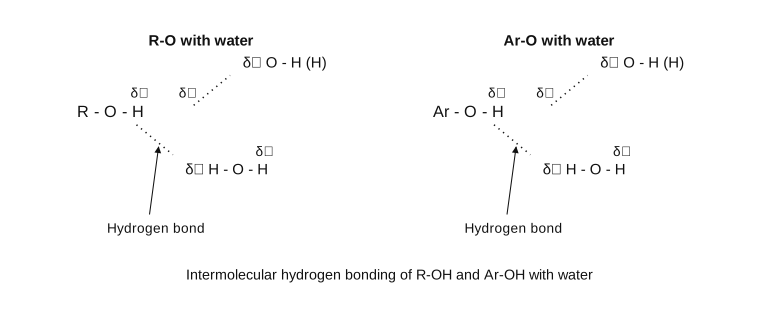
Alcohols and phenols are strongly polar molecules because of their -OH group, and this polarity manifests as extensive intermolecular hydrogen bonding, in which the -OH's delta-positive hydrogen on one molecule bonds to a delta-negative oxygen lone pair on a neighbouring molecule, and so on repeatedly through the liquid or solid. This hydrogen bonding is the underlying reason for several of their observed physical properties. Physical state: lower alcohols are colourless, toxic liquids with a characteristic 'alcoholic' odour, while pure phenol is a colourless, toxic, low-melting solid with its own characteristic carbolic/phenolic odour. Boiling points: both alcohols and phenols show boiling points that rise with increasing molecular mass (Table 11.5), but for a fixed molecular formula, increased CHAIN BRANCHING lowers the boiling point, because a more compact, more spherical branched molecule has weaker intermolecular van der Waals contact with its neighbours than an elongated straight-chain isomer does (illustrated by the four butyl alcohol isomers in Problem 11.3). Solubility: phenols, and lower alcohols having up to three carbon atoms, show appreciable solubility in water, because their -OH group can form intermolecular hydrogen bonds directly with water molecules; beyond about three carbons, the growing hydrocarbon portion of the molecule increasingly dominates over the small polar -OH group, and water solubility falls off. A further, more subtle effect distinguishes ISOMERS of similar molecular mass: when a second substituent (such as -NO2) sits ORTHO to the -OH, an intramolecular hydrogen bond can form between them, using up the -OH's hydrogen-bonding capacity inter …
Drawn by us to help you understand the concept clearly, and verified to make sure it's accurate. For exams, practice from your textbook's own diagram.
What this figure shows. Shows chains of alcohol molecules (R-OH) and phenol molecules (Ar-OH) linked to one another through intermolecular hydrogen bonds: each O-H unit is drawn with a delta-positive H hydrogen-bonded to the delta-negative oxygen lone pair of the next O-H unit in the chain, repeating to form an extended hydrogen-bonded network -- the structural basis given for alcohols' and phenols' unusually high boiling points relative to non-hydrogen-bonding compounds of simi …
Name | Formula | M.P. (deg C) | B.P. (deg C) | Solubility (g/100 g H2O): Methyl alcohol | H3C-OH | -97 | 65 | 0.793 [likely a misprint for a much higher water-miscibility, transcribed as printed]. Ethyl alcohol | H3C-CH2-OH | -115 | 78 | 0.789 [as printed; likely the same printing convention as methyl alcohol]. n-Propyl alcohol | H3C-CH2-CH2-OH | -126 | 97 | 0.804. Isopropyl alcohol | (H3C)2CH-OH | -86 | 83 | 0.789. n-Butyl alcohol | H3C-(CH2)3-OH | -90 | 118 | 0.810. Isobutyl alcohol | H3C-CH(CH3)-CH2-OH | -108 | 108 | 0.802. sec-Butyl alcohol | H3C-CH2-CH(CH3)-OH | -114 | 99.5 | 0.806. tert-Butyl alcohol | (H3C)3C-OH | 25.5 | 83 | 0.789. Phenol | C6H5-OH | 41 | 182 | 9.3. p-Cresol | H3C-C6H4-OH | 35 | 202 | 2.3. o-Nitrophenol | O2N-C6H4-OH (ortho) | 45 | 217 | 0.2. p-Nitrophenol | O2N-C6H4-OH (para) | 114 | -- | 1.7. (Note on source fidelity: the printed solubility column for methanol and ethanol, 0.793 and 0.789 g/100 g water, is transcribed exactly as it appears in the source; methanol and ethanol are in fact fully mi …
Worked out. Worked example: the boiling points of n-butyl, isobutyl, sec-butyl and tert-butyl alcohol are given as 118, 108, 99.5 and 83 deg C respectively; explain the order. Solution: as branching increases, the intermolecular van der Waals forces between molecules become weaker (a more compact, spherical branched molecule has less surface-area contact with its neighbours), so the boiling point falls -- hence straight-chain n-butyl alcohol has the highest boiling point and the most branched tert-butyl alcohol the lowest. Isobutyl alcohol, though branched, is still a primary alcohol, so its boiling point is higher than that o …
Worked out. Worked example: the water solubility of o-nitrophenol and p-nitrophenol is 0.2 g and 1.7 g per 100 g of water respectively; explain the difference. Solution: in o-nitrophenol, the -OH and the adjacent -NO2 group are positioned so that an intramolecular hydrogen bond can form between them (the phenolic H hydrogen-bonding to a nitro oxygen on the very next ring position), which uses up the -OH's hydrogen-bonding capacity internally and leaves little of it available to bond with solvent water. In p-nitrophenol, the -OH and -NO2 are too far apart (para) for any such intramolecular bond, so the -OH is instead free to form strong intermolecular hydrogen bonds with surrounding water molecules. Since solubility rises with the strength of solute-solvent intermolecular attraction, …
Drawn by us to help you understand the concept clearly, and verified to make sure it's accurate. For exams, practice from your textbook's own diagram.
What this figure shows. Shows an alcohol (R-OH) and a phenol (Ar-OH) each hydrogen-bonded directly to a surrounding water molecule: the O-H's delta-positive hydrogen forms a hydrogen bond to a delta-negative oxygen lone pair of water, while water's own O-H hydrogens can likewise hydrogen-bond to the alcohol's/phenol's oxygen lone pairs -- illustrating the mutual (solute-to-solvent and solvent-to-solute) hydrogen bonding responsible for the water solubility …
Worked out. Explains that sodium bicarbonate, sodium hydroxide and sodium metal form an increasingly strong series of bases, and that this can be used to qualitatively distinguish weak from strong acids: a weak acid reacts only with a sufficiently strong base and fails to react with a weak base, whereas a strong acid reacts readily with both weak and strong bases. HCl (a strong acid) is given as the reference example, reacting with both NaHCO3 (HCl(aq) + NaHCO3(aq) -> H2O(l) + NaCl(aq) + CO2 gas) and NaOH (HCl(aq) + NaOH(aq) -> NaCl(aq) + H2O(l)) -- setting up the phenol-vs-NaHCO3/NaOH reactivity test used as the chapter's laboratory diagnostic for acidic ch …