Chemistry · Ch 11 — Alcohols, Phenols and Ethers
Preparation of phenol
Preparation of phenol
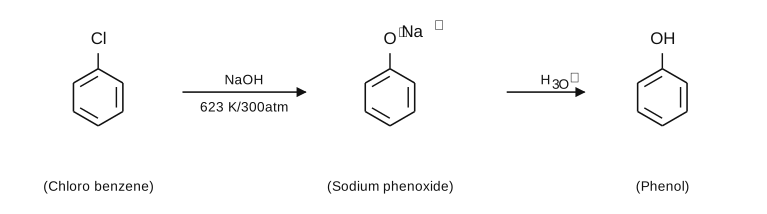
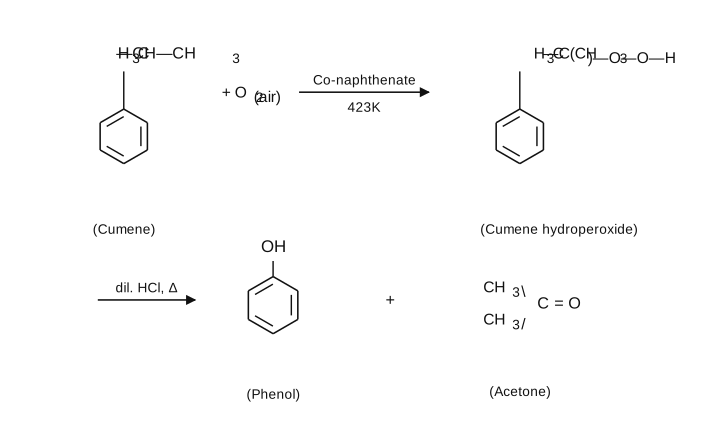
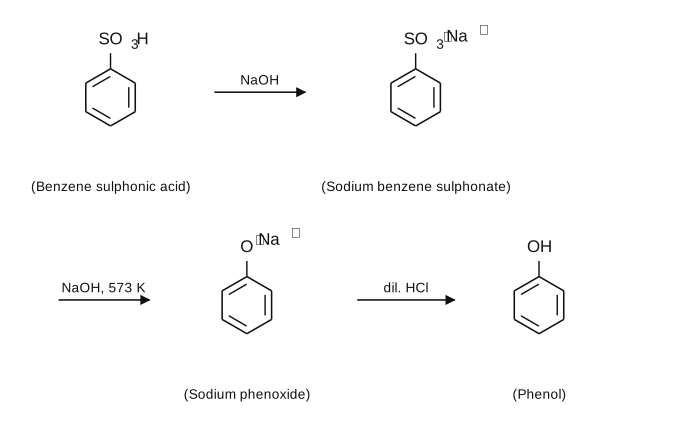
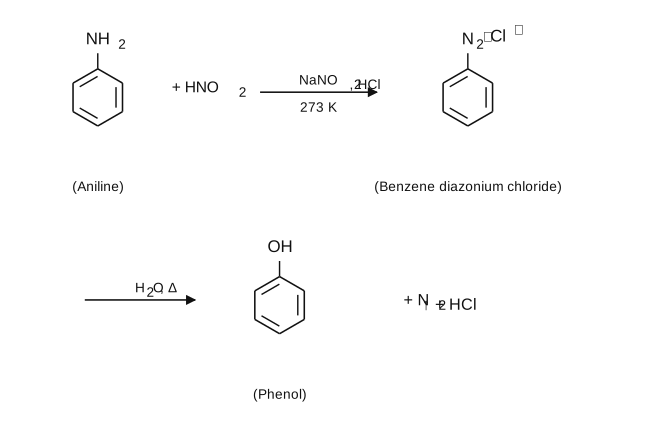
Phenol can be prepared by four distinct routes. (a) The Dow process starts from chlorobenzene, which is fused with NaOH under forcing conditions (623 K and 300 atm) to displace the ring chlorine and give sodium phenoxide; treatment with dilute HCl then liberates phenol. (b) The cumene process is the commercially dominant industrial route: cumene (isopropylbenzene) is air-oxidised, in the presence of a cobalt-naphthenate catalyst, to cumene hydroperoxide, which is then decomposed with dilute acid to give phenol together with acetone as a commercially valuable by-product -- the economic appeal of this route is precisely that it produces two saleable chemicals from one feedstock. (c) From benzene sulfonic acid: the sulfonic acid is first neutralised with NaOH to sodium benzene sulfonate, which is then fused with solid NaOH at 573 K to displace the sulfonate group and give sodium phenoxide; acidification with dilute HCl again liberates phenol. (d) From aniline: aniline is treated with nitrous acid (generated in situ from NaNO2 and HCl) at a low temperature (273 K) to form benzene diazonium chloride, which is then simply hydrolysed with water (releasing ni …
Drawn by us to help you understand the concept clearly, and verified to make sure it's accurate. For exams, practice from your textbook's own diagram.
What this figure shows. Chlorobenzene is fused with NaOH at high temperature and pressure (623 K, 300 atm) to displace the chlorine and form sodium phenoxide; this is then treated with dilute HCl (H3O+) to protonate the phenoxide and liberate phenol. Three-stage scheme: chlorobenzene --NaOH, 623K/300atm--> sodium phenoxide --dil. HCl- …
Drawn by us to help you understand the concept clearly, and verified to make sure it's accurate. For exams, practice from your textbook's own diagram.
What this figure shows. The industrial route to phenol: cumene (isopropylbenzene, drawn as a benzene ring bearing a -CH(CH3)2 group) undergoes air oxidation at 423 K in the presence of a cobalt-naphthenate catalyst to form cumene hydroperoxide (the ring's isopropyl CH is converted to a -C(CH3)2-O-O-H group); this hydroperoxide is then decomposed with dilute HCl (with heating) to give phenol as the major product, with acetone [(CH3)2C=O] formed simultaneously as a comme …
Drawn by us to help you understand the concept clearly, and verified to make sure it's accurate. For exams, practice from your textbook's own diagram.
What this figure shows. Benzene sulfonic acid (C6H5-SO3H) is first neutralised with NaOH to give sodium benzene sulfonate (C6H5-SO3Na); this salt is then fused with solid NaOH at 573 K, which displaces the sulfonate group to give sodium phenoxide; acidification with dilute HCl finally liberates phenol. Three-stage scheme: benzene sulfonic acid --NaOH--> sodium benzene sulfonate --NaOH, 573K--> sodium phe …
Drawn by us to help you understand the concept clearly, and verified to make sure it's accurate. For exams, practice from your textbook's own diagram.
What this figure shows. Aniline (C6H5-NH2) is treated with nitrous acid, generated in situ from NaNO2 + HCl, at a low temperature of 273 K to form benzene diazonium chloride (C6H5-N2+ Cl-); this diazonium salt is then hydrolysed (with water, releasing N2 gas) to give phenol. The text notes this diazotisation-then-hydrolysis sequence is also used elsewhere (referenced again in the chapter on amines) as a general way to convert an aromatic amine i …