Chemistry · Ch 11 — Alcohols, Phenols and Ethers
Preparation of alcohols
Preparation of alcohols
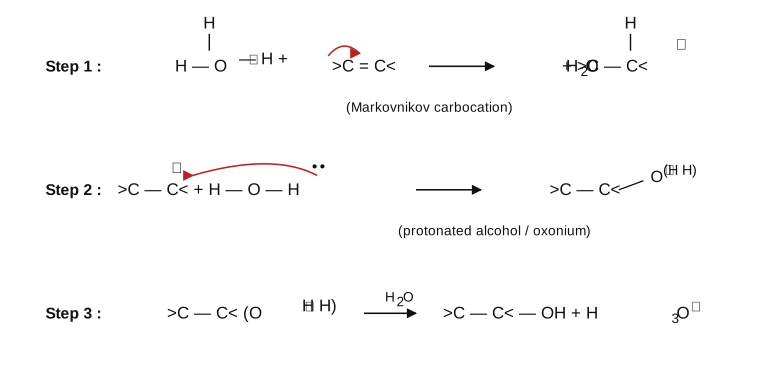
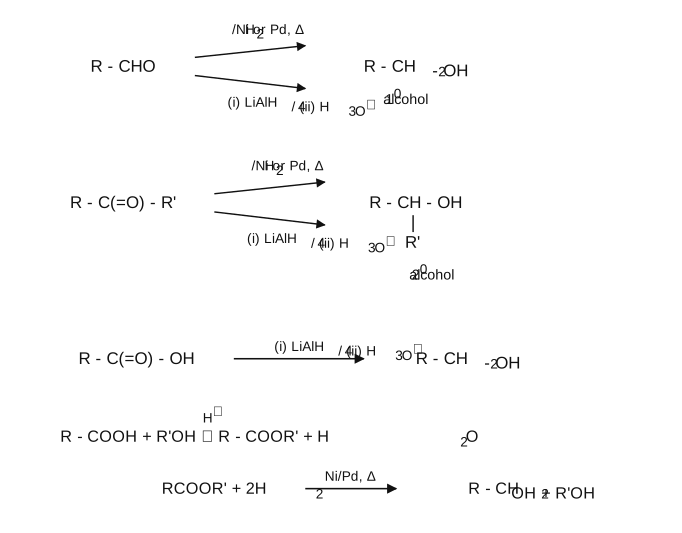
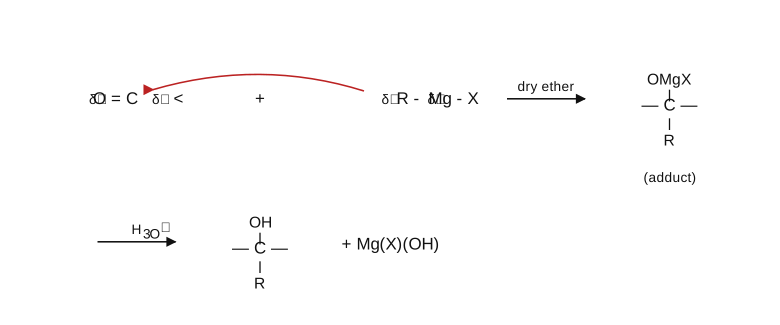
Alcohols can be prepared by five general routes. (a) Hydrolysis of an alkyl halide with aqueous alkali or moist silver oxide gives the corresponding alcohol directly (this route is covered in more mechanistic detail in the alkyl-halides chapter). (b) Acid-catalysed hydration of an alkene: the alkene first reacts with sulfuric acid to form an alkyl hydrogen sulfate, which is then hydrolysed to the alcohol; because the reaction proceeds through the more stable carbocation intermediate, the -OH group ends up on the MORE substituted carbon, in accordance with Markownikoff's rule (the three-step mechanism -- protonation, nucleophilic attack by water, then deprotonation -- is detailed as its own figure). (c) Hydroboration-oxidation: an alkene first undergoes an addition reaction with diborane (B2H6) to give a trialkylborane, which is then oxidised with hydrogen peroxide in alkaline medium to the alcohol; because boron adds to the LESS hindered carbon in the first step, this route places the -OH on the less substituted carbon, the opposite (anti-Markovnikov) regiochemistry to route (b). (d) Reduction of carbonyl compounds: aldehydes reduced with H2/Ni or LiAlH4 give primary alcohols, and ketones reduced the same way give secondary alcohols; carboxylic acids require the stronger reducing agent LiAlH4 (H2/Ni alone cannot reduce a -COOH group) to give primary alcohols, though industrially the acid is instead first esterified and the ester then catalytically hydrogenated, since LiAlH4 is expensive; LiAlH4 has the further advantage of leaving an isolated C=C bond untouched, letting it selectively reduce the carbonyl of an unsaturated aldehyde/ketone to give an unsaturated alcohol. (e) Addition of a Grignard reagent to an aldehyde or ketone, followed by acidic hydrolysis of the resulting magnesium-alkoxide adduct: formaldehyde gives a primary alcohol, any other aldehyde gives a secondary a …
Drawn by us to help you understand the concept clearly, and verified to make sure it's accurate. For exams, practice from your textbook's own diagram.
What this figure shows. The three-step mechanism by which an alkene undergoes Markovnikov (acid-catalysed) hydration with dilute H2SO4/H2O, drawn as a generic C=C system: Step 1, protonation of the alkene's pi bond by H3O+ forms a carbocation intermediate (the more stable, more substituted carbocation forms preferentially, which is the structural basis of Markovnikov's rule); Step 2, nucleophilic attack of a water molecule's oxygen lone pair on the electrophilic carbocation carbon forms a protonated (oxonium) alcohol; Step 3, deprotonation of that oxonium species by another water molecule releases the neutr …
Worked out. Worked example: draw structures for (i) 2,5-diethylphenol, (ii) prop-2-en-1-ol, (iii) 2-methoxypropane, (iv) phenylmethanol. Solution: (i) a benzene ring with -OH at C1 and an ethyl (-C2H5) group at both C2 and C5; (ii) H2C=CH-CH2-OH, allyl alcohol, with the OH-bearing carbon numbered C1, the double bond at C2-C3; (iii) CH3-CH(OCH3)-CH3, an isopropyl group bearing a methoxy substituent at its central (C2) carbon; (iv) C6H5-CH2-OH, benzyl alcohol, a benzene ring bea …
Drawn by us to help you understand the concept clearly, and verified to make sure it's accurate. For exams, practice from your textbook's own diagram.
What this figure shows. Three reduction pathways to alcohols: an aldehyde (R-CHO) reduced by H2/Ni or LiAlH4-then-H3O+ gives a primary alcohol (R-CH2-OH); a ketone (R-CO-R') reduced the same way gives a secondary alcohol (R-CH(OH)-R'); and a carboxylic acid (R-COOH), which needs the stronger reducing agent LiAlH4 (H2/Ni cannot reduce it), gives a primary alcohol (R-CH2-OH) directly -- while the industrial alternative first esterifies the acid (R-COOH + R'OH -> R-COOR', H+ catalyst) and then catalytically hydrogenates the ester (RCOOR' + 2H2 -> R-CH2OH + R'OH, Ni/Pd catalyst, heat) because LiAlH4 is expensive. A Remember box notes LiAlH4's advantage over H2/Ni: it leaves an isolated C=C bond untouched, so it can selectively reduce an unsaturated aldehyde/ketone's carbonyl group …
Drawn by us to help you understand the concept clearly, and verified to make sure it's accurate. For exams, practice from your textbook's own diagram.
What this figure shows. Shows the Grignard mechanism -- a Grignard reagent R-MgX adds across the polarised C=O of an aldehyde or ketone (nucleophilic R attacking the delta-positive carbonyl carbon) to give a magnesium alkoxide adduct, which is then hydrolysed with dilute acid (H3O+) to the alcohol plus a basic magnesium halide salt -- and tabulates the three outcomes (Table 11.4): formaldehyde (H-CHO) + R-MgX gives a primary alcohol R-CH2OH; any other aldehyde (R'-CHO) + R-MgX gives a secondary alcohol R-CH(OH)-R'; and a ketone (R'-CO-R'') + R-MgX gives a tertiary alcohol R-C(OH)(R')(R''). A Do-you-know box adds that an epoxide (e.g. ethylene oxide) reacts with a Grignard reagent, followed by acidic hydrolysis, to give a primary alcohol two ca …
Worked out. Worked example: the substrate CH3-CH=CH-CH2-CHO (an unsaturated aldehyde, labelled A) is treated (i) with H2/Ni and (ii) with LiAlH4 then H3O+; predict the product in each case. Solution: the substrate contains both an isolated C=C and a -CHO group. H2/Ni reduces both functional groups, so the product is the fully saturated alcohol CH3-CH2-CH2-CH2-CH2-OH. LiAlH4 selectively reduces only the -CHO (it does not touch an isolated olefinic bond), so the product retains the double bond: CH3-CH=C …