Chemistry · Ch 12 — Aldehydes, Ketones and Carboxylic Acids
Nomenclature of aldehydes and carboxylic acid
Nomenclature of aldehydes and carboxylic acid
Aldehyde and carboxylic-acid names are closely related, and each family has both a TRIVIAL and an IUPAC naming system. TRIVIAL NAMES: an aliphatic aldehyde's trivial name is derived from the trivial name of the CORRESPONDING carboxylic acid, by replacing its '-ic acid' ending with '-aldehyde' (so, for instance, acetic acid gives acetaldehyde). Where a substituent's position needs to be shown on either an acid or an aldehyde under the trivial system, it is labelled with a Greek letter -- alpha for the carbon adjacent to the carbonyl carbon, beta for the next carbon along, and so on (see Table 12.1 for the worked pairs). Some further aromatic-acid trivial names worth knowing: benzoic acid, phthalic acid, and acetyl salicylic acid (aspirin); a 'Remember' box notes that an acid whose -COOH is not attached directly to the ring (e.g. phenylacetic acid) is instead called a side-chain aromatic acid, not a true aromatic carboxylic acid (see 12.2.3). IUPAC NAMES: an aliphatic aldehyde's IUPAC name is built from the name of the corresponding ALKANE by replacing its final '-e' with '-al' -- so the whole family is named 'alkanal'. An aliphatic carboxylic acid's IUPAC name is built the same way but with '-oic acid' instead -- family name 'alkanoic acid'. In both cases, the LONGEST chain that includes the -CHO or -COOH group is taken as the parent chain, and it is always numbered so that the -CHO/-COOH carbon is C1 (this carbon is necessarily at one end of the chain, since -CHO and -COOH can only ever sit at a chain terminus). Where TWO -CHO groups sit at opposite ends of the same chain, the alkane's final '-e' is instead RETAINED and the suffix '-dial' is added to the parent-alkane name; for the equivalent dicarboxylic-acid case, 'dioic acid' is added to the parent-alkane name instead. An alicyclic compound with -CHO attached directly to the ring is named as a 'carbaldehyde' (the suffix is added AFTER the full name of the parent cycloalkane); an alicyclic compound with -COOH attached directly to the ring is named as a 'cycloalkane carboxylic acid'. When a ring carries …
Table 12.1 pairs 12 acid/aldehyde homologues by structure, trivial name and IUPAC name (carboxylic acid columns first, then the matching aldehyde columns): H-COOH Formic acid/Methanoic acid with H-CHO Formaldehyde/Methanal; CH3-COOH Acetic acid/Ethanoic acid with CH3-CHO Acetaldehyde/Ethanal; CH3-CH2-COOH Propionic acid/Propanoic acid with CH3-CH2-CHO Propionaldehyde/Propanal; CH3-CH2-CH2-COOH n-Butyric acid/Butanoic acid with CH3-CH2-CH2-CHO Butyraldehyde/Butanal; (CH3)2CH-COOH Isobutyric acid (alpha-methylpropionic acid)/2-Methylpropanoic acid with (CH3)2CH-CHO Isobutyraldehyde (alpha-methylpropionaldehyde)/2-Methylpropanal; CH2=CH-COOH Acrylic acid/Prop-2-enoic acid with CH2=CH-CHO Acrolein/Prop-2-enal; HOOC-COOH Oxalic acid/Ethanedioic acid with CHO-CHO Oxaldehyde (Glyoxal)/Ethanedial; C6H5-COOH Benzoic acid (benzenecarboxylic acid)/Benzoic acid with C6H5-CHO Benzaldehyde (benzenecarbaldehyde)/Benzaldehyde; o-CH3-C6H4-COOH o-Toluic acid/2-Methylbenzoic acid with o-CH3-C6H4-CHO o-Tolualdehyde/2-Methylbenzaldehyde; o-HO-C6H4-COOH Salicylic acid/2-Hydroxybenzoic acid with o-HO-C6H4-CHO Salicylaldehyde/2-Hydroxybenzaldehyde; benzene-1,2-(COOH)2 Phthalic acid/Benzene-1,2-dicarboxy …
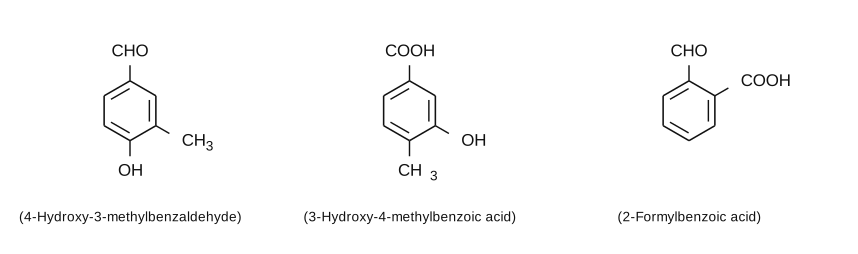
Drawn by us to help you understand the concept clearly, and verified to make sure it's accurate. For exams, practice from your textbook's own diagram.
Worked out. 4-Hydroxy-3-methylbenzaldehyde (a benzaldehyde ring also bearing -OH and -CH3 at the 4- and 3- positions), 3-Hydroxy-4-methylbenzoic acid (the corresponding acid), and 2-Formylbenzoic acid (a benzoic acid ring also bearing a -CHO group, named using the substituent prefix 'formyl' for -CHO) as worked examples of naming a ring carrying two or more different functional groups, where the higher-priority group is gi …
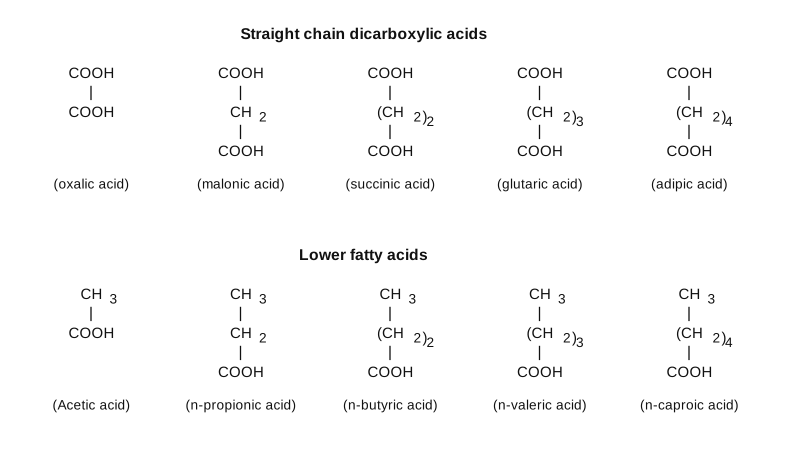
Drawn by us to help you understand the concept clearly, and verified to make sure it's accurate. For exams, practice from your textbook's own diagram.
Worked out. A commercially-known naming series for straight-chain dicarboxylic acids -- oxalic acid HOOC-COOH, malonic acid HOOC-CH2-COOH, succinic acid HOOC-(CH2)2-COOH, glutaric acid HOOC-(CH2)3-COOH, adipic acid HOOC-(CH2)4-COOH -- alongside a parallel series for lower fatty (monocarboxylic) acids -- acetic acid CH3-COOH, n-propionic acid CH3-CH2-COOH, n-butyric acid CH3-(CH2)2-COOH, n-valeric acid CH3-(CH2)3-COOH, n-caproic acid CH3-(CH2)4-COOH -- both given as background trivial-naming trivia in a 'Do you …