Chemistry · Ch 12 — Aldehydes, Ketones and Carboxylic Acids
Other methods of preparation of aldehydes and ketones
Other methods of preparation of aldehydes and ketones
These further routes all start from one common functional group, yet give aldehydes and ketones by genuinely DIFFERENT specific reactions in each case. (a) FROM ACYL CHLORIDES: an acyl chloride is reduced specifically to the corresponding ALDEHYDE by hydrogen gas, using a palladium catalyst that has been deliberately poisoned with barium sulfate (R-COCl + H2, Pd-BaSO4 catalyst, gives R-CHO + HCl) -- this is the ROSENMUND REDUCTION; using plain, unpoisoned palladium instead over-reduces the product all the way through to the alcohol, so the poisoned catalyst is essential to stop cleanly at the aldehyde stage. Aliphatic KETONES, by contrast, are obtained from an acyl chloride by reacting it with dialkyl cadmium (itself first prepared from cadmium chloride and a Grignard reagent: 2 R-MgX + CdCl2 gives R2Cd + 2 Mg(X)Cl); for example, 2 CH3-COCl + (CH3)2Cd gives 2 CH3-CO-CH3 (acetone) + CdCl2, and the analogous reaction with benzoyl chloride gives acetophenone. Aromatic ketones from an acyl chloride are instead made by Friedel-Crafts acylation of the arene (Std. XI Ch. 15, sec. 15.4.6). (b) FROM NITRILES: ALDEHYDES are obtained by first reducing the nitrile with stannous chloride and HCl to an imine hydrochloride -- this is the STEPHEN REACTION -- which is then acid-hydrolysed to the aldehyde: R-C#N + 2[H], SnCl2/HCl, gives R-CH=NH.HCl, and this on H3O+ gives R-CHO + NH4Cl (worked for ethanenitrile -> ethanal, and for benzonitrile -> benzaldehyde). Alternatively, DIBAl-H (diisobutylaluminium hydride, AlH(i-Bu)2) can reduce the nitrile to the imine instead of SnCl2/HCl, with the specific advantage that DIBAl-H does not touch any C=C or C#C double/triple bond present elsewhere in the same molecule (worked for pent-3-enenitrile -> pent-3-enal, where the alkene survives intact). KETONES from nitriles are instead prepared by reacting the nitrile with a Grignard reagent in dry ether, followed by acid hydrolysis: H3C-C#N + CH3MgCl in dry ether, then H3O+, gives acetone (CH3-CO-CH3) + NH3 + Mg(Cl)OH; the analogous reaction of benzonitrile with phenylmagnesium bromide gives benzophenone. (c) FROM AROMATIC HYDROCARBONS: aromatic ALDEHYDES need special methods to obtain from a methylarene, since a plain strong oxidant would simply over-oxidise the -CH3 group all the way to -COOH rather than stopping at -CHO. Four such methods are given: the ETARD REACTION (toluene + chromyl chloride, CrO2Cl2, in CS2 solvent, forms a chromium complex, which on acid hydrolysis gives benzaldehyde); oxidation with CrO3 in acetic anhydride at 273-283 K (methylbenzene is converted to a benzylidene diacetate, which on acid hydrolysis gives the aldehyde); SIDE-CHAIN CHLORINATION of toluene (Cl2/hv gives benzal chloride, CHCl2-C6H5, which on acid hydrolysis at 373 K gives benzaldehyde -- this is in fact the com …
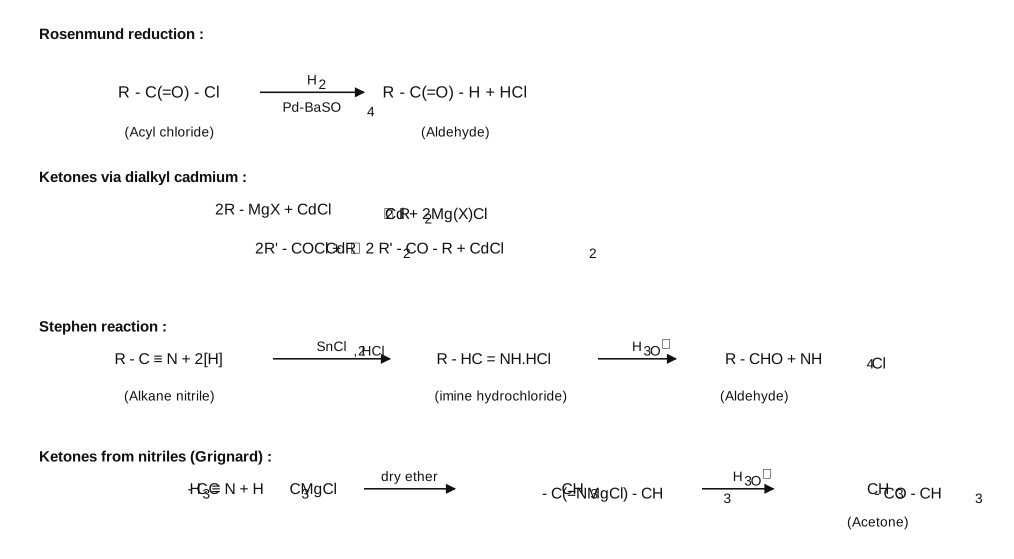
Drawn by us to help you understand the concept clearly, and verified to make sure it's accurate. For exams, practice from your textbook's own diagram.
Worked out. Rosenmund reduction: R-COCl + H2, Pd-BaSO4 catalyst, gives R-CHO + HCl (acyl chloride to aldehyde). Stephen reaction: R-C#N + 2[H] with SnCl2/HCl gives the imine hydrochloride R-CH=NH.HCl, which on acid hydrolysis (H3O+) gives R-CHO + NH4Cl; worked for ethanenitrile (CH3-C#N -> ethanimine hydrochloride -> ethanal + NH4Cl) and for benzonitrile (C6H5-C#N -> benzanimine hydrochloride -> benzaldehyd …