Chemistry · Ch 12 — Aldehydes, Ketones and Carboxylic Acids
Physical state, boiling points and solubilities of carboxylic acids
Physical state, boiling points and solubilities of carboxylic acids
Lower aliphatic carboxylic acids, up to about nine carbon atoms, are colourless liquids with distinctly irritating odours; the higher homologues beyond that are instead colourless, odourless, wax-like solids of low volatility. Table 12.5 tabulates the boiling points of the lower acids, which -- like the aldehydes and ketones of section 12.6.2 -- rise steadily with each added -CH2- unit. Crucially, though, carboxylic acids have consistently HIGHER boiling points than alkanes, ethers, alcohols, aldehydes OR ketones of genuinely comparable molecular mass (worked out carefully in Table 12.6). The reason: in the liquid phase, carboxylic-acid molecules characteristically pair up into DIMERS, each pair held together by TWO separate hydrogen bonds simultaneously -- the acidic O-H hydrogen of one molecule hydrogen-bonds to the carbonyl oxygen of its partner molecule, and, symmetrically, the partner's own acidic hydrogen bonds back to the first molecule's carbonyl oxygen (Fig. 12.3). Because this dimer pairing effectively DOUBLES the size of the unit that has to be separated for boiling to occur, the resulting van der Waals contribution to the boiling point rises sharply too -- and, remarkably, acetic acid dimers persist even in the GAS phase, not just in the liquid. Taken together with 12.6.1 and 12.6.3, this gives the chapter's overall ranking of intermolecular-force strength: hydrogen bond > dipole-dipole attraction > van der Waals force -- and so the matching boiling-point order: carboxylic acids > alcohols > ketones > aldehydes > ethers > alkanes. On SOLUBILITY: lower aliphatic carboxylic acids, up to four carbon atoms, are fully miscible with water, thanks to hydrogen bonding forming directly between the acid molecules and the surrounding water molecules; as molecular mass rises further, though, the growing hydrophobic hydrocarbon portion of the molecule steadily reduces water solubility, so higher carboxylic acids -- and aromatic acids such as benzoic acid too -- end up practically insoluble in water at room temperature (though they remain soluble in less-polar organic solvents such as ether, alcohol or benzene). A closing 'Do you know?' box notes some commercially convenient solid forms of the two smallest aldehydes: formaldehyde is …
Table 12.5 lists name, formula and boiling point: Formic acid HCOOH 373 K; Acetic acid CH3COOH 391 K; Propionic acid CH3CH2COOH 414 K; Butyric acid CH3CH2CH2COOH 437 K; Valeric acid CH3CH2CH2CH2COOH 460 K -- a steady rise …
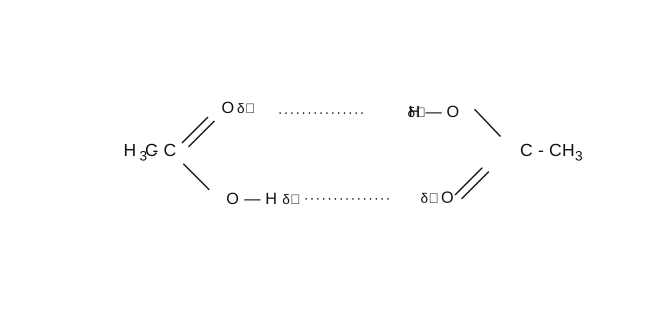
Drawn by us to help you understand the concept clearly, and verified to make sure it's accurate. For exams, practice from your textbook's own diagram.
What this figure shows. Two acetic acid molecules (each H3C-C(=O)-OH) drawn held together by TWO hydrogen bonds simultaneously, in a cyclic (ring-like) arrangement: the acidic O-H hydrogen of each molecule hydrogen-bonds to the carbonyl oxygen of the OTHER molecule, with delta-plus/delta-minus markers on each interacting O-H and C=O, illustrating the double hydrogen-bonded dimer responsible for carbox …
Table 12.6 compares six ~58-60 molecular-mass compounds by family, molecular mass, boiling point and (qualitatively) strength of intermolecular forces, in increasing order: CH3-CH2-CH2-CH3 (Alkane, mass 58, b.p. 272 K); CH3-O-CH2-CH3 (Ether, mass 60, b.p. 281 K); CH3-CH2-CHO (Aldehyde, mass 58, b.p. 322 K); CH3-CO-CH3 (Ketone, mass 58, b.p. 329 K); CH3-CH2-CH2-OH (Alcohol, mass 60, b.p. 370 K); CH3-COOH (Carboxylic acid, mass 60, b.p. 391 K) -- the 'Strength of intermolecular forces' column is marked as increasing steadily down this same list, at essential …