Chemistry · Ch 13 — Amines
Basic strength of aliphatic amines
Basic strength of aliphatic amines
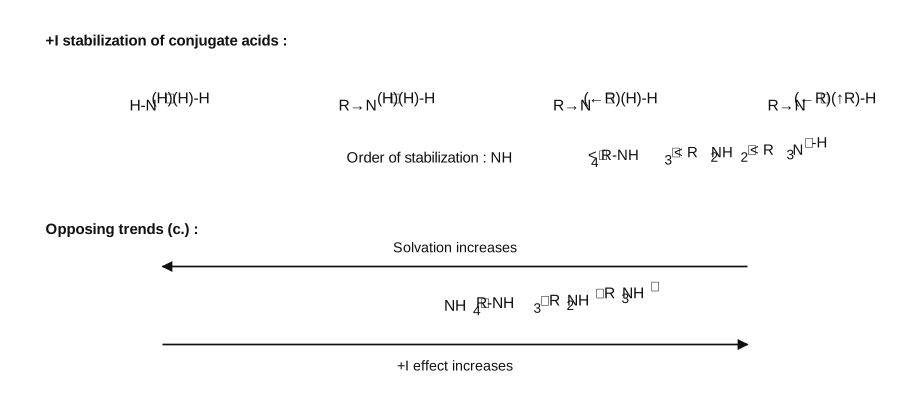
Reading straight off the observed pKb values in Table 13.4, the trend for ammonia and the three classes of aliphatic amine can be written as an order of pKb VALUES: NH3 > R-NH2 > R2NH < R3N -- and, since a LOWER pKb corresponds to a STRONGER base, this translates into an order of BASIC STRENGTH: NH3 < R-NH2 < R2NH > R3N (equation 13.2). In plain words: basic strength genuinely increases in the expected, straightforward way as we move from ammonia to a primary amine, and again from a primary amine to a secondary amine -- but then it turns around and DECREASES again as we move from a secondary amine to a tertiary amine, so that overall, among the aliphatic amines, the SECONDARY amine turns out to be the strongest base, not the tertiary amine one might naively expect from simply having the most alkyl groups. The basic strength (and its matching pKb value) is governed by how far the protonation equilibrium of eq. (13.1) lies to the right, which in turn depends on how well the resulting conjugate acid (the protonated ammonium ion) is stabilised -- the GREATER the stabilisation of that conjugate acid, the further right the equilibrium sits, and so the stronger the base and the smaller its pKb. Two structural effects act on this conjugate-acid stabilisation, and they pull in OPPOSITE directions. The first is the +I (electron-releasing inductive) effect of alkyl groups: each alkyl group bonded to nitrogen pushes electron density toward it, stabilising the positive charge that develops on nitrogen in the conjugate acid; since the number of alkyl groups bonded to nitrogen steadily increases from NH4(+) through RNH3(+) and R2NH2(+) to R3NH(+), this +I effect ALONE would predict a smoothly increasing, monotonic order of basic strength all the way from ammonia to the tertiary amine: NH3 < RNH2 < R2NH < R3N -- which does NOT match what is actually observed for the tertiary amine. The second effect is solvation of the conjugate acid by water: the solvent stabilises the positively-charged conjugate acid by hydrogen-bonding through each hydrogen still attached to the now-positive nitrogen, and the NUMBER of such N-H hydrogens available for this stabilising solvation steadily DECREASES from four (in NH4+) down to just one (in R3NH+) as more alkyl groups replace those hydrogens -- so NH4+ is the BEST solvated and hence best-stabilised of the whole series by this effect, while R3NH+ is the WORST solvated. The two effects operate in genuinely opposite directions and must be combined: moving from ammonia to a primary amine, and again to a secondary amine, the +I effect's stabilising benefit outweighs the loss of solvation, so basic strength keeps increasing as obse …
Drawn by us to help you understand the concept clearly, and verified to make sure it's accurate. For exams, practice from your textbook's own diagram.
Two opposing trends. Each alkyl group's +I effect pushes electron density toward the positive nitrogen, stabilizing the conjugate acid more as substitution grows; but each alkyl group also removes an N-H hydrogen, so solvation by water falls in the same direction. The observed aqueous basicity order (2° > 1° > 3° > …