Chemistry · Ch 13 — Amines
Basicity of arylamines
Basicity of arylamines
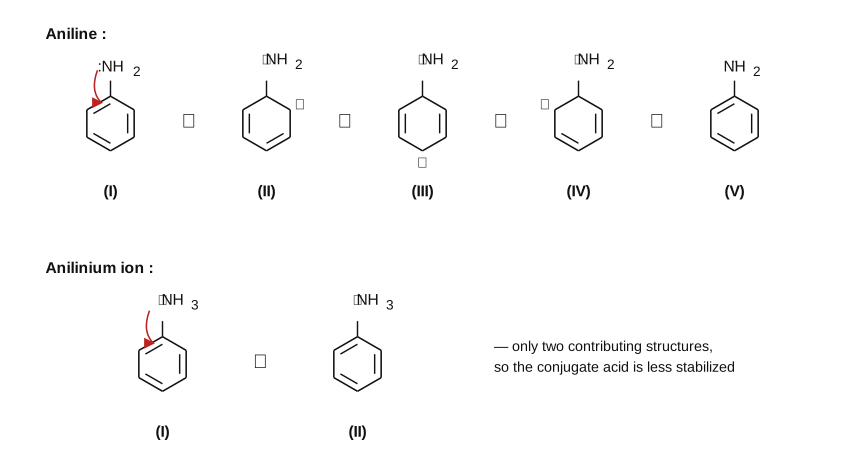
Reading Table 13.4's arylamine pKb values (aniline 9.38, N-methylaniline 9.30, N,N-dimethylaniline 8.92) against the aliphatic and ammonia values above them (all well under 5), arylamines in general are markedly WEAKER bases than both ammonia and any of the aliphatic amines. This weaker basicity is explained, exactly as for aliphatic amines, through the Lowry-Bronsted protonation equilibrium -- for aniline specifically: aniline + HCl (aqueous) is in equilibrium with anilinium chloride (a substituted ammonium chloride salt), equation (13.3), and the corresponding reverse reaction with excess aqueous NaOH regenerates the free aniline again. The key structural reason the FORWARD (protonation) direction of this equilibrium is comparatively DISfavoured -- i.e. why this equilibrium sits further toward the LEFT than the corresponding aliphatic-amine equilibrium does -- is that in an arylamine the -NH2 group is bonded DIRECTLY to the aromatic ring, so the lone pair of electrons on nitrogen is CONJUGATED with (delocalised into) the ring's pi system, and is consequently LESS available to accept an incoming proton than a purely aliphatic amine's lone pair, which has no such ring to delocalise into. This delocalisation can be pictured concretely: aniline itself is resonance-stabilised by FIVE distinct resonance structures (the nitrogen lone pair pushed, in turn, onto each of the ring's ortho and para ring carbons, plus the one structure with the lone pair left on nitrogen), spreading its electron density usefully across the whole ring system and lowering aniline's own ground-state energy. The anilinium ion -- the conjugate acid formed once nitrogen HAS accepted a proton -- by contrast has NO lone pair left on nitrogen at all (it has used that lone pair to bond the new proton), so it can only be resonance-stabilised by the ring's OWN two Kekule-type resonance structures, with no additional nitrogen-lone-pair-into-ring delocalisation contributing at all. Because aniline itself (the base, before protonation) is resonance-stabilised by five structures while its conjugate acid (anilinium, after protonation) is resonance-stabilised by only two, anilin …
Drawn by us to help you understand the concept clearly, and verified to make sure it's accurate. For exams, practice from your textbook's own diagram.
Why aniline is a weak base. Aniline's nitrogen lone pair delocalizes into the ring, giving FIVE contributing structures; protonation removes that lone pair, leaving the anilinium ion only TWO. The free base is therefore stabilized relative to the conjugate acid, the ionization equilibrium lies left, and aniline' …