Q.Isobutylamine is an example of ............
a. 2° amine b. 3° amine c. 1° amine d. quaternary ammonium salt.
Concept understanding — Classification of Amines
Amines are classified along two independent axes. By how many of ammonia's three hydrogens are replaced by an alkyl/aryl group: one replacement gives a primary (1 degree) amine, two gives a secondary (2 degree) amine, three gives a tertiary (3 degree) amine -- secondary/tertiary amines are further split into simple/symmetrical (all groups on nitrogen identical) or mixed/unsymmetrical (groups differ). By the nature of the groups on nitrogen: aliphatic (only alkyl groups) or aromatic (at least one aryl group directly on nitrogen). Crucially, this classification is based on the nitrogen atom, unlike alcohols or alkyl halides, which are classified 1 degree/2 degree/3 degree by the CARBON atom bearing the functional group -- so isopropylamine is a primary amine even though isopropyl alcohol is a secondary alcohol. Amines occur widely in nature, as part of proteins, vitamins, hormones and plant products such as nicotine.
Isobutylamine, (CH3)2CH-CH2-NH2, has only ONE carbon group attached to its nitrogen -- classification of an amine depends on the nitrogen atom, not the carbon skeleton's own branching.
c. 1° amine
Step 1. Draw isobutylamine and locate its nitrogen. Isobutylamine is (CH3)2CH-CH2-NH2 -- a branched four-carbon chain with the amino group on the terminal CH2.
Step 2. Count how many groups are attached DIRECTLY to nitrogen (section 13.1's own rule). Only ONE carbon group (the CH2- of the chain) is bonded to nitrogen; the branching (the two methyls on the adjacent carbon) is one carbon further away and does not count toward nitrogen's own substitution.
Step 3. Apply the amine classification rule. Since amines are classified by how many alkyl/aryl groups sit directly on NITROGEN (not by how branched the carbon skeleton is), one group on nitrogen makes this a primary amine -- exactly analogous to how the chapter's own 'Remember' box notes that isopropylamine is a primary amine even though isopropyl alcohol is a secondary alcohol.
c. 1° amine
Applying section 13.1's nitrogen-based (not carbon-based) classification rule to isobutylamine's branched structure
- Classifying isobutylamine as a '2° amine' by mistakenly counting the branching on the carbon skeleton, confusing the amine classification rule (based on nitrogen) with the alcohol/alkyl halide classification rule (based on the carbon bearing the functional group).
- Confusing isobutylamine (a primary amine) with a genuinely secondary amine like isopropylmethylamine, which does have two separate carbon groups actually bonded to nitrogen.
- CBSE 2025Set D1 markMCQQ.CH3-C(CH3)(CH3)-NH2 is a(a) Primary amine(b) Secondary amine(c) Tertiary amine(d) Ammonium salt
›Reveal solutionSolution
Amine class is set by the number of carbons on N; here N has only one carbon -> primary amine.
Amines are classified by the number of carbon atoms directly attached to the nitrogen:
- 1 carbon on N -> primary (1deg)
- 2 carbons on N -> secondary (2deg)
- 3 carbons on N -> tertiary (3deg)
In (CH3)3C-NH2 (tert-butylamine), although the central carbon is tertiary (attached to three CH3 groups), the nitrogen atom is attached to only ONE carbon. Classification depends on the nitrogen, so this is a primary amine.
✓Final answer(a) Primary amine.
- CBSE 2025Set ANNUAL1 markMCQQ.Which of the following is a secondary amine?(a) Cyclohexylamine(b) Isopropylamine(c) Diphenylamine(d) N, N-Dimethylaniline
›Reveal solutionSolution
Diphenylamine, (C6H5)2NH, has 2 groups on N — a secondary amine.
Classify each amine by how many carbon/aryl groups are attached to nitrogen:
- Cyclohexylamine: C6H11−NH2 — one substituent on N ⇒ primary amine.
- Isopropylamine: (CH3)2CH−NH2 — one substituent on N ⇒ primary amine.
- Diphenylamine: (C6H5)2NH — two phenyl groups on N ⇒ secondary amine.
- N,N-Dimethylaniline: C6H5−N(CH3)2 — three substituents on N ⇒ tertiary amine.
Only diphenylamine has exactly two groups on nitrogen, making it the secondary amine.
✓Final answer(c) Diphenylamine
- CBSE 2024Set D1 markMCQQ.CH3-C(CH3)(CH3)-NH2 is a(a) Primary amine(b) Secondary amine(c) Tertiary amine(d) Quaternary salt
›Reveal solutionSolution
Amines are classified by carbons on N; here N has one carbon -> primary amine.
The compound CH3-C(CH3)(CH3)-NH2 is (CH3)3C-NH2, tert-butylamine. Classification of amines is by the number of carbon atoms directly bonded to NITROGEN, not by the type of carbon:
- 1° amine: N bonded to one carbon (R-NH2)
- 2° amine: N bonded to two carbons
- 3° amine: N bonded to three carbons
Here the nitrogen is bonded to just one (tertiary) carbon, so the amine is PRIMARY, even though that carbon is a tertiary carbon.
✓Final answer(a) Primary amine — nitrogen is attached to only one carbon.
- CBSE 2023Set F1 markMCQQ.The functional group of secondary amine is(a) -NH-(b) -NH2(c) NH3(d) NH3+
›Reveal solutionSolution
Secondary amine = R2NH, so its functional group is -NH- (>NH).
Amines are classified by how many hydrogens of ammonia (NH3) are replaced by alkyl/aryl groups:
- primary amine: R-NH2 (one H replaced) → functional group -NH2
- secondary amine: R2NH (two H replaced) → functional group -NH- (>NH)
- tertiary amine: R3N (all three H replaced) → functional group >N-
Hence the functional group of a secondary amine is -NH-.
✓Final answer(A) -NH-.
- CBSE 2022Set ANNUAL1 markQ.Identify Primary, Secondary and Tertiary amine in following compounds -(i) C2H5-N(C2H5)-CH2CH3 [N bonded to three ethyl-type groups: C2H5, CH2CH3, and a third C2H5 branching down from N](ii) CH3-NH-CH2CH3(iii) CH3-CH2-NH2
›Reveal solutionSolution
Classify an amine by counting how many of the three bonds on nitrogen (besides the lone pair) go to carbon (alkyl/aryl) groups versus hydrogen: 3 C = tertiary, 2 C + 1 H = secondary, 1 C + 2 H = primary.
Amines are classified as primary (1 degree), secondary (2 degree) or tertiary (3 degree) according to the number of hydrogen atoms of ammonia (NH3) that have been replaced by alkyl/aryl groups.
- The nitrogen here is bonded to three separate ethyl-type carbon chains (three C-N bonds, no N-H bond) - this is a tertiary amine (a trialkylamine, N,N-diethylethanamine).
- The nitrogen is bonded to a methyl group and an ethyl group, with one N-H bond remaining (CH3-NH-CH2CH3) - two carbon substituents on N - this is a secondary amine (N-methylethanamine / N-ethylmethanamine).
- The nitrogen is bonded to only one ethyl group and carries two N-H bonds (CH3CH2-NH2) - one carbon substituent on N - this is a primary amine (ethanamine).
✓Final answer- Tertiary amine,
- Secondary amine,
- Primary amine.
- CBSE 2022Set E1 markMCQQ.CH3-C(CH3)(CH3)-NH2 is a(a) Primary amine(b) Secondary amine(c) Tertiary amine(d) Quaternary salt
›Reveal solutionSolution
Amines are classified by the number of carbon (alkyl/aryl) groups on nitrogen, not by the branching of the carbon skeleton. Here nitrogen bears only one carbon, so it is 1°.
The compound CH3-C(CH3)(CH3)-NH2 is tert-butylamine, (CH3)3C-NH2.
Classification of amines depends on how many carbon atoms are directly bonded to the nitrogen:
- 1° (primary): one C on N (R-NH2)
- 2° (secondary): two C on N (R2NH)
- 3° (tertiary): three C on N (R3N)
Even though the carbon carrying the -NH2 is a tertiary carbon (bonded to three other carbons), the nitrogen itself is bonded to only ONE carbon. Therefore the amine is primary. (The word 'tert' here describes the carbon skeleton, not the amine class.)
✓Final answer(a) Primary amine.
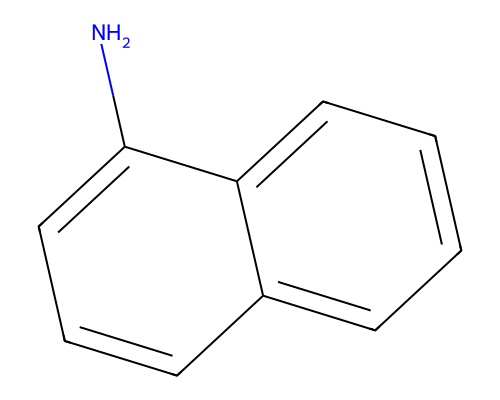
- CBSE 2022Set TERM21 markMCQQ.The amine shown in the figure (1-aminonaphthalene: a naphthalene ring system with an -NH2 group attached directly to a ring carbon) is:(a) 1° Amine(b) 2° Amine(c) 3° Amine(d) None of these
›Reveal solutionSolution
Amines are classified by how many carbon groups are attached to the nitrogen, not by which carbon skeleton those groups belong to.
The amine shown, 1-aminonaphthalene, has the -NH2 group bonded to exactly one carbon (a ring carbon of the naphthalene system). The classification of an amine (1°, 2°, 3°) depends only on the number of carbon (alkyl/aryl) groups directly attached to the nitrogen atom:
- 1° amine: N bonded to 1 carbon group (R-NH2)
- 2° amine: N bonded to 2 carbon groups (R2NH)
- 3° amine: N bonded to 3 carbon groups (R3N)
Here, the nitrogen is attached to only one naphthalene ring carbon (plus 2 H atoms), so it is a primary (1°) amine, exactly analogous to aniline (C6H5-NH2) being a primary aromatic amine.
✓Final answer(a) 1° Amine.
- CBSE 2021Set NC1 markMCQQ.Trimethylamine, (CH3)3N is a(a) 1 degree amine(b) 2 degree amine(c) 3 degree amine(d) 4 degree amine
›Reveal solutionSolution
Classification of amines as 1°, 2°, or 3° depends on how many alkyl/aryl groups replace the hydrogens of NH3 — trimethylamine, (CH3)3N, has all three hydrogens replaced by methyl groups, making it tertiary.
Amines are considered as derivatives of ammonia, NH3, obtained by replacing one, two, or three hydrogen atoms by alkyl/aryl groups:
- One H replaced: primary (1°) amine, R–NH2
- Two H replaced: secondary (2°) amine, R2NH
- Three H replaced: tertiary (3°) amine, R3N
In trimethylamine, (CH3)3N, all three hydrogen atoms of ammonia have been replaced by methyl groups, so nitrogen is bonded to three carbon atoms and carries no N–H bond. This makes it a tertiary amine. (Note this classification differs from that used for alcohols and halides, which is based on the carbon atom bearing the functional group, not the functional-group atom itself.)
✓Final answer(c) 3° (tertiary) amine — nitrogen is bonded to three methyl (carbon) groups.
- CBSE 2021Set OC1 markQ.Classify the following amines as primary or secondary: CH3NH2 and (CH3)2NH
›Reveal solutionSolution
Amines are classified by how many alkyl/aryl groups replace the hydrogens of ammonia; one substitution gives a primary amine, two gives a secondary amine.
Classifying by degree of substitution
Amines are derivatives of ammonia (NH3) formed by replacing one, two, or three hydrogen atoms with alkyl/aryl groups:
- CH3NH2 (methanamine): only ONE hydrogen of ammonia is replaced, by a methyl group; the nitrogen is bonded to one carbon group and two hydrogens (R−NH2). This makes it a primary (1°) amine.
- (CH3)2NH (N-methylmethanamine / dimethylamine): TWO hydrogens of ammonia are replaced, both by methyl groups; the nitrogen is bonded to two carbon groups and one hydrogen (R2NH). This makes it a secondary (2°) amine.
(A tertiary amine, R3N, would have all three hydrogens replaced, with no N–H bond left.)
✓Final answerCH3NH2 is a primary amine; (CH3)2NH is a secondary amine.
- CBSE 2018Set ANNUAL1 markQ.What are amines?
›Reveal solutionSolution
Amines are ammonia derivatives with one or more H atoms replaced by alkyl/aryl groups, classified as primary, secondary, or tertiary by how many H's are replaced.
Amines can be thought of as organic derivatives of ammonia (NH3), formed by successively substituting its hydrogen atoms with alkyl or aryl groups:
- Primary (1°) amine: one H replaced, R–NH2 (e.g. CH3NH2, methylamine).
- Secondary (2°) amine: two H's replaced, R2NH (e.g. (CH3)2NH, dimethylamine); the two R groups may be the same or different.
- Tertiary (3°) amine: all three H's replaced, R3N (e.g. (CH3)3N, trimethylamine). The nitrogen atom retains a lone pair of electrons, which is responsible for the basic and nucleophilic character of amines. They occur widely in nature (e.g. in proteins, alkaloids) and are important in the synthesis of dyes, drugs, and polymers.
✓Final answerAmines are organic derivatives of ammonia, formed by replacing one (1°, R–NH2), two (2°, R2NH) or all three (3°, R3N) hydrogen atoms of NH3 with alkyl/aryl groups.
- CBSE 2017Set ANNUAL1 markMCQQ.Which of the following is a 3° amine?(a) Triethylamine(b) t-Butylamine(c) N-methylamine(d) Ethylamine
›Reveal solutionSolution
The degree (1°/2°/3°) of an amine is decided by how many of ammonia's three hydrogens are replaced by alkyl/aryl groups; triethylamine has all three replaced.
- Triethylamine, (C2H5)3N: all three H atoms of NH3 replaced by ethyl groups → tertiary (3°) amine.
- t-Butylamine, (CH3)3C-NH2: only one H replaced by a (bulky) tert-butyl group → this is a primary (1°) amine, despite the branching in the alkyl group — degree of the amine depends on substitution at nitrogen, not on the alkyl group's own structure.
- N-methylamine (methylamine, CH3NH2): one H replaced → primary (1°) amine.
- Ethylamine, C2H5NH2: one H replaced → primary (1°) amine.
Only triethylamine has nitrogen bonded to three carbon groups, making it the tertiary amine among the options.
✓Final answer(a) Triethylamine
🎓Unlock everything free for 14 days
- ✓Full step-by-step solutions
- ✓Concept-first explanations
- ✓Methods, shortcuts & mistakes
- ✓PYQ mapping + timed mock tests
Full access for 14 days. No credit card required.