Chemistry · Ch 9 — Coordination Compounds
Ambidentate ligand
Ambidentate ligand
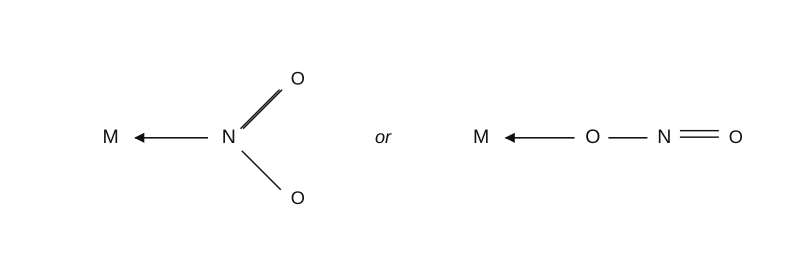
An ambidentate ligand genuinely possesses two different donor atoms, but forms a coordinate bond through only ONE of them at a time in any given complex -- the two possible binding modes give rise to a distinct pair of linkage isomers (formally covered in section 9.7.2a). The nitrite ion, NO2-, is the chapter's central example: it can bind a metal through its nitrogen atom (written M-NO2, and IUPAC-named 'nitro') or through one of its oxygen atoms (written M-O-N=O, and IUPAC-named 'nitrito', see Table 9.1). Likewise, the thiocyanate ion, SCN-, has two donor atoms -- sulfur and nitrogen -- and can bind either as M<-SCN (through sulfur, named 'thiocyanato') or as M<-NCS (through nitrogen, named 'isothiocyanato'). Distinguishing an ambidentate ligand (two donor atoms, only one used per complex) from a true bidentate ligand like ethylenediamine …
Drawn by us to help you understand the concept clearly, and verified to make sure it's accurate. For exams, practice from your textbook's own diagram.
The ambidentate nitrite ligand binding a metal M through nitrogen (nitro, M-NO2) or through oxygen (nitrito, M-ONO). Drawn by us from the textbook's own printed facts and verified element …