Chemistry · Ch 9 — Coordination Compounds
Colour of the octahedral complexes
Colour of the octahedral complexes
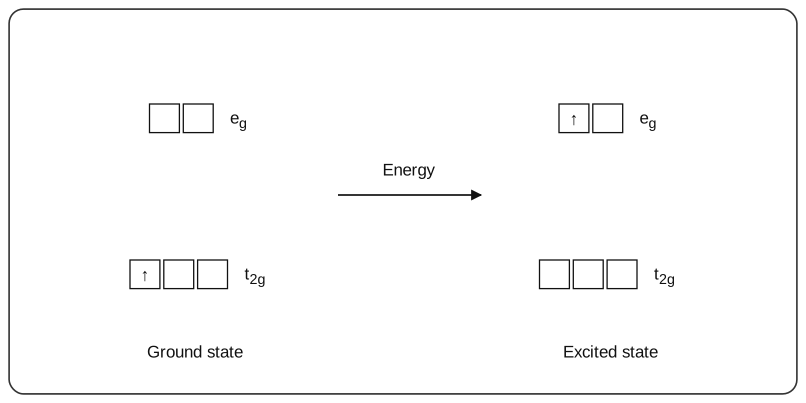
The splitting of a metal ion's d orbitals into the t2g and eg sets, separated by the energy gap Delta-o, is directly responsible for the colour seen in many octahedral transition-metal complexes. Delta-o corresponds to a specific, measurable frequency of electromagnetic radiation, which for most transition-metal complexes happens to fall within the visible region of the spectrum. When white light passes through (or reflects off) the complex, the complex specifically ABSORBS the exact frequency of light matching Delta-o, using that absorbed energy to promote one electron from the lower t2g set up into the higher eg set -- this electronic transition is called a d-d transition (Fig. 9.3). Having absorbed one particular colour of light out of the visible spectrum, the complex then displays to the eye the colour that is COMPLEMENTARY to the one it absorbed (i.e. the colour left over once that one wavelength has been removed from white light). The worked example is [Ti(H2O)6]3+: titanium's single d electron (Ti3+ is 3d1) sits in one of the three t2g orbitals in the complex's electronic ground state. The Delta-o for this specific complex corresponds to an absorbed energy of 20,300 cm-1 (equivalently 520 nm, or 243 kJ/mol) -- absorbing a photon of exactly this energy promotes the single t2g electron up into an eg orbital (the complex's excited state). Beca …
Drawn by us to help you understand the concept clearly, and verified to make sure it's accurate. For exams, practice from your textbook's own diagram.
What this figure shows. Two side-by-side energy-level diagrams, each showing the split t2g (lower) / eg (upper) pair of levels for a d1 ion. LEFT ('Ground state'): the single d electron sits in one of the three t2g orbitals; the eg level is empty. RIGHT ('Excited state'): after absorbing a photon of energy equal to Delta-o, the single electron has been promoted up into one of the two eg orbitals, leaving t2g empty. The energy difference between the two diagrams is exactly Delta-o, corresponding to the specific wavelength of visible light absorbed by [Ti(H2O)6]3+ (520 nm / 20,300 cm-1), which is why the complex appears violet -- th …