Chemistry · Ch 9 — Coordination Compounds
Crystal Field theory (CFT)
Crystal Field theory (CFT)
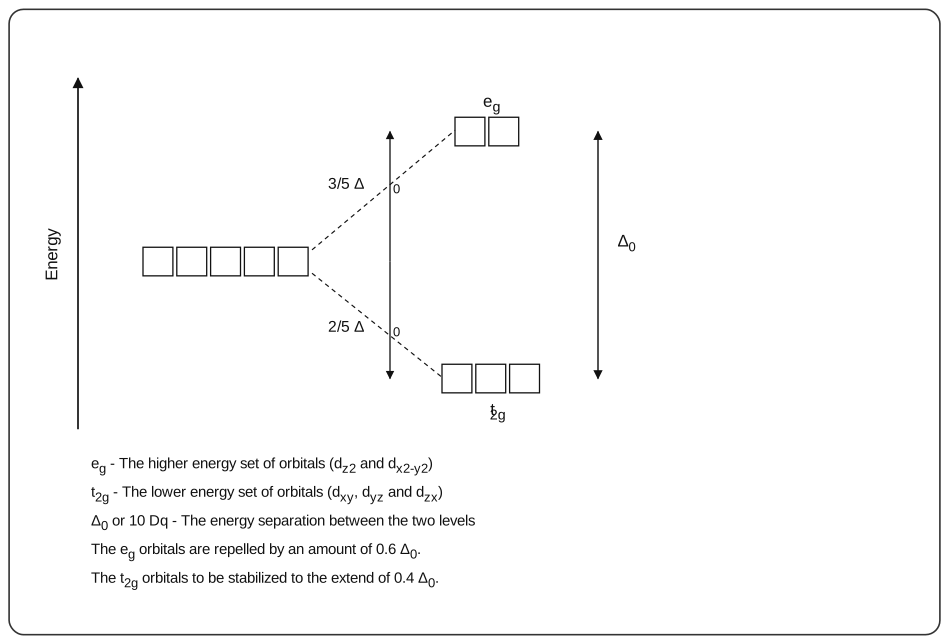
Crystal Field Theory (CFT) rests on treating each ligand as nothing more than a simple POINT NEGATIVE CHARGE, with the entire metal-ligand interaction assumed to be purely electrostatic (ionic-type) -- explicitly, CFT assumes there is NO orbital overlap or covalent-bonding character between metal and ligand at all, in direct contrast to VBT's orbital-overlap picture. In an isolated, gaseous metal ion (with no ligands nearby), all five d orbitals -- dx2-y2, dz2, dxy, dyz and dzx -- are degenerate, meaning they all have exactly the same energy. If an approaching ligand field were perfectly symmetrical with respect to all five d orbitals, this degeneracy would simply persist; but in a real octahedral complex, the six ligands approach along the +/-x, +/-y and +/-z axes specifically, and this is NOT symmetrical with respect to the five different d-orbital shapes, so the degeneracy is destroyed (Fig. 9.2). The two orbitals whose lobes point DIRECTLY along those axes -- dx2-y2 and dz2 -- experience noticeably STRONGER electrostatic repulsion from the approaching ligands and are pushed UP in energy, forming the higher-energy eg set. The three orbitals whose lobes instead point diagonally, BETWEEN the axes -- dxy, dyz and dzx -- experience comparatively WEAKER repulsion and are pushed DOWN in energy, forming the lower-energy t2g set. The energy gap between these two sets is the crystal field splitting parameter, written Delta-o (the 'o' for octahedral, sometimes also written as 10 Dq); measured from the original degenerate baseline, the eg set sits 0.6 Delta-o (3/5 Delta-o) higher, and the t2g set sits 0.4 Delta-o (2/5 Delta-o) lower. Ligands are classified by how large a Delta-o they produce: strong-field ligands (those whose donor atom is carbon, nitrogen or phosphorus -- e.g. CN-, CO, NH3, en, EDTA) create a large Delta-o and favour PAIRING electrons in the lower t2g set before any electron occupies the upper eg set, giving a low-spin complex; weak-field ligands (donor atom a halogen, oxygen or sulfur -- e.g. F-, Cl-, Br-, I-, SCN-, C2O4(2-)) create a Delta-o smaller than the electron-pairing energy, so electrons instead spread out singly across BOTH sets first (Hund's rule) before any pairing occurs, giving a high-spin complex. Table …
Drawn by us to help you understand the concept clearly, and verified to make sure it's accurate. For exams, practice from your textbook's own diagram.
What this figure shows. An energy-level diagram. A dashed horizontal line in the middle marks the energy of the five degenerate d orbitals in the free (uncomplexed) metal ion / a hypothetical spherically symmetric field. From this baseline, the diagram splits into two sets in the real octahedral ligand field: the eg set (comprising dz2 and dx2-y2) is drawn RAISED above the baseline by 3/5 Delta-o (=0.6 Delta-o), and the t2g set (comprising dxy, dyz and dzx) is drawn LOWERED below the baseline by 2/5 Delta-o (=0.4 Delta-o). The total vertical gap between the eg and t2g levels is labelled Delta-o (equivale …
Ligands arranged in order of INCREASING field strength (weakest to strongest, i.e. smallest to largest Delta-o):
I- < Br- < Cl- < S2- < F- < OH- < C2O4^2- < H2O < NCS- < EDTA4- < NH3 < en < CN- < CO.
Weak-field ligands (donor atom is a halogen, O or S) sit toward the left/start of this series and favour high-spin complexes. Strong-field ligands (donor atom is C, N or P) sit toward the right/end of this series and favour low-sp …
Drawn by us to help you understand the concept clearly, and verified to make sure it's accurate. For exams, practice from your textbook's own diagram.
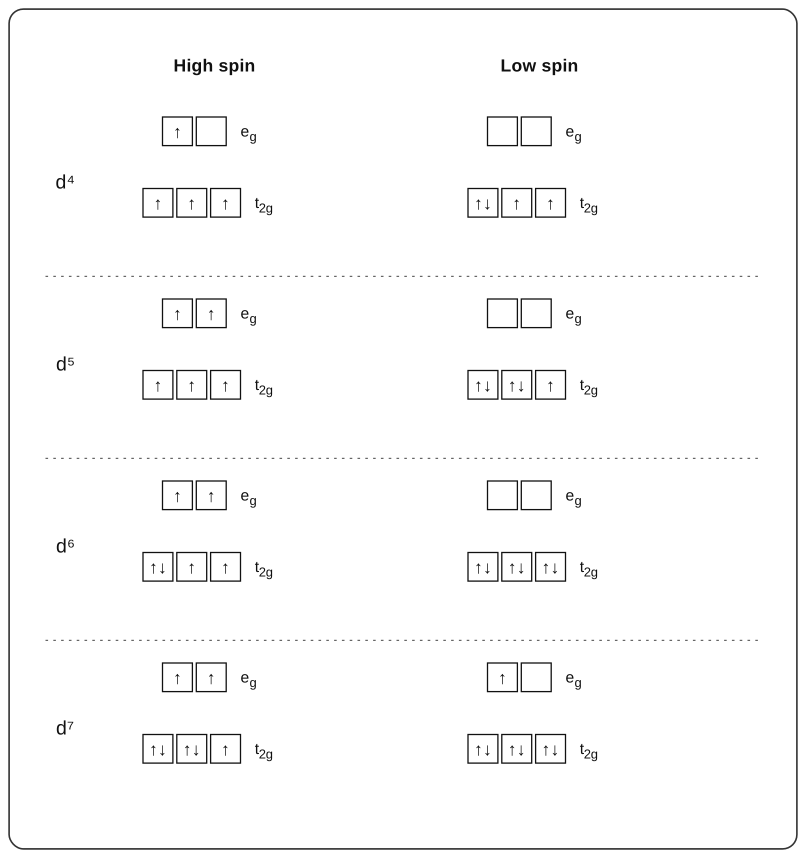
For octahedral complexes, only d4, d5, d6 and d7 metal-ion configurations can show a genuine high spin vs. low spin distinction (d1-d3 always fill t2g singly per Hund's rule regardless of field strength, and d8-d10 always end up with the same forced arrangement regardless of field strength, so those are not distinguishable by spin state).
d4: high spin = t2g3 eg1 (4 unpaired); low spin = t2g4 eg0 (2 unpaired).
d5: high spin = t2g3 eg2 (5 unpaired); low spin = t2g5 eg0 (1 unpaired).
d6: high spin = t2g4 eg2 (4 unpaired); low spin = t2g6 eg0 (0 unpaired).
d7: high spin = t2g5 eg2 (3 unpaired); low spin = t2g6 eg1 (1 unpaired). …