Chemistry · Ch 5 — Electrochemistry
Measurement of conductivity
Measurement of conductivity
The conductivity of a solution can be determined from resistance measurements by the Wheatstone bridge.
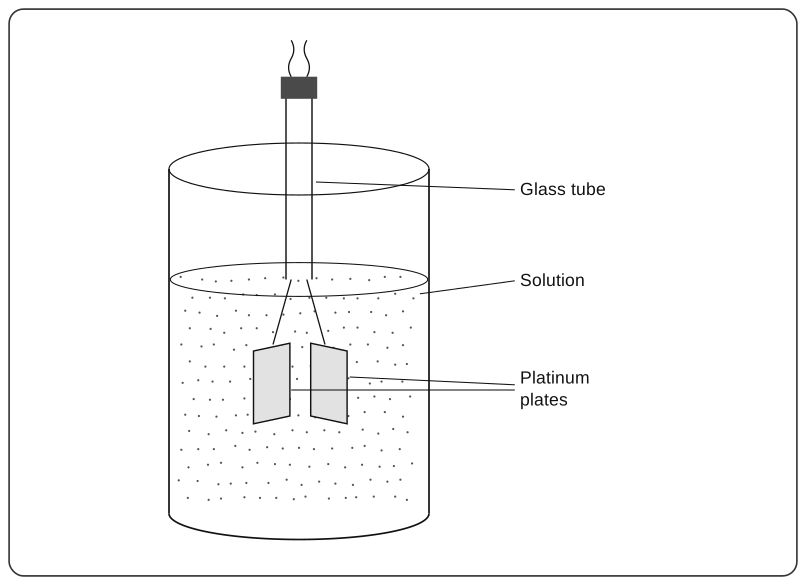
Conductivity Cell : The conductivity cell consists of a glass tube with two platinum plates coated with a thin layer of finely divided platinum black. This coating is achieved by the electrolysis of a solution of chloroplatinic acid. The cell is dipped in the solution whose resistance is to be measured, as shown in Fig. 5.2.
Drawn by us to help you understand the concept clearly, and verified to make sure it's accurate. For exams, practice from your textbook's own diagram.
What this figure shows. The conductivity cell used for resistance measurements: a glass tube (vessel) holding the solution whose resistance is to be measured, with two parallel platinum plates — coated with finely divided platinum black by electrolysis of chloroplatinic acid — suspended in the solution a fixed distance apart. The fixed geometry of the two …
Cell constant : The conductivity of an electrolytic solution is given by Eq. (5.5), . For a given cell, the ratio of the separation between the two electrodes divided by the area of cross section of the electrode is called the cell constant:
The SI unit of cell constant is , conveniently expressed in . Eq. (5.5) then becomes
The determination of molar conductivity consists of three steps :
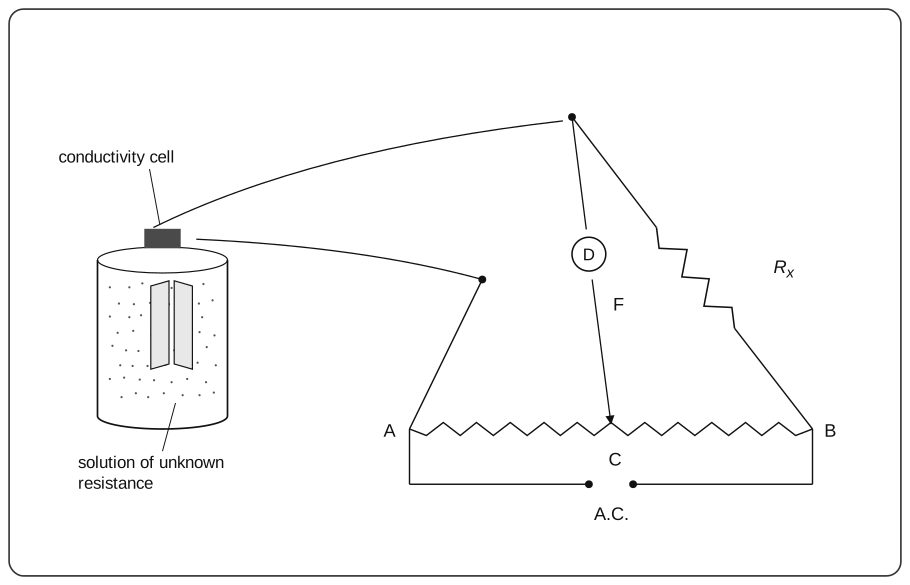
1. Determination of cell constant : The cell constant is determined using 1 M, 0.1 M or 0.01 M KCl solutions, whose conductivity is well tabulated at various temperatures. The resistance of the KCl solution is measured by Wheatstone bridge (refer to the Standard XII Physics Textbook, Chapter 9), shown in Fig. 5.3.
Drawn by us to help you understand the concept clearly, and verified to make sure it's accurate. For exams, practice from your textbook's own diagram.
What this figure shows. The bridge circuit of step 1 of the conductivity measurement. The conductivity cell (small beaker at the left, holding the solution of unknown resistance) forms one arm; the variable known resistance (zig-zag symbol) forms the other. D is the current detector at the apex, F is the sliding contact moved along the uniform wire AB until D shows no deflection, and A.C. is the alternating-current source. At the null point C, $R_{solution …
In Fig. 5.3, AB is the uniform wire and is the variable known resistance placed in one arm of the Wheatstone bridge. The conductivity cell containing KCl solution of unknown resistance is placed in the other arm; D is a current detector, and F is the sliding contact that moves along AB. A.C. represents the source of alternating current. The sliding contact is moved along AB until no current flows — the detector D shows no deflection, and the null point is obtained at C. According to the Wheatstone bridge principle,
By measuring the lengths AC and BC and knowing , the resistance of the KCl solution can be calculated, and the cell constant follows from Eq. (5.13):
since the conductivity of the KCl solution is known. …