Q.ix. It is impossible to measure the potential of a single electrode. Comment.
You're viewing a preview — the full solution, concept, methods & PYQ mapping are locked.
Start your 14-day free trial to unlock the full solution →Step 1. A redox process cannot occur in isolation: every oxidation half reaction must be paired with a reduction half reaction happening somewhere else.
Step 2. Consequently, whenever a potential is measured with a voltmeter, what is actually measured is always the potential difference between TWO electrodes combined into a cell, i.e. the algebraic sum — never a single electrode alone.
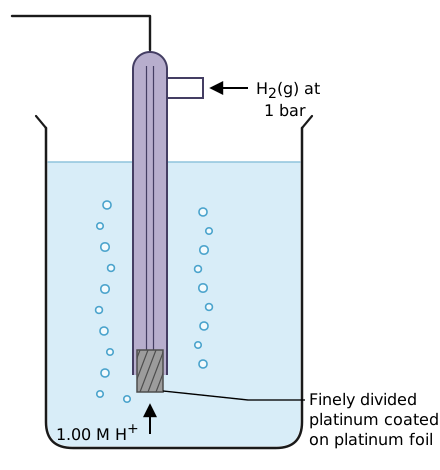
Step 3. This is exactly why chemists needed to agree on an arbitrary reference electrode (the standard hydrogen electrode, SHE), whose own potential is simply DEFINED as zero; every other electrode's 'potential' quoted in tables is really the emf of that electrode combined with SHE. …
Unlock everything free for 14 days
- Full step-by-step solutions
- Concept-first explanations
- Methods, shortcuts & mistakes
- PYQ mapping + timed mock tests
Full access for 14 days. No credit card required.