Answer the following in brief · Q10
Q.x. Why do the cell potential of lead accumulators decrease when it generates electricity ? How the cell potential can be increased ?
Maharashtra MsbshseTextbookSubjectiveImportance★★★★★
59% · 66/111 Questions
You're viewing a preview — the full solution, concept, methods & PYQ mapping are locked.
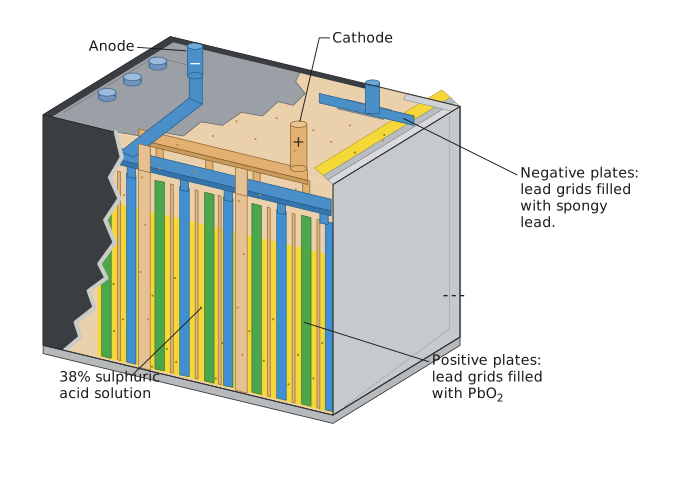
Start your 14-day free trial to unlock the full solution →Step 1. During discharge, both electrode reactions convert lead-based material to PbSO4, consuming SO4(2-) and H+ from the sulphuric acid electrolyte: overall .
Step 2. As H2SO4 is used up, its concentration (and density) falls, and because the cell potential depends on the sulphuric acid concentration, the potential falls too — from about 2V toward about 1.8V.
Step 3. To increase the potential again, the cell is recharged: an external potential slightly greater than 2V is applied, which reverses both electrode reactions, converting PbSO4 back to Pb and PbO2 and regenerating H2SO4. …
Unlock everything free for 14 days
- Full step-by-step solutions
- Concept-first explanations
- Methods, shortcuts & mistakes
- PYQ mapping + timed mock tests
Full access for 14 days. No credit card required.