Chemistry · Ch 15 — Introduction to Polymer Chemistry
Neoprene
Neoprene
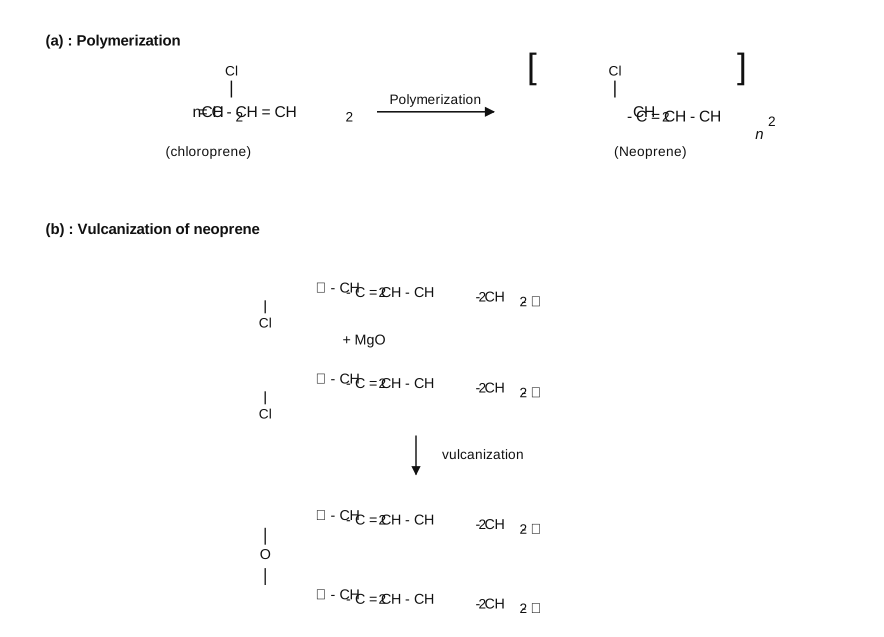
Neoprene is a synthetic rubber formed by addition polymerization of the monomer chloroprene (2-chloro-1,3-butadiene, CH2=C(Cl)-CH=CH2), which polymerizes rapidly in the presence of oxygen to give the repeating structure -[CH2-C(Cl)=CH-CH2]n- (Fig. 15.6a); it is vulcanized using magnesium oxide rather than sulfur (Fig. 15.6b). Neoprene is particularly resistant to petroleum, vegetable oils, light and heat, which makes it the material of choice for hose pipes carrying gasoline, gaskets, cable insu …
Drawn by us to help you understand the concept clearly, and verified to make sure it's accurate. For exams, practice from your textbook's own diagram.
What this figure shows. Two panels. (a) Polymerization: n CH2=C(Cl)-CH=CH2 (chloroprene) undergoes addition polymerization to give the neoprene repeating chain -[CH2-C(Cl)=CH-CH2]n-, drawn as a repeated backbone unit carrying a chlorine substituent on the double-bond carbon. (b) Vulcanization: several neoprene chains, each drawn as the repeating -CH2-C(Cl)=CH-CH2- unit, are shown linked to one another through added MgO cross-linking bridges between chains, illustrating how magnesium oxide vulcanization ties the originally separate linear neoprene chains into a cross …